Assorted Links

1. Are States Really More Efficient than the Federal Government?
Not so, according to a contrarian take in the Atlantic:
…despite its reputation for bureaucracy and incompetence, the federal government runs pretty well, and where it runs poorly it tends to be stifled by outdated rules and regulations. “The underlying argument is that the federal government is unwieldy and inefficient,’ said Kettl. “That’s not true.”
In other words, government only works poorly when its stifled by government. The article goes on to equate the efficiency of the Social Security Administration with its low rate of error and slim operating budget relative to the amount of money it redistributes. The efficiency of the agency is not the issue. If the U.S. can’t come up with a much cheaper way to take care of old people, it will eventually become insolvent.
Republicans want to put more entitlement spending decisions in the hands of state governments. I was just in New Mexico, and made a passing comment to a friend who lives there about the possible benefits of decentralizing health care spending. She said that the state – the 2nd poorest in the Union – would be devastated by this.
In the short term, increasing competition usually creates winners and losers. Long term, it generates innovation that benefits everyone. The challenge is to either bargain with the losers, or convince enough people that the group benefits (delayed and largely unseen) outweigh the costs to the losers. Can the crisis be averted by transferring the job of mailing of welfare checks to the states? Certainly not. However, as long as the Federal Government sets the norms for what counts as effective health care – i.e., what’s worthy of subsidy – we won’t see real change.
2. Ask a Tahitian: “What is seasteading?”, Marc Collins interviewed on The Big Think.
Two things I did not know:
- Submarine cables put Tahiti on the Internet’s backbone.
- There have *only* been 2 hurricanes in the last 100 years that have caused casualties (better still be prepared).
3. Michele Goldberg says we’ve entered “Tyranny of the Minority” in her debut NY Times column.
Our Constitution has always had a small-state bias, but the effects have become more pronounced as the population discrepancy between the smallest states and the largest states has grown. …
… America is now two countries, eyeing each other across a chasm of distrust and contempt. One is urban, diverse and outward-looking. This is the America that’s growing. The other is white, provincial and culturally revanchist. This is the America that’s in charge.
She quotes Governor Jerry Brown speculating that the country could rip apart if there are more elections like 2016. That would be bad, since this division is centered upon a warped mirror, causing both sides to identify in terms of their opposition to the other. Let’s return to the original thought experiment behind this blog: what would the world look like if it had two countries, versus 200 (roughly the current number), versus 2,000? What would the U.S. look like if it had two main identities, versus 50+?
4. Studies Find Ketogenic Diets “Have Profound Effect on Brain Health”
A question for future exploration: why does interest in ketogenic diets correlate with an interest in competitive governance?
Does eating a lot of fat promote cognitive liberty? Or, does a certain strand of contrarianism cause one to accept ideas outside of the mainstream with large potential upsides, and a small downside in the event of a failed experiment?
Our Declining America Needs Less Libertarianism, More Moderation, Federalism and Seasteading
As a political observer and commentator, my mind can’t help being occupied over the last year with America’s decay into soft civil war and mutual extremism from Republicans and Democrats. Generally my thoughts align with the few moderate voices saying this growing tribalism is an existential threat to our country, such as Scott Alexander (“Against Murderism”), Andrew Sullivan (“Can Our Democracy Survive Tribalism?”, and Russ Roberts (“The World Turned Upside Down (and what to do about it”). But as someone with a strong identity around libertarianism, competitive governance, and seasteading, I have thoughts to add to the discussion.
First, I’m feeling much less comfortable strongly promoting libertarianism and my libertarian identity in today’s America, because it just feels like we have bigger problems. Whatever the equivalent of Maslow’s Hierarchy is for your country of residence, we have, sadly, moved down it. I no longer see my country as a safe, stable place with decent but not great rules that I should try to change into an amazing free society. Or one with a vibrant tradition of individualism that can be tapped into and the strength to handle deep criticism.
Instead, I see a country with increasing bipartisan extremism, including political street violence. One which is not merely a post-peak empire (that’s fine with me), but which, as it declines, is fractionating along geographic, ethnic, religious and class lines and dissolving into internecine sectarian conflict, zero-sum battles, and soft civil war.
 And so it feels more urgent and important to promote moderation and anti-tribalism than a specific platform like libertarianism. On the other hand, I feel more energized than ever to speak about the critical importance of federalism and seasteading. Federalism feels like not just a libertarian minority idea, but a key part of the liberal technology that allowed different groups to live peacefully together in the United States. So I believe that promoting federalism should be a key part of the moderate platform that develops in response to current political ills.
 However, it remains to be seen whether such a moderate platform can win mindshare in the memetic arena when competing with today’s virulent clickbait memes and their toxic winning weapons of outrage, dishonesty, superficiality, and exaggeration. Seizing enough support to change the momentum of our growingly narcissistic democracy will be a huge challenge. And so, the worse things get on land, the more critical it becomes to have the escape valve, innovation laboratory, and startup sector of seasteading.
Which is why it’s so exciting to see The Seasteading Institute signing an MOU with French Polynesia for our Floating City Project and forming a broad movement as shown in the Tahitian First 100 conference with seasteaders, Polynesian leaders, and entrepreneurs. While at the same time, our new book from Simon & Schuster is spreading an exciting, detailed, big tent vision of seasteading to the world. One city on a hill is never enough – we must Let A Thousand Nations Bloom.
And all of this is why I’ve started writing again this past year, mainly on Facebook and Twitter, and will relaunch my blog by the end of the year. Because a world gone mad, an empire in decline, and a populace losing touch with the virtues of civilization needs philosophy, federalism, and floating cities. And that means it needs Friedmans continuing to spread our Friedmaniacal ideas.

Ephemerisle, 2016
Insightful Review of Seasteading Book
Blogger Below Potential has posted a good, concise review of Joe and Patri’s new Seasteading book, calling it a “must-read” for conservatives, progressives and libertarians alike. It also mentions the politically confused, which is – if we’re honest – all of us.
Technology rather than an Ideology
Seasteading is a technology for anybody to try their vision of society. Seasteaders are from all political spectrums – and some simply identify as politically confused. They share the conviction that experiments are the source of all progress and that humanity needs more experiments in governance. They have realised that arguing about politics is a waste of time and that trial and error is the way to go.
My first blog (if you don’t count LiveJournal) was called “Radical Ignorance” – an idea from Austrian economics referring to the impossibility of assigning probabilities to future events where human action is concerned. This outlook makes one more humble about what governments (armed with statisticians and other high priests of statecraft) can accomplish, but there is a risk of taking it too far, and giving up on trying new things collectively that might bring benefits. We might not make a colossal mistake, but we might fall… below potential.
Seasteading is one of the few ways out of this paradox. We can try to make a better future, but only after figuring out who “we” are, and what ideas we imagine have the best chance of working.
First Annual Berkeley Colloquium on Seasteading & Marine Biology

I never get email at my old seasteading address. It’s been three years since I was staff writer at the Institute, but I got a note out of the blue this month from a French marine biologist in the Bay Area (“on mission … at NASA”). Dr. Virginie Tilot de Grissac wanted to meet some seasteaders. She seemed (from my Googling) to be a genuine intellectual – a curious academic, whose papers and conference talks are motivated by a desire to find out something previously unknown. She’s also been to the deepest explored parts of the ocean, and seen plants that grow with no sunlight – only hydrothermal energy.
I punted to Joe Quirk (President of The Seasteading Institute), but there were no events happening when Virginie was available. “Hey,” I thought, “why not invite her *and* Joe, and whoever else wants to come, to lunch at the Berkeley Marina?” There’s no better place to talk about the future of oceans/governance than aboard Tara, the stoutest little sloop on J Dock.
Virginie came with her old childhood friend, Michael Gomez – a Bay Area native and fellow marine biologist. She mentioned that it was a trip with Michael to the aquarium with their mothers that first made her want to be a marine biologist. This led to a conversation about what inspires change. The Cold War “space race” narrative gave us a whole generation of kids that grew up into crazy adults that want to colonize Mars.
Michael told us about “Resilient by Design,” through which the Rockefeller Foundation is dividing a $4.6 million grant among 10 teams, who are competing to come up with the best solutions to improve the Bay’s resilience to natural disaster and sea-level rise.
Virginie and Joe discovered a mutual friend in Pascal Erhel Hatuuku, a seasteading ambassador from French Polynesia who identifies as Marquisian, and proposed floating islands in the South Pacific four years before The Seasteading Institute was founded (see his mostly French seasteading talk). I haven’t met him, but the fact that he uses a Moana screenshot on his powerpoint makes me think we’d get along. If you haven’t seen it, Moana is Disney’s latest blockbuster. It will inspire you to venture beyond the fake boundaries we set up when we lose touch with our ancestors’ wisdom.
We were also visited by one of J Dock’s bolder seagulls, who was attracted by our DIY sushi (canned salmon, arborio rice, and seaweed snacks), bringing our colloquium up to five participants.
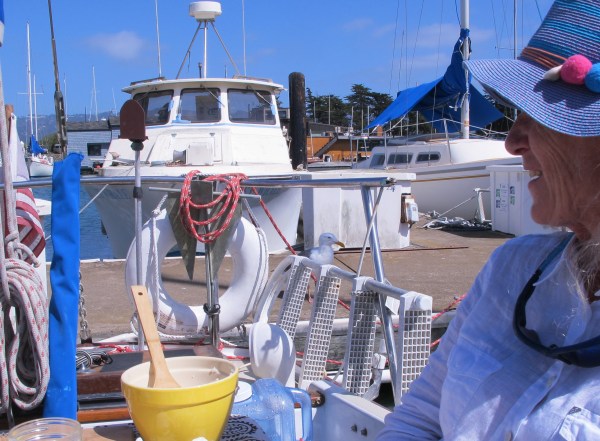
Watching… Waiting…
Virginie made known her intention to put together a conference at UNESCO Paris, titled, “A multi-sectoral strategy for Island communities facing climate change.” UNESCO is the United Nations Educational, Scientific and Cultural Organization. Consider me a skeptic on some counts. In my mind, the U.N. stands for a certain “talking over doing” approach, not to mention its reverence of global governance that stifles the trial and error needed from many independent countries to discover what works. But if Virginie – a doer and original thinker – is representative of her colleagues, the conference could produce some interesting results.
As an aside: UNESCO’s Twitter feed is abuzz, since today is Peace Day, apparently. I liked this image they shared:

If any Bay Area-ites want to co-host another “first annual” colloquium on something seasteading-related, drop a line in the comments.
Federalism 2.0, or Bully Federalism?

States flexing their power, just as our Founders intended https://t.co/DCOBjKe8e3 by David Davenport, @Lenny_Mendonca via @sfchroniclepic.twitter.com/WMDJqUkzLo
— Hoover Institution (@HooverInst) September 17, 2017
The Hoover Institution’s David Davenport can’t make up his mind about the resurgence of Federalism from the unlikeliest of states. He is one author of the SF Chronicle’s second pro-Federalism Sunday op-ed in two weeks – a piece titled, “States flexing their power, just as Founders Intended” (9/14/17). But we soon learn that this is not, in fact, your (founding) father’s federalism. Just a few days earlier, Davenport put out a 1-minute clip on “California’s Bully Federalism,” on conservative blog Townhall.com, noting that some of the state’s go-it-alone policies are less about freedom from federal interference than imposing California Über Alles. Take a listen:
Still, Davenport swallows his pride and joins his voice with a liberal to make the broadest possible case for federalism (whether or not you agree with the specifics):
Now everything from legalized marijuana, the minimum wage, climate change, immigration, auto emissions, and civil rights is on the federalism agenda. On one issue or another, federalism is now for everyone, from conservatives to liberals, a spectrum represented by the authors.
Federalism 1.0 was tainted by the association of states rights with pre-Civil Rights Era discriminatory statutes. Davenport’s concern, which I share, is that California will use its economic heft to impose its values on other states it sees as less enlightened. The prime example of bullying is California’s ban on state-paid travel – including for university students – to states that don’t provide sufficient protection for LGBT individuals. If progressives discover that Federalism 2.0 is a way to accelerate cultural and political change across the country, the term may overtake big data as the hottest buzzword in Silicon Valley. I think the strategy will backfire, and lead other states to hunker down in a fortress mentality.
The potential downside of federalism, as I noted in my last post on Federalism, is that states will seek “federalism for me, but not for thee.” Although I’m partial to certain uniquely Californian values, I don’t want to see them imposed them on other states. The beauty of the founders’ concept of states as laboratories of democracy is that they can run different experiments – not set the agenda nationwide.
On the other hand, I recently attended a memorial event for California’s leading historian, Kevin Starr, who apparently believed in California as a beacon on a hill that could atone for the sins of the nation (i.e., mistreatment of minorities, immigrants, refugees, and the environment). Federalism 2.0 should be about leading by example, and resisting the temptation to bullying.
Don’t label me, man.

I have good news and bad news for lovers of fermented tea, aka kombucha. First, the good:
If you purchased GT’s kombucha products between March 11, 2011 and Feb. 27, 2017, you may be entitled to benefits from the kombucha class action settlement.
Sweet! Now the bad: the GT’s and Whole Foods are being sued by a competing purveyor of probiotic beverages, KeVita, for underreporting their drinks’ sugar content. I knew something about their Trilogy flavor seemed too good to be true.
In related news, Glenn Greenwald’s The Intercept reports on a Whole Foods supplier – Pitman Family Farms – that is accused of falling short of standards for the humane, “free-range” label they use on their Mary’s Free Range Chicken product. It’s unclear from the story whether Pitman raises chickens from separate substandard facilities and labels them as such, but it doesn’t look good for either company.
As someone who may spend $8 for a dozen eggs on occasion, I want to know that what I’m buying is the real thing. One solution is better labeling. The same health food newsletter that recently extolled voting with your dollars ended with a plea for activism, in the form of support for the National Organic Standards Board, a federal advisory board of dedicated volunteers. But the inspectors seem to not be doing their jobs, and who could blame them? There are thousands of small organic farms and only a handful of bureaucrats, who prefer air-conditioned offices to smelly hen houses. Industry probably sets up their facilities in a way that makes it easiest for inspectors to check the right boxes, not engage a thoroughgoing search for truth. This is not to impugn anyone’s motives, just speculate on how I might act if I were in the inspector’s shoes.
In the case of GT’s kombucha, it took a rival producer to discover the “”error”” in GT’s nutritional facts. In the mysterious case of the “”free””-range chickens, it was the private news outlet that brought you Snowden’s leaks on drone strikes and the NSA that shined a light in the chicken coop. Even public goods like transparency and accuracy in labeling can come from competition. The mistake is thinking that the label, the standards, or the legislation are what create accountability.
Good Earthlings Vote with Their $$

Fairfax, California (population: 7,598) straddles the cosmopolitan haven of San Rafael and the more rural West Marin. It’s a town where everybody seems to know everybody – where town drunks rub elbows with local police, bikers with cyclists, hippies with yuppies, rednecks with tattoo freaks, and pot farmers with cowherds. These charming contradictions have earned Fairfax the nickname of “Mayberry on Acid.”
Good Earth Natural Foods, in the heart of downtown Fairfax, sells groceries to customers who care about recycling post-consumer waste. I had the pleasure of shopping at Good Earth yesterday, and picked up their latest newsletter, The Good Earthling. This issue was promoting organic food as the foundation of good health, and organic soil as the foundation of organic food. The back-page article, titled “Vote with your Dollar!”, says:
The simplest and most poignant form of food activism is voting with your dollar; making every place or way you buy your food a conscious decision about who you support, and who you do not. Your monetary choices combine with the monetary choices of likeminded individuals to make waves, and have significant effects on whether or not certain entities are allowed to thrive, and grow.
Once again, progressive values are suddenly being expressed in terms of decentralization and individual choice. Could the 2016 election have permanently de-romanticized politics for a certain segment of the population? Let us hope.

Be a good earthling. Vote with your dollars and buy good grass-fed meats. It’s good for the soil, good for the animals, and good for you.
Michael Strong on SF Bay/Seattle Radio
Update: The show is now available as a podcast/mp3.
https://soundcloud.com/bobzadek/michael-strong-on-education-entrepreneurship-capitalism
This Sunday (9/17, 8-9am PACIFIC) I will have the privilege of interviewing Michael Strong, alongside guest host and Seasteading author Joe Quirk. The topics are startup cities, education, entrepreneurship, and human flourishing. You can listen online here, or on 860 AM in the SF Bay.

Michael Strong is a contributor to this blog, founder of multiple charter schools, author of BE THE SOLUTION: HOW ENTREPRENEURS AND CONSCIOUS CAPITALISTS CAN SOLVE ALL THE WORLD’S PROBLEMS, and co-founder (with Whole Foods CEO John Mackey) of Conscious Capitalism, Inc.
I’m fascinated by startup cities for all of the obvious reasons, but I’m especially interested in Michael’s perspective as an entrepreneur and defender of capitalism who also speaks disparagingly of materialism, and owns very few things. He heralds a shift in the things people value, from “stuff” to meaningful experience. Our conversation will look at whether the imperatives for the under-developed world, where material scarcity is still a reality, are different from those in the developed world, where people are drowning in worthless possessions, and where infrastructure seems better suited to a bygone era. We’ll also discuss the relationship intellectuals have to capitalism, and why they have historically been hostile to the system that made them wealthy. Do they have some good points? How can we incorporate the best critiques into the foundations of the new forms of government we want to build?
It ‘s also worth mentioning that Michael is about to move from Austin to the San Francisco Bay Area to start a new school, and that Conscious Capitalism has a (dormant) Bay Area Chapter. From the website:
If there’s one place that positive change is alive and well, it’s the San Francisco Bay Area.
In the comments, I’d like to hear whether Bay Area-ites agree with this statement.
I am grateful to Bob Zadek (whose weekly show I produce) for the opportunity to sub for him this weekend. Joe and I welcome your calls at any time during the show, at (424) BOB – SHOW. Let’s give Michael a warm welcome to the Bay Area.
California Wakes Up to State Sovereignty; Still Dreaming

It was only a matter of time before progressives caught on to states rights. Or, rather, it was only a matter of time, plus a Donald Trump presidency and Republican majorities in Congress. Zócalo Public Square columnist Joe Mathews recently penned an op-ed in the SF Chronicle titled, “In great American tradition, let California take undocumented immigrants.” I won’t assume he speaks for all Californians when he refers to federalism as a “great American tradition,” but this is still a welcome turn of events.
The debate over ending Deferred Action (read: deportation) for Childhood Arrivals could hasten a political realignment that bends California majorities towards support for local, or at least regional, solutions. Mathews proposes an alternative “California resident” status – not quite U.S. citizenship (which California can’t grant), but a step towards integration for immigrant children, raised in California, whose national identity and true citizenship differ. Maybe, Mathews suggests, the best way to resolve the discrepancy is to make “Californian” into something more like a nationality – a legal relationship between non-citizen residents and state government. This would imply greater sovereignty for California and, in turn, for other states seeking to reclaim powers delegated to them by the 10th amendment.
Mathews favorably quotes a researcher with the California Freedom Coalition, whose goal is a nothing short of a new nation of California. CFC might not be proposing the right route, or the right coalition, but Californians are clearly eager to lead on climate change, health care, education and technology. They rightly (in my view) consider immigrants to be assets, and are willing to invest in helping them belong here, “with the rights and responsibilities that entails.” More direct leadership would likely humble some progressive pipe dreams, like the transition to an all-renewable economy, or universal health care and higher ed. But maybe – just maybe – Californians could rise to the challenge if they temper their faith in human progress with realism, and their realism with faith.
Although our original naturalization policy was surprisingly liberal [1], there are good reasons to preserve a national identity through uniform citizenship requirements. Free movement of people among states is one of the reasons that the Constitution grants Congress authority over naturalization policy. Mathews deals with the potential spillover effects of California’s residency experiment by suggesting that Federal Government be required to deport undocumented residents arrested outside of California back to the Golden State. And indeed, the Constitution does not grant federal government authority over resident aliens in the states. This became a source of heated disagreement between President John Adams and James Madison. [2] Madison argued that the Adams’ Alien Act (allowing imprisonment and deportation of non-citizens deemed dangerous) violated due process rights of “alien friends.” Thus, Mathews’ idea sounds good in theory, and may have backing from the Father of the Constitution himself.
However, in a world governed by political compromise, states in stricter compliance with federal immigration law would need to be appeased on some dimension. Here, I wonder whether progressives could stomach the political price of federalism – namely, letting other states do as they please, even when it goes against our “”Enlightened Californian Sensibilities.”” If Mathews and the rest of us Californios could humble ourselves just a bit, we might be able to make some real progress.
[1] The Founders’ Immigration Policy, by Alex Nowrasteh, The Huffington Post Blog, 3/28/2012
[2] James Madison and the First American Immigration Crisis, by Mike Maharrey, The Tenth Amendment Center
P.S. I welcome your feedback in the comments. This is the first post to this blog in almost a year, and my first post in more than three years. I’m curious to get a sense of who is still reading.
(This is a guest post by Below Potential – ed)
If you are interested in economics and/or political thought, you may have come across the following three terms:
- Competitive Governance
- Seasteading
- Free Private Cities
The purpose of this post is to explain in a clear and concise manner the economic and political thought behind each of these terms. Of particular importance is to understand how these terms, respectively, the ideas behind them relate to each other.
The Market for Governance
In contrast to other markets, the market for governance has been producing meagre results. Products (the bundle of rules and public goods provided by governments) are low-quality, prices (taxes) are high and the customers (the citizens) are generally unsatisfied.
The reason for this is lack of competition. In a competitive market producers of bad products are weeded out by natural selection. In the governance industry, producers (governments) are not subject to this selection mechanism. Instead, the market for governance is dominated by a series of large geographic monopolies.
There are two reasons for the lack of competition in the governance industry:
On the supply-side there are high barriers of entry. Imagine you have a new idea that would revolutionise the governance industry. In any other industry you would have to convince some investors to give you the necessary capital. Then you could start producing and selling to customers. As things stand today, market entry into the governance industry would be significantly more difficult. You would have to win either an election or a revolution.
On the demand-side there are high barriers of switching. Switching your internet provider means something like having to send an email to customer service. Switching governance providers means either emigration or the election of a new government within your current jurisdiction.
Obtaining permission to immigrate into a country can take years. On top of that, since today’s governments often cover a whole language area, emigration may well entail having to learn a new language. The problem with elections, on the other hand, is that neither you nor anybody else has an incentive to put any effort in making a good choice – as illustrated by David D. Friedman in The Machinery of Freedom:
Imagine buying cars the way we buy governments. Ten thousand people would get together and agree to vote, each for the car he preferred. Whichever car won, each of the ten thousand would have to buy it. It would not pay any of us to make any serious effort to find out which car was best; whatever I decide, my car is being picked for me by other members of the group. Under such institutions, the quality of cars would quickly decline.
If high barriers of entry for producers and high barriers of switching for consumers are causes for the dysfunctionality observed in the market for governance, then it becomes clear that there cannot exist a solution that does not tackle at least one of these causes.
Competitive Governance
The idea underlying Competitive Governance is to minimise the cost of switching governance providers by switching between geographic jurisdictions.
This is to be achieved by geographically decentralizing political power, i.e. increasing the number (decreasing the size) of units of governance among which people could move. Low barriers of exit would mean higher competitive pressure for governments and therefore better governance.
Seasteading
While the focus of Competitive Governance is on the demand-side of the market for governance (the high barriers of switching faced by consumers), the focus of Seasteading is on the high barriers of entry, i.e. on the supply-side of the market for governance.
In contrast to the earth’s land, the ocean is largely unclaimed by states. Seasteaders want to develop the technology to create permanent, autonomous communities on the ocean, arguing that the creation of ocean platforms constitutes a much lower barrier to entry for forming a new government than winning an election or a revolution – or a war. And with technology advancing, the barriers of entry to the market of governance will decline year by year.
By opening up the vast space of the ocean for experimentation with new institutions, an evolutionary process will be started that will led to new and better products in the market for governance.
Proponents of Competitive Governance have argued for more competition in the governance industry, but traditionally they did not provide an explanation for how to effectuate this change. Seasteading can be considered as a a route for getting from here to there, i.e. as a proposal for implementing Competitive Governance.
Free Private Cities
Competitive Governance and Seasteading refer to the level of the governance industry and are agnostic with respect to the shape and form of the units of governance within the governance industry. Put differently: the question of how governance is to be provided is out of scope.
Titus Gebel’s proposal for the foundation of so-called Free Private Cities, on the other hand, provides one answer to this question. Gebel, a German entrepreneur, argues for private, for-profit companies to act as governance providers in defined territories (Free Private Cities) and he has started such a company: Free Private Cities Ltd.
Citizens/customers in a Free Private City would pay a fee for the governance services provided by the company. Each customer’s rights and duties would be laid down in a written agreement between the customer and the governance provider of the respective Free Private City.
Free Private Cities may be established within the territory of an existing state, whereby the parent state (hoping to reap benefits from a potential hub of growth and prosperity) grants the operator the right to set its own rules within a defined territory. Most likely though, the first Free Private City is going to be established via Seasteading on the ocean.


 Let A Thousand Nations Bloom