The Consequences of Economic Freedom
Exit and Voice in The Intelligent Investor
Benjamin Graham‘s The Intelligent Investor is a pretty awesome investment book. In the latest, revised edition, published by Harper and updated with commentary by Jason Zweig, there is a fascinating note on Graham’s revisions to the chapter on shareholder activism:
“(The) original section…dealt with shareholders’ voting rights, ways of judging the quality of corporate management, and techniques for detecting conflicts of interest between insiders and outside investors. By his last revised edition, however, Graham had pared the whole discussion back to lesss than eight terse pages about dividends.
Why did Graham cut away more than three-quarters of his original argument? After decades of exhortation, he evidently had given up hope that investors would ever take any interest in monitoring the behavior of corporate managers.”
Smart man. If ever there was an example of the superiority of exit as compared to voice in terms of changing the way that corporations function, it would be shareholder’s meetings. Zweig, oddly enough, plays the idealist, recommending that if a shareholder sees bad management practices at a company, that shareholders should “vote against every director to let them know you disapprove,” “attend the annual meeting and speak up for your rights,” and, in his most inspired recommendation, he urges investors to “find an online message board devoted to the stock…and rally other investors to join your cause.” If those suggestions don’t make you snicker, how about this platitude:
“Understanding and voting your proxy is as every bit as fundamental to being an intelligent investor as following the news and voting your conscience is to being a good citizen.”
What’s most stark about these passages is the fact that in the first 500 pages of the book, Zweig (and Graham) make a compelling case for the obvious, and simple, solution for those investors holding the stock of a poorly-managed company – sell, for chrissakes. Exit. Leave. There are a million other companies out there you could own that provide better value for money, that don’t require a quixotic quest to rally and unify thousands of investors. And yet, the moment Zweig even thinks about voting and democracy, context-dependence leads him to completely abandon his value-free arguments on how to be a successful investor and embrace value-laden notions of how to be a “good corporate citizens.”
One of the coolest aspects of the competitive government “movement,” if you will, is the attempt to reframe the debate about politics so that people can think about government as an industry. There are tons of idealistic democratic activists out there who would laugh at the concept of going to a shareholder’s meeting when they could just sell their shares. If only they could all be given a copy of Exit, Voice, and Loyalty.
In her book Persuasion, the great Jane noted:
How quick come the reasons for approving what we like!
And not too long before then, Ben Franklin wrote in his autobiography:
So convenient a thing it is to be a reasonable creature, since it enables one to find or make a reason for everything one has a mind to do.
There’s a story in the NYTimes (strangely in the Arts section) about a group of cognitive social scientists whose work supports the Franklin-Austen theory.
…researchers are suggesting that reason evolved for a completely different purpose: to win arguments. Rationality, by this yardstick (and irrationality too, but we’ll get to that) is nothing more or less than a servant of the hard-wired compulsion to triumph in the debating arena. According to this view, bias, lack of logic and other supposed flaws that pollute the stream of reason are instead social adaptations that enable one group to persuade (and defeat) another. Certitude works, however sharply it may depart from the truth…
“Reasoning doesn’t have this function of helping us to get better beliefs and make better decisions,” said Hugo Mercier, who is a co-author of the journal article, with Dan Sperber. “It was a purely social phenomenon. It evolved to help us convince others and to be careful when others try to convince us.” Truth and accuracy were beside the point.
In general it’s a good pragmatic policy to argue for what’s true, but there are many cases where uncovering the truth could lead to social ostracism or worse. Giordano Bruno became an expert on that; Galileo was his best student. To take a rough approximation of our ancestral environment, which presumably involved Dunbar-like population levels, our ability to reason irrespective of accuracy served as a valuable tool. We could use it to jockey for status, form coalitions, and to gain access to high value mates. We could lower the status of those who oppose us. We could do all sorts of things as we argue. But it is not primarily a truth tracking process; beauty often bests truth, perhaps only second in that respect to ridicule. But don’t be too funny, since the threat of ostracism carried greater weight in our evolutionary past–exile could mean death–and our ability to reason would not have served us well if it were to aim always at truths. Speaking truth to power is nice, but unpleasant facts might kill the messenger. As Omar says in the Wire or Emerson said in Concord, if you strike the king, you must kill him.
Despite the fact that their work illuminates the weakness of reasoning, these cognitive social scientists are ardent deliberative democrats in the tradition of Jurgen Habermas and John Rawls. They believe that guided by the proper rules, democratic debate is the best form of government. This isn’t for moral reasons, they conclude, but for epistemic. When groups deliberate, it’s implied that their cognitive biases cancel each other out.
He and Ms. Landemore suggest that reasoned discussion works best in smaller, cooperative environments rather than in America’s high-decibel adversarial system, in which partisans seek to score political advantage rather than arrive at consensus. Because “individual reasoning mechanisms work best when used to produce and evaluate arguments during a public deliberation,” Mr. Mercier and Ms. Landemore, as a practical matter, endorse the theory of deliberative democracy, an approach that arose in the 1980s, which envisions cooperative town-hall-style deliberations.
Now this is all from a newspaper story, so there’s a lot jam packed into a thousand words, even less on this application of the theory to politics. I don’t know if they mean groups are epistemically more efficient at discovering facts or at expressing values. It would be misguided to say groups deliberate to find moral truths. At any rate, because they’re academics, they immediately apply their findings to institutions of immense power. I love this move. Behavioral economists and psychologists mastered it in the last decade. Take a finding such as how best to organize a cafeteria–nudge salads in front of deserts!–and then apply it to federal governance at once on everyone. These people are power hungry management consultants looking for clients in the state. They want to call themselves scientists or philosophers but instead they should be much more modest and find jobs at McKinsey on how best to organize a focus group.
Ahhhhh, focus groups. To which David Ogilvy retorted, “You can search all your parks in all your cities, you’ll never find a statue dedicated to a committee.”
Any advertiser, not just that wily Ogilvy, will tell you that the worst form of advertising would be to provide an objective list of reasons why your product is better than its rivals. It is far more effective to have an amiable talking gekko or an overly cheerful siberian tiger explain one benefit your product offers. Persuasion requires an odd kind of reasoning.
Entrepreneurs know this as well because it is very difficult to introduce a new product. In addition to his thoughts on the king, Emerson also remarked that if you build a better mousetrap, the world would beat a path to your door. He obviously didn’t run a VC or a start up in a market against vested interests. Unless innovators have invented a cure for cancer, where the demand is obvious and instant, most of them have to create markets in addition to products.
Let’s look at Facebook. It is a wonderful product with a clean design, but it would have fallen flat if Zuckerberg et alii had released it to everyone all at once. One of the key problems Facebook solved was getting people to feel comfortable posting their true identities on the Internet. MySpace was characterized by falsehoods, pseudonyms, and fake accounts. People could sign up as tigers or dead celebrities or both. But because Facebook started on campuses where people trusted their classmates, they created profiles that would more credibly mirror their real world identities. On top of that, Zuckerberg sparked a status cascade by beginning the whole thing on the most exclusive campus in the world. Not only did that add credibility to the site, but it seems it also added cache for all the other schools down the line as they were added, Yale, Princeton, Stanford, and so on…
Missing in all this is anything resembling persuasion based on reason and deliberation, least of all glorified focus groups. If reason and deliberation about the facts ruled, this kind of snowballing up and out for new products would be rare. Instead it would be much better to have everyone meet for “product deliberation day” and decide which new products to adopt. But tastes and preferences don’t change that way. Creating a new market, even for demonstrably higher quality goods, is difficult. And in general younger generations are quicker to adopt new technologies than the older crowd. Geoffrey Moore wrote the locus classicus on the pattern. It’s called Crossing the Chasm. He noticed that for a lot of high technology products, chronology matters in customer development. It’s a story best told by his now famous adoption curve:
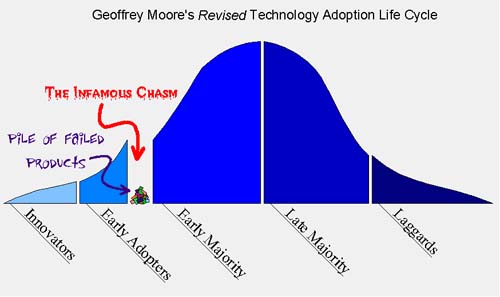
A rollout has to happen in a certain sequence. If the bottom of this graph represents time, adoption occurs first with the visionaries on the left side who become evangelists for the earlier adopters, a somewhat avant-garde crowd on the lookout for what’s new. The perilous chasm is the space between these enthusiasts and the mainstream. Very few products make it across. If rule sets in governance are a kind of technology, imagine how hard it is to introduce new political orders. Freedom of conscience was introduced into the political market by William Penn in a colonial backwater in 1682, far away from the burning intolerance of England. But the early adopters were evangelists–literally–and the success of the policy created a cascade throughout the colonies and eventually back to Europe. Again, as in Facebook’s rollout, in this story you will not find explanations involving deliberation and reasoning. Instead you find search, experimentation, and the snowball.
Whereas entrepreneurs have to persuade customers to use their new products, democracies get to impose them on everyone at once, the willing and unwilling alike and in one-size-fits-all quantities. Focus groups are bad enough in the market. Design by commitee rarely works. But this tactic is even worse with public goods, where the success and failure of a new policy can involve potentially great harm to an entire public.
I bring this up on a blog about political theory because I’m very skeptical about my ability to convince the rest of the world that competitive governance is a good thing. No amount of deliberation in a town hall will alter that. I take very seriously the infallibility of reasoning. And if we’re trying to innovate new forms of governance, we can’t rely on suped-up focus groups. But that’s okay, because we’re not going to have to. Fortunately new technologies don’t wait for juries to reach a consensus.
Like a good little management consultant, I’ve drawn a matrix to represent one possibility space of opinions about our ideal world full of new city-states and seasteads. People will tend to fall in one of these quadrants:
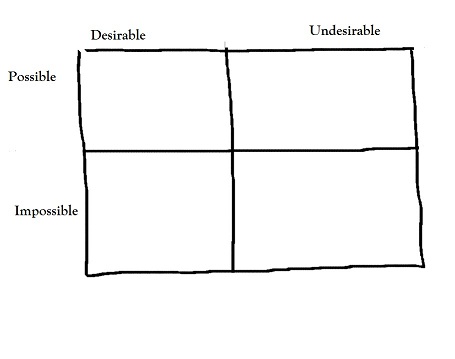
Where do you think most the world fits in this matrix? I’d guess in the impossible and undesirable camp. It would be a great waste of time to argue with them. The real trouble-makers are those who think it’s both possible and undesirable. But even so, these are the last people we want to waste our time reasoning with. If we must engage with them at all, I propose that instead of trying to convince them it’s desirable, we try to convince them it’s impossible. While they live under that illusion, we will build in peace and hatch a plan on how to develop our first customers. Then we’ll snowball out like William Penn before us.
Gurgaon, India : Lessons for a Free Cities Future

 This post comes from Thousand Nations contributor Zachary Caceres–Editor
Alex Tabarrok, one of the editors of the brilliant work The Voluntary City, wrote today about a recent New York Times article on the Indian city of Gurgaon. The city is a rapidly-growing metropolis, currently with the 3rd highest income per capita in India. Thousand Nations readers will find especially interesting the city’s unique political circumstances:
Gurgaon was widely regarded as an economic wasteland. In 1979, the state of Haryana created Gurgaon by dividing a longstanding political district on the outskirts of New Delhi. One half would revolve around the city of Faridabad, which had an active municipal government, direct rail access to the capital, fertile farmland and a strong industrial base. The other half, Gurgaon, had rocky soil, no local government, no railway link and almost no industrial base.
As an economic competition, it seemed an unfair fight. And it has been: Gurgaon has won, easily. Faridabad has struggled to catch India’s modernization wave, while Gurgaon’s disadvantages turned out to be advantages, none more important, initially, than the absence of a districtwide government, which meant less red tape capable of choking development.
In other words, Gurgaon is a bustling, flourishing testament to the power of good rules – even when competing against areas with ‘better’ infrastructure.
Tabarrok points out that for-profit corporations swiftly filled the ‘institutional vacuum’ left by the absence of government by investing billions in Gurgaon. Health clinics, electricity, water, roads, and a security force outnumbering the ‘real’ police are all provided privately. One leading Indian business magazine has ranked Gurgaon the number one Indian city to work and live.
Michael Strong has argued for innovation in legal systems with the allegory that the US Post Office will eventually be competed away by superior entrepreneurial alternatives like Gmail and FedEx, rendering America’s favorite monopoly a slush-fund subsidy for junk-mailers. In Gurgaon, this is literally what has happened: private couriers meet the needs of residents because the ‘official’ service was unreliable.
Unfortunately, not everything about Gurgaon works well and many services are underprovided to regions of the city – especially areas filled with working poor. Tabarrok refers to Gurgaon as a series of oases: highly developed islands owned and operated by for-profit institutions with subpar connections to one another. Many commenters have scolded Tabarrok for interpreting the city’s development too charitably, since traffic and blackouts in these underprovided regions remain a serious issue. But somewhat ironically, these complaints are almost entirely regarding the provision of public goods in the areas between private developments. These regions were one of the few responsibilities actually left to the government:
Developers built the infrastructure inside their projects, while a state agency, the Haryana Urban Development Authority, or HUDA, was supposed to build the infrastructure binding together the city.
This striking divide is an unfortunate case study in the power of incentives. Tabarrok recommends to readers that the solution to this problem is in ‘scaling-up what works’. This is precisely the idea behind the private cities component of the “Free Cities” project, familiar to many Thousand Nations readers. Large-scale development projects like the 30 billion dollar Songdo City in South Korea do not risk the problem of the ‘oasis’ since it has, well, ‘scaled up what works’. Michael Strong’s quasi-‘Georgist’ proposal to use land-value dividends to provide funding for Free Cities also ameliorates this trouble. Well-functioning and efficiently provided public goods will only increase the value of the land on which the city rests by encouraging commerce and immigration. Marrying this to incentive programs like “Citizens Dividends” or “Flexi-wage” (official salaries tied to City growth-rates) means a positive feedback loop, benefiting city developers and residents, rich and poor alike.
Gurgaon is far from ideal, but it hints at the bright future ahead for innovative projects like Free Cities.

New Paul Romer TED Talk, Honduran Charter City Update
State Legitimacy as Status Quo Bias
The Behavioral Economics of Democratic Decline and Why Letting a Thousand Nations Bloom Can Solve it
by guest blogger
It’s an old yarn to point out that there seems to be something mystical, religious, ‘irrational’ about the allegiance of many to the modern State. Herbert Spencer wrote of the “divine right of Parliaments,” Randolph Bourne scorned Americans’ “pure filial mysticism.”
The increasingly popular work in ‘behavioral economics’ has studied the ‘irrational’ foundations of economic decisions: in other words, the degree to which people’s actual decisions deviate from the predictions of ‘rational-choice’ models traditionally used in social science. Behavioral economics is widely co-opted as a wholesale criticism of markets, but few bother mentioning that many of its findings equally apply to political decisions. (A notable exception is Bryan Caplan’s wonderful book Myth of the Rational Voter).
One of the strongest findings in behavioral economics (and a favorite of ‘libertarian’ paternalists) is a bundle of irrationalities termed “status quo bias.” This bias, put simply, is the tendency — as the difficulty of making a decision increases — for people to opt for the ‘default’.
Behavioral economists find that merely shifting the phrasing of a questionnaire from a ‘neutral framing’ (no default option) to a ‘status quo’ framing (an arbitrarily chosen default option with the possibility to switch) yields a significant preference for the ‘default’ option. This finding is corroborated in various ‘field experiments.’ For example, when choosing a bundle of stocks to invest in for their retirement, people are quite likely to choose whichever bundle was the ‘default’ option. Behavioral economists call this “framing effects”, when the mere structure of the decision (i.e. the presence of a default) biases a choice.
Behavioral scholars argue that this bias arises from the cognitive failings of human beings: our ‘bounded rationality’ is not without its costs.
People prove themselves as ‘risk averse’ in these experiments; they will forsake uncertain future gains for the status quo because it is difficult to understand the probabilities and possibilities of the outcomes. In the case of the retirement example: as it becomes more difficult to compare stock bundles, their future returns, and their risks — people are significantly more likely to opt for the status quo option. Unless people have a strong emotional attachment to an alternative, they will be prone to the status quo bias of the ‘frame’ even in the presence of ‘rationally’ obtainable gains from switching.
But of course all political decisions, whether votes or a penchant for revolution, are likewise made with an implicit framing – the status quo or ‘default’ institutional arrangement under which a person has lived.
If one accepts that imagining and evaluating the costs and benefits of alternative political arrangements is difficult (‘cognitively costly’) it becomes clear that preferences for political institutions likely suffer from framing effects, leading to status quo bias. Unless a person has a particular reason for strongly favoring an alternative arrangement, they are significantly more likely to opt for the status quo. If a person has any emotional attachments to the status quo or even merely has difficulty imagining the outcomes of an alternative, they will also opt for the status quo.
Where does this leave modern democracy? Consider Mancur Olson’s theory of democratic State growth. Olson’s dynamic, familiar to many Thousand Nations readers, is that the inexorable logic of democracy tends, over time, to bring ever-greater redistribution to concentrated interests from the dispersed whole. This growing ‘capture’ of the economy leads to societies like today’s economically unstable, stagnating Western democracies.
But Olson’s process is as psychological as it is economic. The end of democratic State growth is one of tremendous uncertainty. The economic patterns of society become ‘fuzzy,’ as distribution is severed from its natural, procedural pattern (factor payments) to methods captured by organized interests and prone to the vicissitudes of political bargaining (subsidies, rents, regulations).
One’s own position in the overall ‘churn’ becomes difficult to decipher. As explained by political philosopher Anthony de Jasay, if any citizen’s net position
can be ascertained, [it] will be submerged under large flows of gross gains and gross losses impinging on much the same people… Not all can, let alone will, see through this and recognize their net position, if indeed a net position has objective meaning. Since economic policy causes prices and factor incomes to be other than what they would be in a policyless capitalist state, and since it may in any case be inherently impossible to “know” the ultimate incidence of the total set of directives, incentives, prohibitions, taxes, tariffs, etc. in force, a subject need not be stupid to be mistaken about where the churning around him really leaves him.
The behavioral outcome of this uncertainty, in the words of de Jasay, is “false consciousness,” “illusions,” and “downright mistakes by both the state and its subjects.” The mounting ‘cognitive costs’ of deciphering the interventionist mire become prohibitive and citizens become behaviorally irrational.
Political scientists have shown the costs of status quo bias in simple acts of political reform. Even mutually beneficial reforms like free-trade, which also has broad support by economists, will fail a popular vote in the presence of uncertainty as to the gains and losses to individual voters themselves. In the words of two game theorists, “uncertainty regarding the identities of gainers and losers can prevent an efficiency-enhancing reform from being adopted, even in cases in which reform would prove quite popular after the fact.” People opt instead for the seeming certainty of the status quo.
Thus we end with the disheartening spectacle that democracies contain both the economic incentives to stagnate and the psychological effects to reinforce allegiance to these same declining regimes. The Public Choice logic of Mancur Olson meets the biases of the behavioralists.
Fortunately Olson explains that his destructive process can be turned back. But unfortunately, this typically requires a massive exogenous shock to the system, like a natural disaster or the widespread destruction of a nation like Japan and Germany during World War II.
However, projects like Free Cities and Seasteading potentially provide a run-around past ‘Olsonian Shock Therapy,’ while achieving the same end. The phrase “one Hong Kong is worth 1000 policy papers” has a behavioral foundation. A Free City within the bounds of a society captured by Olsonian interests massively lowers the cognitive costs of imagining and calculating the cost and benefits of alternative institutions. The alternative is not far away: it’s inhabited by people much like the onlooking citizen of the host nation. Likewise, a Free City or a Seastead offer the spectacle of an ‘uncaptured’ society, where members are rationally opting-in to the arrangement based on the clear benefits to themselves. They are psychological laboratories to escape the ‘churn’ and to imagine a better life outside the bounds of demosclerosis.
The arguments of Public Choice have behavioral foundations, rendering the prospect for internal reform of many societies even more unlikely. While societies are increasingly captured by special interests, the psychological costs of considering alternative governance become prohibitively high. States crowd out the decentralized institutions that demonstrate the benefits of pluralism in one’s daily life. States also obscure the cost/benefit analysis of allegiance to a given political system through continuous and ever-growing acts of intervention.
People thus become wedded to the ‘status quo’: addicted to often self-defeating redistribution and ‘risk averse’ to challenging the structure itself. But to break this vicious cycle, we need not wait for tragedies like bombs and earthquakes: we need only to tip the world towards letting a thousand nations bloom. A few good seeds can swing the behavioral scales in our favor.
Adapt and Obliquity
Two pop non-fiction books by two Englishmen who write for the Financial Times, both with one word titles in the mold of Blink. Ignore that similarity. I highly recommend them both, as their main concepts apply to the theory of competitive governance.
John Kay’s Obliquity is about how it is often the indirect method that best achieves a goal, rather than directly approaching things head on. (Eric Falkenstein reviewed Kay’s book here.) A couple of examples: those who aim to be happy in an abstract way have a harder time achieving their end than those who lose themselves in an activity pursued for its own sake. And likewise, and perhaps surprisingly, firms with general mission statements calling for profit maximization perform less well than those who speak of a specific goal like providing the best customer service in their industry. The first rule of maximizing shareholder value, according to Kay, is to never explicitly say you’re maximizing shareholder value. At least not in mission statements. GE heavyweight Jack Welch pointed out that the principle of “maximizing shareholder value” tells you nothing about what you should do in the morning when you arrive in your office. Instead you ought to focus on getting work done.
Key doesn’t mention this, but Jack Welch’s quip is equally true of political institutions. It’s hard to fathom how “maximizing justice” would work pragmatically for government service providers. Better to see what systems people prefer to live in when they vote with their feet and then to replicate what works best, learning through trial and error. Applied to the questions of political philosophy, the oblique idea would be to avoid top down design-based systems in favor of filtering processes that cull good policies out of a possibility space. In other words, competitive governance.
These same themes are developed deftly by Tim Harford in Adapt. He even devotes a section to charter cities. Call it the lesson of the Galapagos:
“The Galapagos Islands were the birthplace of so many species because they were so isolated from the mainland and, to a lesser degree, from each other. ‘Speciation’ — the divergence of one species into two separate populations–rarely happens without some form of isolation, otherwise the two diverging species will interbreed at an early stage, and converge again. Innovations, too, often need a kind of isolation to realise their potential.” pg 86-87
This point doesn’t come up in the context of rule set experimentation, but I say let a thousand galapagoi bloom. It’s not a cry for protectionism, but for sovereignty. One hero of Harford’s book is a Russian engineer by the name of Peter Palchinsky, a truth-seeking technocrat shot by Stalin’s secret police for collecting information about failing industries.
“What Palchinsky realised was that most real-world problems are more complex than we think. They have a human dimension, a local dimension, and are likely to change as circumstances change. His method for dealing with this could be summarised as three ‘Palchinsky principles’: first, seek out new ideas and try new things; second when trying something new, do it on a scale where failure is survivable; third, seek out feedback and learn from your mistakes as you go along. The first principle could simply be expressed as ‘variation’; the third as ‘selection’.” pg. 25
I enjoyed the book very much, as Harford is quite skilled at presenting ideas clearly amid story-driven narrative. His chapter on the counterinsurgency in Iraq is excellent. While some might find these ideas obvious or old–fans of Hayek, for instance–I think it’s a good entry point for most anyone else.
Kayfabe Politics
 Over at the Edge, Eric Weinstein writes:
we may fairly ask what rigorous system would be capable of tying together an altered reality of layered falsehoods in which absolutely nothing can be assumed to be as it appears. Such a system, in continuous development for more than a century, is known to exist and now supports an intricate multi-billion dollar business empire of pure hokum. It is known to wrestling’s insiders as “Kayfabe“.
Because professional wrestling is a simulated sport, all competitors who face each other in the ring are actually close collaborators who must form a closed system (called “a promotion”) sealed against outsiders. With external competitors generally excluded, antagonists are chosen from within the promotion and their ritualized battles are largely negotiated, choreographed, and rehearsed at a significantly decreased risk of injury or death.
As applied to politics, I am partial to any metaphor that emphasizes deception, staged-conflict that masks deeper agreement, and a willing suspension of disbelief by consumers for the benefit of enjoying a spectacle in which their side might win higher status. Humans crave agonistic structures. Indeed, there are fewer differences between Wrestlemania and televised presidential debates, national party conventions, and other electoral college party shenanigans than you might at first think. In some ways Wrestlemania is better because you have to buy it On Demand.
Weinstein concludes:
Kayfabrication (the process of transition from reality towards Kayfabe) arises out of attempts to deliver a dependably engaging product for a mass audience while removing the unpredictable upheavals that imperil participants. As such Kayfabrication is a dependable feature of many of our most important systems which share the above two characteristics such as war, finance, love, politics and science. Importantly, Kayfabe also seems to have discovered the limits of how much disbelief the human mind is capable of successfully suspending before fantasy and reality become fully conflated.
Strange Sightings: Liberal Secessionists in Arizona
A long-simmering movement by liberal stalwarts in southern Arizona to break away from the rest of the largely conservative state is at a boiling point as secession backers press to bring their longshot ambition to the forefront of Arizona politics. A group of lawyers from the Democratic stronghold of Tucson and surrounding Pima County have launched a petition drive seeking support for a November 2012 ballot question on whether the 48th state should be divided in two.
Will Greece Exit the Eurozone?
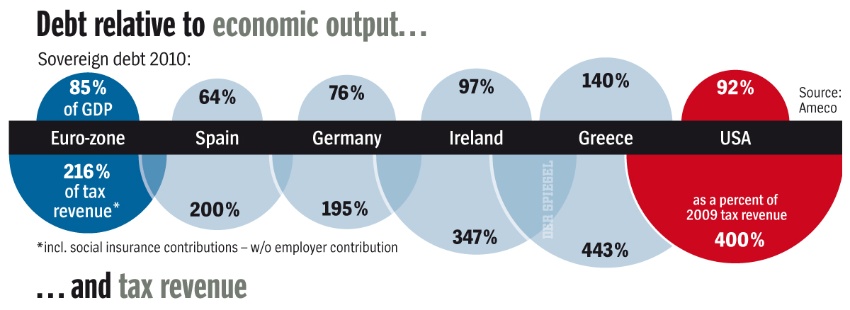
Spiegel sez the PIIGS are starting to squeal:
Greece’s economic problems are massive, with protests against the government being held almost daily. Now Prime Minister George Papandreou apparently feels he has no other option: SPIEGEL ONLINE has obtained information from German government sources knowledgeable of the situation in Athens indicating that Papandreou’s government is considering abandoning the euro and reintroducing its own currency.
Alarmed by Athens’ intentions, the European Commission has called a crisis meeting in Luxembourg on Friday night. In addition to Greece’s possible exit from the currency union, a speedy restructuring of the country’s debt also features on the agenda.
Bankruptcy is not the best way to let a thousand nations bloom, but the eurozone is offering a high cost, but informative experiment in confederation. Mixing profligate national fiscal policy with international monetary policy is proving to be untenable.


 Let A Thousand Nations Bloom