One Conundrum of Governance
Gary Becker writes:
While average rates of growth do not appear to differ much between democracies and authoritarian regimes, the variability in performance does differ more among authoritarian governments.
While developing democracies may linger in the purgatory of mild or no growth, autocratic rulers tend to offer heavens or hells. Here’s one comparison data graph by Almeida and Ferreira:
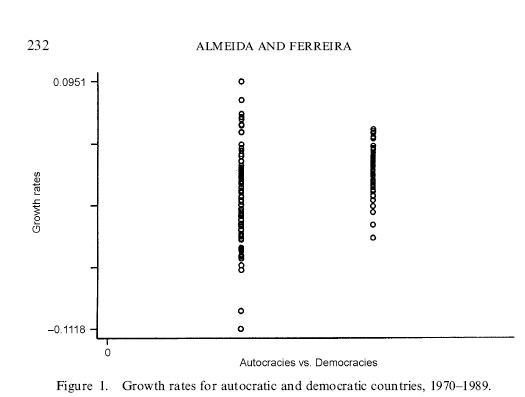
Hat to tip to Bryan Caplan, who also adds, “Interesting finding #2: When a dictator accidentally dies, growth rates persistently change. When a democratic leader accidentally dies, in contrast, they don’t.”
One thing that might cloud this issue is that catch up economic growth is often faster and of greater magnitude than that in the developed world. After innovative countries have slogged through the trial and error process of invention, autocrats have the luxury of copying what works. But once most countries approach the technological frontier as other sources of growth have been tapped out, I’m curious as to what the comparison between growth rates would be–will angel autocrats still attain superior rates? Singapore is making a run for it….but China may soon tell a different story.
Now if some kind of peaceful filtering process were at work (and the infernal hell of a failed autocracy weren’t so dreadful), I would see the variability of growth rates as a virtue. It would be evidence of a discovery process driven by rule set experimentation. Bottom rung countries would fail fast, fail safely, and fail often, quickly adopting the best practices and rule sets of the top rung batch. The decision making costs in autocracy are lower–one guy or a committee calls the shots–so that kind of process would work best in a market full of tyrants, especially if their customers could easily change government service providers, thereby avoiding onerous impositions. But, alas, the human costs of autocratic variability are very great, men aren’t angels, exit is expensive, and the top rule sets aren’t so easily emulated.

Imitative Versus Innovative Economies
In case you haven’t checked it out, do take a look at Brink Lindsay’s essay on the relationship between economic development and economic freedom. He discusses some important trends in the global economy. Imitation lets poor countries jump start their economies and catch up to rich countries in GDP rankings. For instance, it’s easier to bring 20th century plumbing to China than it is to bring 21st century biotech to California. The really hard task is to discover new ideas, not to spread current best practices to places where they’re absent. The main thesis of Lindsay’s paper is that he believes he sees a positive ratchet effect as the developing world develops. They run out of things to imitate so they have to start thinking for themselves. But that requires economic reforms in favor of liberty:
…the richer and more advanced a country gets, the more economic freedom it needs for growth to continue. Even at the most basic level, poor countries need to develop successful market economies to grow rich. But, once countries become rich, they find themselves ever more dependent on unpredictable entrepreneurial innovation—and, therefore, on a broader range of well-functioning, competitive markets—for continued prosperity. Consequently, as countries develop, they come under increasing pressure to liberalize their markets to stave off deteriorating economic performance.
And later on:
Both when economic development is at a relatively low level (behind the technological frontier), or when it is still at an absolutely low level (still transitioning from mass poverty to mass affluence), the uncertainty of economic life is thus at a relatively low ebb. But, as an economy approaches the technological frontier, and as successful industrialization ushers in mass affluence, increasing uncertainty about how best to advance consumer welfare requires incessant, extensive trial and error to plot a viable path forward. This requires, in turn, an institutional and policy environment that gives free rein to entrepreneurship and competition.
Singapore imitated Hong Kong. In the mid to late 60s, the Koreans imitated the Japanese, who had implemented reforms after WWII. Then, in early 80s, the Chinese imitated the Koreans. The result has been gangbusters. And Lindsay’s contention is supported by this story. But he neglects to tell the countervailing ratchet effect–namely, that yesterday’s innovators become today’s vested interests. And boy do they like to erect barriers to entry in the U.S. and elsewhere on the economic frontier. Yes, in the long run, the jury’s still out on this. Maybe enough stagnation will bring the matter to a head. Get ready to cue the Twisted Sister. On the other hand, maybe it won’t and U.S. dynamism is imperiled by sclerosis.
The future may be better, it may worse, but either way it will come down to whether or not individuals turn up the ratchet Brink takes for granted in the developed world. Continued expansion in economic freedoms doesn’t happen by itself even on the frontier. When there’s no one left to imitate, and no one can create, there’s nothing left but plunder.
If Niall Ferguson Ruled the World…
In a somewhat cheeky article, he says he’d stamp out all the rulers:
But information technology has changed the game of both corporate and political governance completely…
The world, in other words, has left behind the old top-down command structure. In its place has arisen a host of interlocking and overlapping networks. The positive “externalities” created by the mere existence of these networks can hardly be overstated. It is not that I buy the theory of the wisdom of crowds: people in the aggregate can and do make horrendous mistakes. It’s more that networks allow information to flow to where it is needed, making all kinds of markets work better. They may be prone to violent mood swings. But so, in case you hadn’t noticed, are rulers. And while markets may occasionally throw millions of people out of work, they tend not to murder them and toss them into mass graves.
So my answer to the question of what I would do if I ruled the world is quite easy. I would use my power for a period of, at most, a week, to stamp out traditional systems of rule and to replace outdated hierarchies with networks.
Paul Romer Interview About Charter Cities on Zurich Minds
Rolf: Twenty years out, what’s your dream?
Paul: I hope for a world where every family has a choice about living in one of several different cities, all of which are competing to attract new residents. That’s something that we take for granted. You [Rolf] could go to any city in Europe. I could go to any city in the United States…Many of those cities want to grow, they want more activity, they’d be eager to have us as residents. That kind of competition leads to new cities…that do something different, but it also disciplines cities—that if they don’t do their job well, the residents can go someplace else where things are done better.
Hat tip Brandon Fuller
The Law of the Somalis
 This guest post comes from Mark Lutter, a free cities fan and a soon to be graduate student in economics at George Mason University. —Editor
Perhaps the most harmful misconception ever held is that of legal positivism, that rulers must conceive and enforce laws. Michael Van Notten, a Dutch lawyer who married into the Samaron clan, living with them for the last twelve years of his life, demolishes this position at the same time offering a positive prescription on how to achieve economic development under a system of customary law while still living in a statist world. In his book, Law of the Somalis, Van Notten first describes how customary law operates in Somalia. Then he contrasts it with natural law. Finally, he describes how economic development could occur within current legal environment in Somalia.
Xeer is the name of Somali law. Though the law differs depending on the clan, the overall protections of person and property are remarkably uniform. Xeer is based on the protection of property. This means that crime is also defined in terms of property. There can only be crimes against individuals, and justice is compensatory, not punitive. Everyone is also insured through their clan against liability. If one is unable to pay the compensation after wrongdoing, his kin will pay. In this way, every individual is essentially guaranteed damages against any victimization.
Xeer has well defined court structures and procedural protections to prevent wrongful incrimination. Each Juffo, the smallest unit of the Somali political life, the extended family, has its own Oday, judge. The judge is an individual carefully chosen by clan elders. If he makes unsatisfactory judgments, he will no longer be asked to judge particular cases. When an offense is committed, the victim goes to his Oday, who will approach the Oday of the aggressor. If they cannot resolve the conflict, they will create a court with additional Odays from their extended family.
The superiority of Xeer, or any customary law, is that it is immune to political machinations. Government is the single largest externality in existence; no one in government pays the full cost of their role as an aggressor. Law that successfully restricts institutionalized force to defense of property is a necessary but insufficient condition of prosperity. Said legal system must also successfully integrate into international law in order to encourage foreign capital.
After describing how Xeer works, Van Notten goes on to describe several shortcomings, the most important being the inability to sell land to anyone outside the clan. This is because of the necessity of defending the land should the clan go to war. In order to encourage foreign investment, Michael Van Notten lays out a plan to nudge Xeer in the right direction. His idea is to create a Freeport, operating under Xeer, but without its shortcomings. The lack of taxes, no regulations, and cheap labor would attract investment. The resulting expansion would incentivize Somalis to change their law to allow foreign investment, bringing forth the premier legal environment man has ever conceived.
In short, Michael Van Notten has written a fantastic book. It is an excellent introduction to customary, as opposed to statutory law. It ends with a vision of a free prosperous Somalia and a way to achieve it. If his vision is achieved, it would represent the single greatest hope for liberty in the 21st century.
Videos from the Future of Free Cities Conference
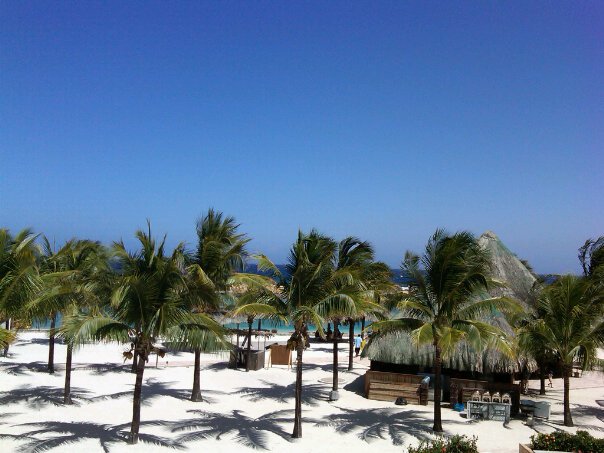
Future Free City?
I thought the conference came off quite well, despite the inaccessibility of the island of Roatan. Once you get there, you can relax in the beauty of the place. The island has its charms. I even discovered a new tropical drink. It’s called the Monkey La La. (Come on, it’s fun to say.)
Upon returning to the U.S., the customs officials at San Francisco Airport didn’t like the fact that I had just arrived from Honduras without any checked baggage. “Why were you in Honduras?”
Me: “I was attending a conference on the ins and outs of creating a free economic zone in Honduras.”
Customs: “????”
Me: “To alleviate poverty, to provide an end around to a whole host of corrupt institutions, the government of Honduras is in the process of creating a city that would have business friendly laws and regulations.”
Customs: “?????!!!!????”
Me: shrug.
Customs: “Mr. Gibson, do you mind stepping over here and putting your bags on the table…”
Thanks to the internet, you don’t have to deal with such nonsense. The wonderful folk at the Universidad Francisco Marroquin video taped most the talks at the conference. Michael Strong kicked things off with “Marketing Free Cities as a Mainstream Solution to Global Poverty.” Here’s Kevin Lyons talk on underthrowing the state one contract at a time. (I’ll come back to the concept of “underthrowing” in a future post.) Here’s Patri’s take on competitive governance and seasteading. And here’s Jason Sorens on “Secession as a Continuum.”
Jason has given what I think is a fair assessment of the conference, but I think he should have had more Monkey La Las.
Seasteading at APEE
Patri will be chairing a session on “Seasteading and other government competition” at the Association of Private Enterprise Education (APEE) conference in Nassau, The Bahamas.
Here are the papers we’ll be presenting:
- Seasteading and Institutional Evolution, by Patri Friedman and Brad Taylor.
- Barriers to Entry and Institutional Evolution, by Patri Friedman and Brad Taylor.
Arnold Kling will also be presenting a paper on his idea of unbundling government. The session is on Tuesday April 12 at 1:35; we hope to see some LaTNB readers there!
Fernando de Noronha, Portrait of an Island
 This post on the life, culture and economy of a Brazilian archipelago comes from Thousand Nations reader Anthony Ling.
Having visited the island of Fernando de Noronha and noticing how similar isolated island is to an actual Seasted, I came up with this article focusing on how the resident community deals with their problems and basically what’s their lifestyle in the middle of the Atlantic, at about 300km from Brazil’s coastline.
Population: Housing around 3000 residents, the island receives around 200 visitors daily. Maximum number of visitors in the island at the same time is around 400. The limitation is mostly due to the environmental restrictions existing in the island. Its density very low close to Brazilian cities: only 154/km2, in 18km2 of land.
Housing: Living costs are unusually high in the island, though government bureaucracy is mostly to blame. As building and land ownership is restricted to island residents, a huge number of fees have to be payed and people have to wait in lines to get permits, even for small refurbishments. As expected, a lot of unregulated building takes place. Some resident families end up having up to 10 people living in the same house to avoid building bureaucracy. Building materials have to come from the mainland, and residents claim the transportation costs are almost equivalent to the cost of building an entire house in continental Pernambuco, the state which Fernando de Noronha is officially part of. These regulations incentivize residents to invest as much as possible outside the island and not in their own businesses, as they do not own their property.
Lodging is also expensive. The cheapest place to stay are in small rooms built by residents to make some extra money, starting from around R$350,00/U$200,00/room/night and the most expensive hotels charge from R$800,00-1500,00/U$450-900/room/night.
Food: Practically everything comes from the mainland, so food and water is expensive, though not abusive. A cheap meal (grilled fish under an old wooden tent) is around R$30,00/U$18,00/person, and the best meal in the island costs around R$100,00/U$60,00/person. A half-liter bottle of water in the city market costs around R$3,00/U$1,80, and in the hotels they are almost triple the price. As the territory is practically entirely a national park with severe environmental restrictions, agriculture and manufacturing activities are forbidden. Some websites claim there is a permission to grow sheep, though I did not see this happening during the trip. Fishing is also forbidden, as everything is part of the natural protected environment, though some residents do it anyway.
Infrastructure: Roads are terrible, mostly due to the harsh environmental restrictions that are imposed in the island, as administration claims roads “waterproof the soil and damage the environment”. There is one main paved road which crosses the island, all of the rest are unpaved (soil and rocks). The airport is basically a landing strip with a minimal terminal, attending around 3 flights a day from 2 different Brazilian airlines. Flights respond to around 75% of the island visitors, the rest arriving by sea. Some transportation is done by the coastline, though the lack of docking stations (currently there is only 1 fully operating port) makes it hard: boats cannot dock on the beaches as they are also protected.
Economy: Everything is ecotourism-driven. The beaches and natural beauties attract tourists from all over the world. There are some historical sites which are protected by local and federal government, but they don’t attract as near as many tourists as surfing and diving do. Some scientific research is done by government institutions, mainly studying local wildlife, but it probably costs more money than it makes. Workers come from all over Brazil, usually young people looking for new life-changing experiences. It’s common to hear people saying they expected to stay for only 2 or 3 months but are now living there for the last two years.
Besides regular Brazilian taxes, all visitors are charged a Environmental Protection Fee (the “TPA”), today at R$40,40/U$25,00/visitor/day on the island. The state of Pernambuco spends R$14,6 million/U$8.50 million/year on the island, mostly paying for public worker’s salaries and public education and health costs. The rest (around R$13 million/U$8 million) comes from the TPA and tourism revenues. GDP per capita ends up being very low, around R$10000/U$6000/year, which corresponds to about half the Brazilian average.
Energy: The island’s main energy source is a diesel fuel plant, even though the entire island is a protected environment. They had a wind turbine that attended 6% of the island’s demand, though it was recently shut down.
Trash: Around 10t of trash is produced during high season and it all goes to the mainland by ship. The same ships that bring building materials and other non-food materials come around one every 15 days to pick up the trash on their way back to the continent. The maximum amount of trash that can be transported by this ship from the island to the mainland is 90t in 20 days. The island is currently facing problems with trash accumulation due to some delays with the ship.
Transportation: Gasoline buggys are used to go from one place to another. Owning a buggy has similar restrictions as owning land: you have to be a resident (their number is also limited) and there are several taxes one should pay and lines one should enter, turning buggys around 3 times more expensive than the ones sold in the mainland. There is one gas station in the island operated by Petrobras, Brazil’s “mixed capital” state-contolled oil company, selling the country’s most expensive gasoline: R$3,78/U$2,15/liter. There is also a very small bus line operated privately with a public concession. It’s fare price is around R$3,50/U$2,00, just a bit over the fare payed in large Brazilian cities.
Leisure: For residents, leisure options are minimal. As the island is very small and tourism oriented, most residents aren’t enjoyed by the beaches and natural beauties. Many of them even get sick of it, as the landscapes and daily routines are always the same (think of taking the same Disney ride over and over again everyday). Tourist attractions are mostly environmental ones, and limited to the islands’ size: trekking, snorkeling, horseback riding and boat rides, with the most significant ones being surfing and diving, known to be the country’s best spot for both. There are no cinemas, theatres or other cultural options.
Education: There is small a public school attending the children in the island, with pretty good infrastructure for Brazilian standards but with bad ratings from the Brazilian national public school rating system (IDEB).
Health: There is a public hospital in the island. It is said treatment is good for small heath issues, though for more severe treatment patients have to be transported to hospitals in Recife, the capital of Pernambuco. Local administrators also appear to have a policy against births in the island: they don’t have professionals to take care of pregnant women, forcing them to go to the mainland to give birth. Some say it is due to lack of qualified people wanting to work in the island, but probably the main reason (and known by islanders) is because people who are born in the island are citizens, who then have land property rights.
Money: There is only one Santander bank agency operating in the island. The public Caixa Econômica bank only has an ATM, and Banco do Brasil isn’t available (proving private banks can attend very small communities in distant places).
Security: The Military Police (commonly known in Brazilian cities for street patrol) has 24 officers working the daily routines. Residents say it’s the safest place to live in, and people even leave their keys inside their buggys (very unusual in Brazilian cities).
Defense: The Brazilian Air Force has a small base on the island, though it works mainly with the transportation of Brazilian authorities and politicians. The Marines have a more significant job, with a troop and ships defending the island. The Brazilian Military does constant monitoring on the island as it is considered a strategical base: it is considered an essential position to defend the “Pré-Sal”, the deep ocean oil reserves recently found close to the Brazilian coastline.
Overall: Overregulation in many environmental issues and contradictory social and environmental policies leave island residents in a bad situation, as I wrote about on my personal blog. As I see it, Seasteading comes out as a winner in practically all categories analyzed, not facing Fernando de Noronha’s worst problems: the strict environmental regulation, the lack of leisure options and the notoriously bad Brazilian public sector education and health services. Food, trash and energy (which I thought could be a tough job) seem to be pretty much taken care of. The hardest problem would be defense, though maybe not seasteading close to oil reserves or other valuable natural resources could make things much easier.
Competitive Government World
I suspect that one of the secrets to doing something big is not to attempt to move the levers of history by yourself. Instead, jump onto an existing trend, where powerful historical forces are pushing somewhat in the direction you want, and help shape them. This is the case for competitive government, where the coming bankruptcy (literally) of 20th century government, the trends towards more experimentation (try lots, fail fast for tech startups, self-experimentation on health & happiness for individuals), the commoditization of sovereignty, and our increasingly mobile & interconnected world, each help push the government industry towards being more competitive.
For example, at last week’s Economist event “The Ideas Economy: Innovation for a Disruptive World”, I spoke about seasteading to an audience of entrepreneurs, non-profit leaders, government representatives, and academics all interested in innovation. Afterwards, by a show of hands, the audience voted about two to one in favor of “That sounds cool, we should try it”, over “This guy is just crazy.” The previous day, Intuit CEO Scott Cook spoke about the importance of experimenting inside Intuit, and touched on some very competitive-government like themes, contrasting the old style of management where “the boss votes with his opinion” to the new style of running experiments where “customers vote with their feet”. He also characterized these as ideas winning by “politics & powerpoint” vs. “enabling ideas to prove themselves”.
But he didn’t stop there – at his presentation’s close, he described the Special Economic Zone of Shenzhen as China running an experiment, just like a company would – and learning that capitalism works. If only there was a way to create many such experiments around the world…or as I said in my talk, to have the galvanizing competitive effect of a “Sputnik Moment” happen every day, instead of once a generation.
And this week’s issue of The Economist, the one-page article Taming Leviathan says:
In the 1990s much was made of the idea that capitalism had got so footloose that states were bound to get slimmer to compete for corporate favours. In fact companies proved more loyal than expected – and the state went on one last splurge. But talent and capital are getting more mobile; and the demographic pressure of those ageing populations is mounting. The ever larger state cannot go on for ever. It will stop.
And finally, this weekend was the first Agora I/O Agorist UnConference, a cool idea to have a virtual conference where all talks are by videoconference. Lowers the barrier to entry to participating for sure. Below is my talk, based on my Mises Brazil Structural Libertarianism talk from last year, with some additional thoughts on frontierism vs. agorism.
The Moral Case for Innovation in Governance: Corrupt Institutions and the Arab Revolts
by guest blogger

Memorial for Mohamed Bouazizi
Mohamed Bouazizi’s father died when he was a child: so he became a fruit and vegetable vendor in rural Tunisia to provide for his family and send his siblings to school.
But Tunisian government officials, unmoved by Bouazizi’s plight, harassed the vendor for years. They fined him for selling fruit without a permit, sometimes several months’ worth of earnings. When he could not pay (or bribe) officials, they confiscated his scales and produce. This constant drain on Bouazizi’s meager savings, his mother recalls, stood in the way of his goal of purchasing a pick-up truck, so he no longer had to pull his vendor’s cart several miles each day. But Bouazizi would never reach this goal.
On December 17th, he was again harassed, had his scales and fruit confiscated, and was beaten and spat upon by local officials for resisting. He went to a municipal office to petition, but was turned away. Bouazizi then doused himself with two cans of paint thinner and committed suicide by self-immolation in the street. He was only twenty-six. His death served as a watchword to Tunisians and then the Middle-East at large, setting off the revolts that continue today.
Bouazizi’s tragic story is a reminder to all of those who advocate for the Cambrian Explosion in government that the phrase “Institutions matter” has a human face. To fight for innovation in rules and competitive governance is also to hoist a banner for those like Bouazizi. He and millions like him, quiet and determined, labor in all corners of the world – struggling to reach their full potential because of stultifying rules and government predation.
Institutional barriers to entrepreneurship are also emotional barriers to the feelings of dignity and accomplishment that come with realizing one’s goals. Bouazizi’s suicide was not intentionally a political protest; it was the final, desperate act of a crushed human spirit. His needless death is evidence that movements like Seasteading or Free Cities not only have the testimony of history and economics on their side, but also sit on the moral high ground by fighting for those, like Bouazizi, who need it most.


 Let A Thousand Nations Bloom