Sunday Link Archipelago
Enjoy!
- Some Economics of Advocacy and Government Competition – Second Prize in the Student Division of the 2010 Templeton Essay Contest, for an essay which “argues that argumentation to promote policies which reduce government waste is futile as a conduit for actual change…This essay will discuss the failure of advocacy, but also how waste might yet be minimized by competition between governments, achieved by decentralization. Since such a process also depends on citizen preferences, it seems a distant prospect. However, advances in technology may enable man to reach new frontiers whose governments can compete with extant ones.”
- Saving government failure theory from itself: recasting political economy from an Austrian perspective by Peter J. Boettke, Christopher J. Coyne, Peter T. Leeson. 2007 paper where “We develop an alternative model of political economy grounded in the Austrian conception of the dynamic market process…Political actors are structurally ignorant of the knowledge of comparative costs and the relative prices thatwould guide the production and provision of public goods and services in an economically efficient direction.”
- Paul Romer is making his TED presentation available en Español. Seems to add some credence to the Honduran legislation which just passed, potentially enabling charter cities. If only there was a conference about free cities coming up in Honduras…
The Tools of Regulatory Capture
Obama to Press Centrist Agenda in His Address
You may actually wade into the miasma of this article, but the last thing the article is about is a centrist things-to-do-list. The article is really about who decides what being a centrist is. For the content of the SOTU speech is irrelevant. The Times, sensing which way the wind blows the median voter, will label any speech O gives as centrist at this point. Whatever tower of bureaucratic Babel the speechwriters of O erect and dance around, the Times will send out the centrist PR. Likewise, consider this gem:
Obama Sends Pro-Business Signal With Adviser Choice
Oh, what’s this story of O about? The Times will tell you:
SCHENECTADY, N.Y. — President Obama, sending another strong signal that he intends to make the White House more business-friendly, named a high-profile corporate executive on Friday as his chief outside economic adviser, continuing his efforts to show more focus on job creation and reclaim the political center.
Here in the birthplace of General Electric, Mr. Obama introduced the new appointee, Jeffrey R. Immelt, the company’s chairman and chief executive officer, who will serve as chairman of his outside panel of economic advisers.
So by “pro-business” did you mean “creating greater power for GE’s preferred regulatory regime”? Or maybe by “pro-business” you meant “creating opportunities for GE to obtain subsidies on high speed rail and wind farm construction”. Or maybe you meant Immelt will join forces with O to erect as many barriers to entry as GE can against its incipient rivals. Again, if you have to tell us that O sent a strong signal, then he didn’t send a signal. That’s why you’re trying to convince us what the signal is.
Immelt is really the reverse Orzag. We should expect more of this crony capitalism flowing both ways. (“Crapitalism” as someone put it.)
On that note, I found this delicious morsel buried in the newest Economist:
In the most corrupt countries the rulers simply help themselves to public money. In mature democracies power is abused in more subtle ways. In Japan, for example, retiring bureaucrats often take lucrative jobs at firms they used to regulate, a practice known as amakudari (literally “descent from heaven”). The Kyodo news agency reported last year that all 43 past and present heads of six non-profit organisations funded by government-run lottery revenues secured their jobs this way.
In America, too, ex-politicians often walk into cushy directorships when they retire. This may be because they are talented, driven individuals. But a study by Amy Hillman of Arizona State University finds that American firms in heavily regulated industries such as telecoms, drugs or gambling hire more ex-politicians as directors than firms in lightly regulated ones.
Things that used to make Mancur Olson go hmmmmmmm.

Honduras: ¿Otro enclave u otra utopía?
In case you haven’t seen it elsewhere, Paul Romer’s Charter City idea seems to be gaining some traction in Honduras. There are a few news items in spanish ( for starters, here and here) on President Porfirio Lobo announcing that 1000 square kilometers currently “doing nothing” could become a “Honduran Dream.” Aidwatch also comments.
Two Exciting April Events for Competitive Governance!
If you have the freedom to travel (or are lucky enough to have a university that might pay for it), there are two exciting gatherings coming up in April! The Free Cities Conference & APEE will be great opportunities to discuss competitive governance in a beautiful tropical setting with smart, like-minded friends – and friends not yet met. Hope to see some of you there!
 The Future of Free Cities Conference will be April 3 – 4 on the lovely island of Roátan, Honduras. Co-sponsored by the Universidad Francisco Marroquin and The Seasteading Institute, this inaugural conference will gather those interested in free cities of all types – seasteads, charter cities, free zones, and other ways to increase competition in governance.
I will likely be presenting twice, on the general theory of competitive governance (as outlined in Brad Taylor & my working paper), and on seasteading as an implementation method. LATNB co-blogger Michael Strong will be presenting, as well as TSI Argonaut Fred Kofman, and visionary entrepreneur Peter Thiel may be coming as well.
 The Association of Private Enterprise Education will be having their 2011 Conference April 10-12 in Nassau, The Bahamas. The theme is “Institutional Evolution Toward Freedom and Prosperity” which is just what we are interested in!
So there will be a full competitive governance panel, with Brad Taylor presenting a paper on competitive governance, me presenting on seasteading as a way to implement competitive governance, Arnold Kling presenting on virtual governance (the themes of Unchecked and Unbalanced), and either LATNB co-blogger Michael Strong or Kevin Lyons presenting their work on embedding private law into current legal systems.
I find it incredibly exciting to see the rapid growth of this nascent field of meta/applied public choice, which has such enormous potential to unlock innovation in governance, to the massive benefit of all. Panels, conferences, papers – it’s expanding like crazy, and I’d love you to join us!
When You Vote With Your Feet in the U.S.
Surprise, surprise, surprise….You move to States with no income tax, like Texas. Michael Barone at AEI sifts through the census data:
Texas’ diversified economy, business-friendly regulations and low taxes have attracted not only immigrants but substantial inflow from the other 49 states. As a result, the 2010 reapportionment gives Texas four additional House seats. In contrast, California gets no new House seats, for the first time since it was admitted to the Union in 1850.
There’s a similar lesson in the fact that Florida gains two seats in the reapportionment and New York loses two.
This leads to a second point, which is that growth tends to be stronger where taxes are lower. Seven of the nine states that do not levy an income tax grew faster than the national average. The other two, South Dakota and New Hampshire, had the fastest growth in their regions, the Midwest and New England.
Altogether, 35 percent of the nation’s total population growth occurred in these nine non-taxing states, which accounted for just 19 percent of total population at the beginning of the decade.
Santarcho-Capitalism
 Just in case you missed it last year, I point you to my short post explaining how the spirit of Santa Claus is all about free trade and seasteading. Happy holidays kids.
Pragmatism and Technological Activism
Women on Waves is a Dutch Pro-Choice organization which sails to countries with illegal abortion and takes local women into international waters to provide non-surgical abortions. This is a special-purpose form of seasteading – using the freedom of international waters to give people what they want.
Apparently, WoW also runs into the same problems of credibility among those committed to more conventional forms of activism:
In several years of quiet fund-raising for Women on Waves, including a three-week visit to the United States last year, [WoW founder Rebecca] Gomperts met with mixed results. Among American abortion rights leaders, many of whom practice a policy-oriented form of activism, she received a round of cautious endorsement but little in the way of financial help. ”I think some people probably thought she was crazy,” says Julie Kay, an American lawyer specializing in reproductive rights who met with Gomperts in Dublin last December. ”I know when I first heard about her, I thought: Abortions at sea? Who is this woman? Is she some sort of cowboy doctor?”
And here’s Gomperts herself:
It is difficult to find a steady stream of donors given the radicalism of WOW. Offering women the abortion pill in countries where the procedure is illegal, from a ship under Dutch flag, anchored in international waters, taking advantage of a legal loophole, is more confrontational than a traditional pro-choice poster campaign. But the effectiveness of one of our campaigns is much greater than a traditional advocacy campaign. When we embark on a campaign, the awareness created through the press and protests around illegal abortions makes a huge impact on the issue.
So, just as we have beltway libertarians committed to easy but ineffective forms of policy activism treating unorthodox but promising forms of activism as crazy, we have beltway feminists committed to easy but ineffective forms of policy activism treating unorthodox but promising forms of activism as crazy.
It’s good to know we’re not alone, I guess.
Fun with NGrams
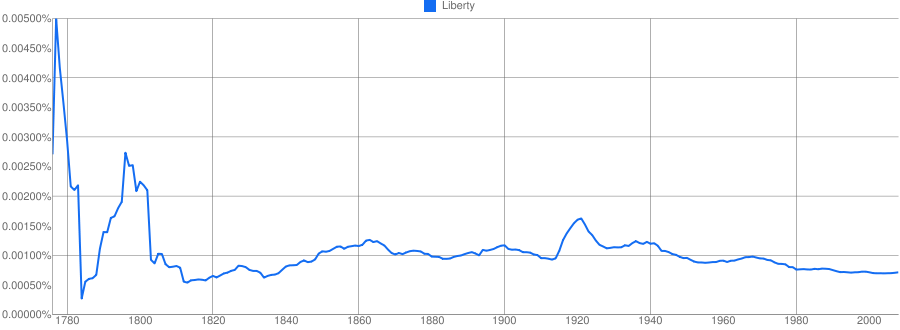
Here is the use of liberty from 1776 to the present:
On the other hand, here’s technology and innovation:
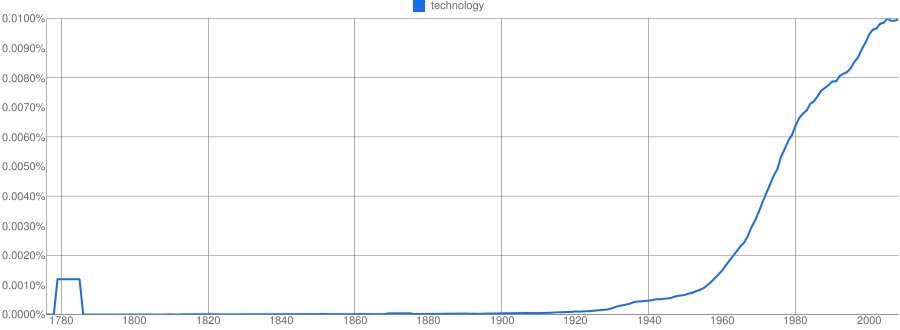
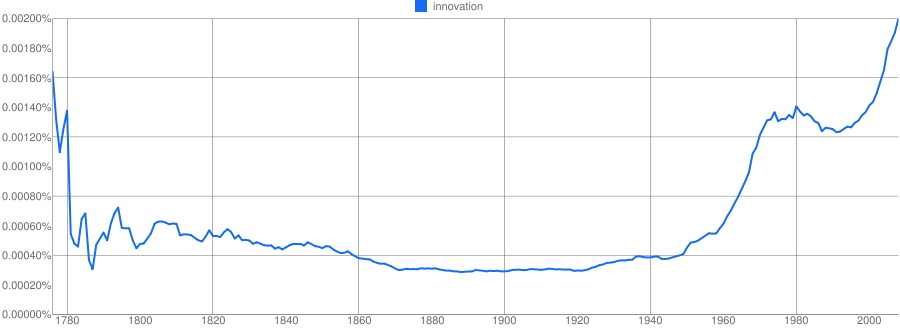
It’s only in the last 70 years or so that thinking about better ways of doing things has bloomed into a rosy weltanschauung of optimism. Of course, people have been thinking about better ways to govern for millennia. Still here’s a general thought about the personality of competitive government–what I wonder is how effectively we can map this techno-intellectual atmosphere onto thinking about institutions, rules sets and competition, without slipping into the completely technocratic on the one side or the so-called progressive on the other. It appears a very good old social technology–liberty–has been slipping in cultural importance. But one correlation on these graphs stands out. Why do technology and innovation and liberty all have a simultaneous bump around 1780?
Saudis to Build Economic Zone

How do you say Tron in Arabic?
From the NYTimes:
Just off a desert road about an hour’s drive from this port city, an enormous arched gate capped by three domes rises out of the sand like the set for a 1920s silent film fantasy. It is, instead, a fantasy of contemporary urban planning, the site of what one day will be King Abdullah Economic City, a 65-square-mile development at the edge of the Red Sea. With a projected population of two million, the city is a Middle Eastern version of the “special economic zones” that have flourished in places like China…
To encourage more foreign companies and their employees to come here, the government will allow foreign ownership for the first time. And officials say the city will have a streamlined bureaucracy, so that unlike in other Saudi cities, where delays can make even the simplest transactions stretch out for days, action on visas or customs documents will take just an hour.
Credibility of commitment–how serious will foreigners take the King’s promise to tie the government’s hands behind its back? We shall see if the King is as convincing as Sheikh Khalifa bin Zayed Al Nahyan.


 Let A Thousand Nations Bloom