Play Penn for Law Market
On a tip from Peter Boettke I’ve been thumbing through Jonathan Hughes’ The Vital Few, a history of entrepreneurial activity in America. He focuses not just on obvious inventors like Thomas Edison or on expert managers like Andrew Carnegie, but he also writes about the lives of institutional entrepreneurs who proposed innovative rule sets to order economic and social activity in a new ways. The one worth reading about is William Penn, architect of the first constitution to establish religious freedom. His foray into governance is a remarkable story that speaks to the power of rule innovation. (And before you raise your own status by saying, “Yeah, but Penn mistreated natives,” think again and dig into history because it turns out he was denigrated by his contemporaries for treating New Worlders as equals. He was a pacifist Quaker. I’m not saying he was perfect, but…)
Penn first proposed religious freedom in Pennsylvania in 1682:
That all persons living in this province, who confess and acknowledge the one Almighty and eternal God, to be the Creator, Upholder and Ruler of the world; and that hold themselves obliged in conscience to live peaceably and justly in civil society, shall in no ways, be molested or prejudiced, for their religious persuasion, or practice, in matters of faith and worship, nor shall they be compelled at any time, to frequent or maintain any religious worship, place or ministry whatever.
Of this rule innovation, Hughes remarks:
These laws were written by an Englishman, ascribed to by Englishmen, at a time when the English King was ruling without Parliament, when England was still trembling from the terrors of the Popish Plot, when religious prosecution was raging, the prisons filled and when, in the fight between the Tories and the Whigs, religious nonconformism was again to be linked by association with treason…
Life was harsh in the new world colony, but for the persecuted, it was worse in the homeland. But, thanks to Penn, the times were a changin’. The costs of opting out of religious totalitarianism were decreasing. And the benefits of opting into a rule set that offered freedom were on the rise. Hughes again:
After years of indifferent success in their colonization schemes, the Stuarts had granted a charter which would not only soon attract thousands from Britain and Europe, but would absorb settlers from other colonies as well. Virginia and New York during the late 1680s were losing young men of military age to Pennsylvania; army garrisons were threatened by desertions to the Quaker settlements, and Maryland’s border had to be patrolled to intercept deserters from the British fleet. Moreover, Pennsylvania attracted men of wealth as well as those of poverty. Her institutions were free, her land rich, and the new colony was soon a success in the New World.
Through competitive governance Penn established a beachhead for freedom of the mind. Its success later spread around the world. Innovative rule proposal led to widespread adoption of a newly found best practice. This is the innovation we’re lacking in our supposed age of accelerating technological change. Penn was an entrepreneur in a law market and he proposed a rule set his contemporaries thought ridiculous. What’s incredible is that he accomplished this stroke of genius in an age of burn your eyes out and then light your body on fire extreme intolerance. Even members of the Objectivist fan club aren’t treated so poorly nowadays. I would say his closest modern equivalent would be John James Cowperthwaite.

The Brewery of the Future: a Shipstead
Via the Guardian, (HT Sconzey) the beer brewer SABMiller foresees new ways to draw a pint:
“The descriptions are intended as food for thought rather than as blueprints for building new facilities. However, the example of the brewery on a ship is entirely feasible. It would allow for rapid entry to new markets, especially where no infrastructure is in place. It would also provide flexibility in positioning and length of stay and allow SABMiller to move with water sources, with people, with crops, or even away from severe weather, natural disasters or political instability.”
As Frank Zappa said, “You can’t have a real country unless you have a beer and an airline – it helps if you have some kind of a football team, or some nuclear weapons, but at the very least you need a beer.”
News from 1988: Developer Proposes Artificial Island

I Too Loathe Centrist Technocrats
Interfluidity writes:
There is something poignant, but also a little blind, in the fact that DeLong’s agitation was aroused by Robert Rubin, who, when elevated to speak ex cathedra from the pages of the Financial Times, had nothing worthwhile to say. To DeLong, Robert Rubin remains a pontiff of the “bipartisan technocrats”. To the rest of us, Rubin has become an icon of self-delusion, corruption, and arrogance…
The moral foundation of the old technocracy — that monetary and financial dynamics would be managed, but in a manner both stable and fair — has been discredited. Gold may have its flaws as a putative currency. But at least it doesn’t conspire to steal pennies from paupers in order to pay off well-situated cronies. As existing monetary authorities most certainly have done, on multiple occasions.
That’s as eloquent a statement of Olsonian public choice applied to monetary theory as I’ve ever heard. Hat tip Arnold, who also waxes eloquently against centrist technocrats.
Governing Seasteads
The Seasteading Institute has just published my paper on governance mechanisms for seasteads. As I point out in the paper, trying to predict what will work ahead of time is not what letting a thousand nations bloom is all about. We do, however, need to start from somewhere and the experience of customary law, private communities, and corporate governance have a lot to teach us. From the conclusion:
Perhaps the single most important point we should take from these case studies, though, is that humans will find ways of solving their problems when low-cost experimentation is possible. In some sense, governance is a hard problem: we simply cannot foresee all the problems ahead of time and devise a good system of rules. In another sense, though, the problem is easy. We know from history that institutional evolution works on land, and there do not seem to be any barriers to it working on the ocean. Of course, this institutional evolution will require careful thinking: it is through conscious effort that good ideas are developed. The magic of ex-post selection only happens ex-post, and a healthy dose of ex-ante common sense and historical knowledge will go a long way in ensuring that early seasteads do not fail due to poor governance.
The paper was a lot of fun to write. It was great getting extensive feedback along the way from some very smart and distinguished people and putting some of the ideas we discuss here at LaTNB in a form which will hopefully prove useful to future marine real estate developers.
Public Choice Ignorance Everywhere
Since learning about public choice economics, I have been constantly shocked by how little it has been internalized by economists. For example, the phenomenon of Donald Boudreaux, Director of the Center for Public Choice, spending his time on the activism strategy of writing letters to the editor when I would describe Public Choice as “the study of how writing letters to the editor doesn’t accomplish anything.” Imagine the Director of the Center for Einsteinian Physics calculating spaceship trajectories using Newtonian mechanics in all of his consulting work, and getting the answers wrong every time because he fails to take relativity into account, and you’ll understand my bewilderment. Public Choice provides awfully compelling reasons to Change Incentives, Not Minds, yet in the end it appears that the teacher’s urge to teach and to have teaching be the answer is so strong as to overwhelm mere economics.
More recently, Megan McArdle gave a shining example of public choice ignorance with a very sensible, reasonable piece about why we should abolish the corporate income tax. The piece concludes:
Want to get corporate money out of politics? Want to erode the power of the Chamber of Commerce? Take away one of their primary motives to get involved.
I don’t say this will persuade everyone. But I hope that liberals will at least consider that there might be a better way than the corporate income tax to achieve their goals.
Pointing out a more efficient policy is classic Folk Activism – it assumes that we don’t have efficient policies because no clever economist has yet designed them or eloquently described their advantages. That might have been a reasonable argument 100 years ago, but we’re in the post-Mancur Olson world: we have a whole school of economics explaining how democracy is systematically biased towards policies that transfer from dispersed interests to concentrated ones.
And what is McArdle doing? She’s complaining about a policy that does exactly what we expect democratic policies to do, and advocating for a different policy that would be against the goals of special interests (“Want to get corporate money out of politics?”) and better for society as a whole. As I said in a Students For Liberty talk this past weekend, for all the good this approach does, McArdle might as well have called a press conference and farted into the microphone.
My metaphor is deliberately provocative because I find this pattern so appalling, and it seems absurd that economists so often ignore these basic results in their own field. It moves me to shout: We do not live in a world that mainly suffers bad policies due to lack of ideas about better ones, or lack of elegant explanations supporting good policies, but one that suffers bad policies due to system and meta-system level incentives. In the real world, if you want to have any chance at any effect on changing bad policies, you must take this into account, frustrating and difficult though it is. Vaguely assuming that the problem is not enough eloquent blog posts or op eds is like finance professors actively investing in individual stocks (ignoring both efficient markets & diversification), or nutrition experts living on Twinkies – experts behaving directly contrary to the most basic results in their own fields.
Of course, finance professors do invest in individual stocks, and nutrition experts sometimes eat twinkies – investing and eating both invoke strong biases that make it hard to follow the best strategy. And the same is true for economists – I call it Folk Activism, after all, because it is so deeply intuitive – it’s not going to go away anytime soon. But let’s at least point it out whenever it happens, make the cognitive dissonance explicit, and call out the economist equivalents of Twinkie-snarfing nutritionists. Sound like a plan?
P.S. One challenge to this idea might be that it is itself a form of Folk Activism. A response is that shame will work on economists much better than politicians, especially if it comes from respected peers. After all, economists (and bloggers) care what other economists (and bloggers) think much more than politicians care what economists think. Still, holding the mirror of public choice up to economists might be too ineffective to be worthwhile, and the best strategy might be simply to ignore the misguided multitude.
Pirate Radio as Freedom Hack
The WSJ reviews a new history of the British pirate radio movement of the 1960s:
At the center of the tale stands Oliver Smedley, a conservative political activist and entrepreneur determined to stop what he saw as Britain’s slide toward socialism. After dabbling in politics and journalism in the 1950s, he launched a network of think tanks and political organizations that pressed his call to cut taxes, slash public spending, eliminate tariffs and reduce government’s role in economic life. When in 1964 two like-minded acquaintances pitched him on the idea of launching a pirate-radio ship, Smedley seized on the project as a chance to trade talk for action by taking on statism’s pride and joy, the BBC.
The BBC is a nonprofit “state corporation” funded primarily by an annual license fee (currently about $200) charged to every television owner. At its founding in 1922, the BBC was designated as the sole provider of radio programming in the United Kingdom. Unofficially, the Beeb was expected to reinforce a traditional view of British culture and life. The programming was a highbrow blend of mostly classical music and lectures. Commercials were forbidden for their alleged coarsening effect. Critics of laissez-faire capitalism, including John Maynard Keynes, cited the BBC’s “success” in delivering a vital service to the masses as proof that public corporations were the answer to the free market’s problems.
Oliver Smedley was eager to demonstrate otherwise. His Radio Atlanta would show the benefits of giving people what they desired instead of what central planners thought they should get. The station would sell commercials not only to make a profit but also to deliver knowledge that is essential to the efficient operation of a market economy. Smedley raised capital, created the convoluted corporate structure necessary to skirt British law, set up an advertising sales operation, bought a ship, fitted it with the necessary broadcast gear and sent it to sea—where it immediately began leaking money.
Looks interesting. The Richard Curtis movie wasn’t half bad. It had its moments. You can buy Death of a Pirate here.
Democracy’s Disadvantage: Candidates Over Issues
Richard Epstein writes:
Candidates represent what might be called tied purchases of a market basket of goods. The only choices that are given to hapless voters is to pick one such basket over another. Anyone who offers the menu at a Chinese restaurant gets to choose one from column A and one from column B. Yet that form of flexibility is denied in choosing people for political office. It is not because of any inherent defect in the political system. It is simply because the person is the smallest unit for which it is possible to cast a vote for holding public office. The only comfort that one takes is that no voter is required to vote for the entire slate of candidates from either party, but can pick and choose among them.
Nonetheless the maximal level of individual choice puts those of us who care primarily about issues in an odd position. I like to look at my purchases one at a time. As a classical liberal, I find that there are few candidates for public office whose preferences track mine on the many issues about which I have strong views. Worse there are many candidates whose policies I largely support, but whose personal temperament and mettle are, to say the least suspect.
By increasing our ability to vote with our feet, we can find a basket of goverment provided goods that more closely align with our tastes and values. (See Charles Tiebout’s seminal model.) The Chinese menu is an apt metaphor. But we can widen it further. In our current political circumstances, we can’t even choose the restaurant, much less the menu. Bon appetito.
Today’s Election
Ummmm, can I just add something?
The Donk and Red Elephant can play Kabuki all they like, negotiating stalemates over an irrelevant policy margin. But this is like taking an active interest in who should be the master chef in the kitchen on the Titanic. The ship’s going down whether you want the duck or the fricassee.
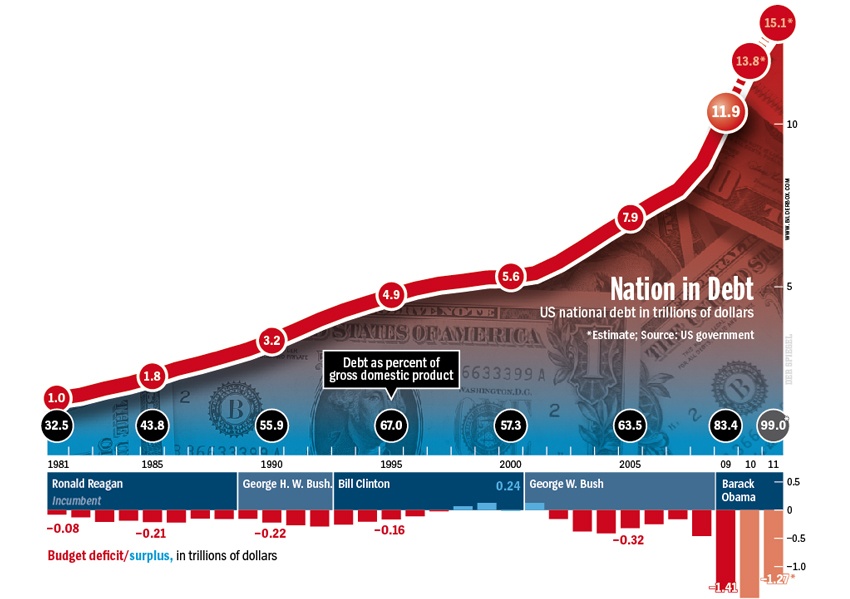
Der Spiegel, “A Superpower in Decline”
What Do the Rolling Stones Have in Common With Google?
The Stones are famously tax-averse. I broach the subject with Keith [Richards] in Camp X-Ray, as he calls his backstage lair. There is incense in the air and Ronnie Wood drifts in and out–it is, in other words, a perfect venue for such a discussion. “The whole business thing is predicated a lot on the tax laws,” says Keith, Marlboro in one hand, vodka and juice in the other. “It’s why we rehearse in Canada and not in the U.S. A lot of our astute moves have been basically keeping up with tax laws, where to go, where not to put it. Whether to sit on it or not. We left England because we’d be paying 98 cents on the dollar. We left, and they lost out. No taxes at all. I don’t want to screw anybody out of anything, least of all the governments that I work with. We put 30% in holding until we sort it out.” No wonder Keith chooses to live not in London, or even New York City, but in Weston, Conn.
HT Mankiw


 Let A Thousand Nations Bloom