This post by Michael Strong is part of Secession Week 2010: Federalism and Secession
Arguably the simplist and most immediate path for “Letting a Thousand Nations Bloom” is to support tribal sovereignty movements around the world, especially in the Common Law nations of the Anglosphere like the U.S. Other colonialist European nations unapologetically battled and conquered indigenous peoples, but coming from a revered tradition of rule of law and the Lockean principle of “first possession,” many British colonists found the entire “conquest” project a bit morally awkward even several hundred years ago.
Thus in the U.S. and other Common Law nations, these armed or diplomatic confrontations ended in negotiated treaties with the native peoples that reserved land for their nations, within the boundaries of the federally governed territories. In the U.S. the sovereignty of the tribes as wholly separate from the federal government is noted often in the constitution. While the governments of these countries may have infringed and even ignored these treaties in many ways over the centuries, there has been continuous recognition of sovereign rights negotiated de jure and in the last fifty years a new de facto assertion and recognition has begun to bloom as regards the “sovereignty” of indigenous peoples (especially in the U.S., Australia, New Zealand, and Canada).
In the U.S., Chief Justice John Marshall laid out a series of opinions starting in the 1830s that affirmed the sovereignty of indigenous peoples. For instance, in Worcester v. Georgia, he wrote, “The Cherokee nation . . . is a distinct community, occupying its own territory, with boundaries accurately described, in which the laws of Georgia can have no force.” To which, of course, President Andrew Jackson is said to have replied “John Marshall has made his decision; now let him enforce it!” Jackson’s subsequent policy of “Indian removal,” including his infamous support for removing the Cherokees from their homes and sovereign territory in “The Trail of Tears” makes his actions among the most shameful in U.S. history (Google offers “Andrew Jackson worst president” as among its autocompletes).
Arguments for continued and expanded Native American sovereignty are strong; Here is an excellent summary of the state of Native American sovereignty from Harvard’s Project on American Indian Development led by Joseph Kalt, who got his doctorate under Armen Alchian. Even more important than Marshall’s Supreme Court decisions is the fact that the U.S. government signed treaties with most of the Native American tribes as sovereign governments. As Kalt states:
The reality is that few tribes in the U.S. were conquered by military campaigns. Most, but not all, tribes entered treaties with the United States. This was particularly true of those that engaged in military combat with the U.S. The very act of treating is a nation-to-nation form of intergovernmental interaction, and the British-cum-Americans certainly saw such interaction as de recto and de jure more regularly than the Spanish or the Portuguese in the Americas. The resulting treaties did not and do not absorb the tribes into the United States; rather, the reverse is true. The treaties recognize and preserve tribal sovereignty: In return for giving up almost all the land in the U.S., the U.S. made promises to the tribes. It promised to respect their rights over reserved land, and to recognize that those lands would be governed by tribes, not by the state governments. Those tribes that did not sign treaties were similarly protected by the doctrine that inherent sovereignty is to be respected by the United States.
In addition, Kalt’s research shows unambiguously the connection between economic prosperity and sovereignty for Native Americans:
If we look back on the history of federal Indian policy in the Twentieth Century, it is not a coincidence that it has only been in the era of self-determination that a significant number of reservations have begun to break the cycle of poverty and dependence. Sovereignty is one of the primary development resources tribes can have, and the reinforcement of tribal sovereignty under self-determination should be the central thrust of public policy. One of the quickest ways to bring development to a halt and prolong the impoverished conditions of reservations would be to further undermine the sovereignty of Indian tribes. We are aware that this is a very “pro-Indian” conclusion. But I must stress that it is a conclusion based on the evidence from case after case. There are no successful cases where federal planning and management has produced sustained economic development in Indian Country. The only thing that is working is self-determination— i.e., de facto sovereignty.
Colonialism, socialism, and dependency never bring prosperity – nor do they bring pride and self-respect. Economic prosperity and self respect only come through self-determination – through de facto sovereignty.
Since the 1970s, there has been a global movement to acknowledge increasing degrees of sovereignty for indigenous peoples around the world. In the U.S., the rise of gambling is the most high profile outcome of this movement, but in many ways the U.S. tribes are in the infancy of regaining and exercising their sovereignty. There are, of course, political forces that would like to keep them subjected to U.S. government power. That said, there is also a global indigenous rights movement that has, among other things, justice on its side and language in various U.N. documents that supports growth in their right to self-determination. It would appear timely and honorable to continue the movement toward proper recognition of American Indian sovereignty in a deep way on the territories that they govern. Again, from a paper co-authored by Kalt,
The Indian nations of the United States face a rare opportunity. This is not the occasional business opportunity of reservation legend, when some eager investor would arrive at tribal offices with a proposal “guaranteed” to produce millions of dollars for the tribe—although such investors still appear, promises in hand. Nor is it the niche economic opportunity of gaming, although that has transformed some tribes’ situations in important ways. This opportunity is a political and organizational one. It is a chance to rethink, restructure, reorganize—a chance not to start a business or exploit an economic niche but to substantially reshape the future. It is the opportunity for nationbuilding.
This opportunity has been unfolding during the last two decades. It is a product of changed relations between Indian nations and the federal government, relations with roots in the Indian politics of the 1960s and in the failure of a century of United States Indian policies that established the federal government as the primary decision maker in Indian country. Since the mid-1970s, partly in response to the demands of Indians themselves, federal policy has shifted toward something called “self-determination”: a belief, often more stated than acted upon, that Indian nations should determine their own futures.
This shift toward self-determination has allowed those nations that have been willing to do so to engage in genuine self-governance, to turn sovereignty as a legal matter into de facto sovereignty: sovereignty in fact and practice. They still face many constraints, not least the power of the courts and of the United States Congress, but since 1975 a significant number of Indian tribes have become the effective decision makers in their own affairs, often with strikingly positive results.”
Among the little known facts about U.S. native american tribes:
1. That they can, under certain circumstances in certain states, acquire new land and transfer their sovereign rights to the new territory.
2. Tribal membership criteria may be determined by the tribes themselves, and need not include any genetic criterion.
Thus, in principle, the Native Americans are in a strong legal position to create 560 nations within the U.S. borders.
Indeed, the tribes are already actively experimenting with diverse approaches to governance. The Navajos are combining traditional Navajo law with common law in interesting ways. For a fascinating analysis of the importance of forming a match between cultural norms and governance structures, see this paper, co-authored by Kalt, on Cultural Evolution and Constitutional Public Choice: Institutional Diversity and Economic Performance on American Indian Reservations.
Of course, the U.S. federal government is a powerful opponent that can do whatever it wants. But if we work together to create a strong moral and practical case for increasing Native American sovereignty, and if the tribes actively deploy their newly gained sovereignty in ways that are beneficial to all, there may be a realistic legal path towards more competitive government within the U.S. boundaries.
Given our belief here at “Let a Thousand Nations Bloom” in the importance of regulatory arbitrage as a means of improving the health and well-being of people (and governments) everywhere, perhaps the Native Americans will save the U.S. from demosclerosis by means of letting 560 Nations Bloom within the U.S. borders. This may be especially true if we combine the legal status of Native Americans with my Free Cities strategy. Perhaps we could see a Nozickian Utopia of Utopias led by the indigenous peoples of North America within our lifetimes.
If you were a leader of a Native American tribe, in what specific ways would you push for sovereignty? What business opportunities, beyond gaming, might there be for a business savvy tribe concerning the opportunities of regulatory arbitrage in an increasingly statist U.S.?
The Tenth Amendment was Bound to Fail
This post by Brad Taylor is part of Secession Week 2010: Federalism and Secession
Federalism can be seen as an attempt to get some of the benefits of large government while avoiding some of the costs: certain powers would be given to central government while others would be retained by states. The crucial question, though, is whether a robust federalism in which states retain significant independence is possible. I won’t attempt to answer that question here. Rather, I’ll suggest that the way the U.S. attempted to protect states’ rights, the Tenth Amendment, was bound to fail.
When America’s federal system of government was proposed, many predicted a slow centralization of power. Some of these people, referred to as “the anti-federalists,” produced rather prescient analyses of the dynamics of federal systems. Brutus (probably Robert Yates) made his views clear:
It is true this government is limited to certain objects, or to speak more properly, some small degree of power is still left to the states, but a little attention to the powers vested in the general government, will convince every candid man, that if it is capable of being executed, all that is reserved for the individual states must very soon be annihilated, except so far as they are barely necessary to the organization of the general government.
To placate the anti-federalists, the tenth amendment was added to the constitution. This explicitly stated that “the powers not delegated to the United States by the Constitution, nor prohibited by it to the States, are reserved to the States respectively, or to the people.” The problem with this protection, of course, was that the federal government had been given significant power in the form of an ability to tax and create rules binding upon all states. The tenth amendment is ultimately only words on paper. For it to be effective in protecting state autonomy, it had to be enforced. As the constitution shifted de facto power upwards to the federal level, the responsibility for enforcement followed. Militarily weak states cannot enforce their rights against a militarily strong federal government. To discover which powers are granted to which entities under the constitution, we can’t simply take the document at its word. Rather, we need to follow the money. The power to tax is of primary importance, as Brutus goes on to say:
The legislative power is competent to lay taxes, duties, imposts, and excises; — there is no limitation to this power, unless it be said that the clause which directs the use to which those taxes, and duties shall be applied, may be said to be a limitation: but this is no restriction of the power at all, for by this clause they are to be applied to pay the debts and provide for the common defence and general welfare of the United States; but the legislature have authority to contract debts at their discretion; they are the sole judges of what is necessary to provide for the common defence, and they only are to determine what is for the general welfare; this power therefore is neither more nor less, than a power to lay and collect taxes, imposts, and excises, at their pleasure; not only [is] the power to lay taxes unlimited, as to the amount they may require, but it is perfect and absolute to raise them in any mode they please.
… It might be here shewn, that the power in the federal legislative, to raise and support armies at pleasure, as well in peace as in war, and their controul over the militia, tend, not only to a consolidation of the government, but the destruction of liberty.
This is essentially the argument of rather more recent political economists such as Gordon Tullock and Anthony de Jasay: a rule enforced by the agent it is meant to constrain is no rule at all. De Jasay insists that if the dominant forces within society wanted the government to perform some action prohibited by the constitution, government is likely to ignore, change, or disingenuously interpret the constitution and perform the action anyway. Without an external enforcer, we’d need a constitutional rule “that is representative yet stands above interests, decisive yet benign, conflictual yet unanimous, square yet round.”
Constitutions can implicitly change over time, even as the document remains unchanged. Robert Higgs (in his chapter in this book) posits three loci of the constitution: the constitutional document itself, what the court says it is, and what the public thinks it is. Especially in times of emergency, the latter two loci drastically change and we see a distinct crisis constitution which increases government power. Voters panic and insist that something be done. Politician respond to this demand by doing something. Courts either share in the panic or are reluctant to strike down unconstitutional regulation for fear of being ignored and having their authority undermined. Once the crisis is over, some of the power might be returned to the people (or, in the case of the tenth amendment, to the states), but rarely all of it. We thus see a ratcheting up of government power. This seems particularly true of the division of powers between states and the federal government. As Anthony Gregory says:
During the Progressive Era, the federal government expanded in numerous ways, regulating trade, adopting an income tax, creating the Federal Reserve, and imposing new standards on industry for the production of foods and pharmaceuticals. Almost all these new federal programs and agencies were violations of the Tenth Amendment, which precludes the federal government from exercising any powers not explicitly delegated to it by the Constitution.
In domestic policy, the most significant “achievement” of the Progressives was alcohol prohibition, which so nakedly expanded federal power beyond constitutional limits that the Constitution had to be changed with the 18th Amendment, lest Americans simply refuse to put up with it. In banning alcohol, the politicians not only sought to modify the relationship between the federal government and the states and people – as spelled out in the Tenth Amendment – but also attempted to control individual lives and personal behavior. Many Americans had championed drinking alcohol as a personal right, unenumerated but fundamental. The Ninth Amendment exists for the sole purpose of protecting those rights of the people that are not specifically listed anywhere else in the Constitution. Thus, Prohibition and its enabling constitutional amendment not only altered the Tenth Amendment’s restraints on government, but the Ninth’s as well.
Since then, we’ve seen a further decline in state autonomy prompted by various panics over war, drugs, the economy, and terrorism. A whole bunch of current federal legislation today is unconstitutional.
Constitutional rules such as the tenth amendment could potentially have some impact on political outcomes by altering public opinion, but they are certainly not binding rules and only work if people retain, in the words of James M. Buchanan, a “constitutional attitude.” An abstract commitment to freedom among the people certainly seems like an unreliable means of protection when compared to something like the power of exit. When it comes to states’ rights, the people haven’t done much to prevent centralization of power.
Tacking an unenforceable rule meant to guarantee state autonomy to a document which otherwise centralized power was never going to create a robust form of federalism. If you think deals giving all the power to one party and leaving the other with no means of recourse are enforceable, have I got a deal for you!

“Man is small, and, therefore, small is beautiful.” – E. F. Shumacher
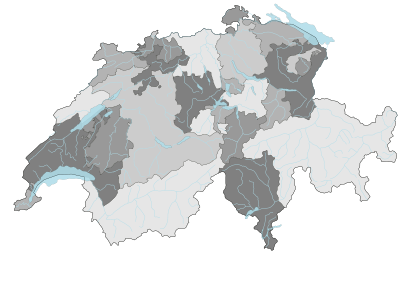
Swiss Cantons
Indeed, not so long ago Switzerland was just another feudal European backwater. People were mostly poor. It is still a cluster of rather distinct cultures and languages — French, German and Italian. But they are unified in many respects–not only by the law, but the linqua franca that is Swiss entrepreneurism. It’s an entrepreneurism in which one respects tradition, but makes room for innovation. This approach was employed when the very rules of modern Switzerland were crafted. Legal genius Eugen Huber, almost single-handedly, wove disparate legal codes into a single system that could retain the evolved rules of the past while sustaining Swiss unity into the future. Huber’s achievement demands high acclaim and serious scrutiny.
What about Switzerland today? Richard Rahn recently wrote a great piece for the Washington Times:
[Switzerland] has almost no corruption and has the rule of law with honest, competent judges and government administrators. The question should be, “What can we learn from the Switzerlands of the world about how to do things right” rather than, “What is wrong with the Haitis of the world?” Switzerland manages to run a smaller government as a share of gross domestic product than the United States and most other countries while providing a higher level of service, security, prosperity and freedom.
That’s right, Switzerland’s government as share of GDP is smaller than that of the U.S. So how do they do it? Small government, small country, solid institutions and local empowerment. Here’s more from Rahn:
Long ago, the Swiss understood that most things government needs to do and constructively does are at the local level. So, unlike in most modern nation-states, local government has the bulk of the resources and activities, while the central government remains relatively small and less important in the daily lives of the people. In the U.S., roughly two-thirds of government is at the federal level, and one third is at the state and local level. Switzerland is just the opposite, with roughly two-thirds of government being at the state (canton) and local level. Both the United States and Switzerland are federal republics. If one reads the Federalist Papers and the other works of the American Founding Fathers, it is clear they envisioned a nation that operates much more like Switzerland than one with the large central government the U.S. now has. (Emphasis mine.)
Conservatives and libertarians are often accused of sounding like broken records when it comes to taxes and spending. People know what they’re going to say: cut taxes and reduce government spending and we’re more likely to create jobs and be more prosperous. And, by in large, that is true.
The maximum marginal tax rate at the federal level in Switzerland is about 11.5 percent, while in the U.S., it will be more than 40 percent as a result of Obamacare and the planned expiration of the George W. Bush tax-rate cuts at the end of this year. In Switzerland, maximum income tax rates in the cantons range from 10.9 percent in Zug to about 30 percent in places like Geneva. In the U.S., state and local income tax rates range from zero in places like Texas and Florida to roughly 12 percent in New York City and California. Thus, the overall maximum income tax rate in Switzerland ranges from roughly 20 percent to 40 percent, depending on location, while in the U.S., the maximum rate ranges from 40 percent to 51 percent.
The Great Inversion
The idea is simple. Suppose that our collective tax bill wouldn’t change from what it is today. I know, I know. There are all sorts of reasons to reduce taxes. But let’s suppose that, on average, 35-40 percent of the nation’s income went to governments–federal, state and local. And, on average, let’s say that about 20 percent of all tax income goes to the federal government, 10 percent goes to state governments (where the remaining 5 percent goes to local governments). I don’t really know if this is true; it’s an educated guess.
Here’s the idea: what if, through some process, we were able to invert the revenue breakdown between federal and state? In other words, what if only 10 percent of all taxes went to the federal government and 20 percent went to the states? Ideally, we might push the thinking further and have 20 percent go to local governments, but inverting state and federal allows for a compromise, of sorts, which I’ll discuss momentarily.
First, the benefits–with more tax collection and distribution happening at the state level, we give a lot more power to the states. It would be a form of fiscal federalism. After the Great Inversion, you might have some states willing to spend a whole lot to create new welfare states or attempt, at least, to recreate the “services” currently offered by the federal government. The big cost hogs of the federal government – entitlements – might be the first things to be devolved. In such a case, we’d get 50 separate experiments on how to fund and administer entitlement programs. When a program fails, it fails for one state rather than the whole country. When a program looks successful, other states can adopt best practices. In addition, states that have some sense about tax competition (e.g. Texas as opposed to California) might opt not to keep rates that high.
Now, why not invert federal and local? One problem with this version of the idea – from the perspective of those who believe in some sort of geographic social equity – is that you’d have very rich people clustering in certain areas who can afford to lavish themselves with lots of government goodies. But poorer municipalities wouldn’t get as many tax receipts so wouldn’t get as many goodies–including basic things like roads and schools. So, when you invert state and federal percentage, you at least expand states’ ability to distribute government goodies to poor municipalities. This is wise, too, as states probably understand the needs of their state better than bureaucrats in Washington–despite the inherent problem of planning. Of course, that doesn’t mean you wouldn’t have all the corruption and pork-barreling you get at the federal level. You would. But at least this process becomes considerably more localized and, therefore, more transparent. It also increases the incentives for people to care. It is after all, closer by.
People wanted to live in states with more general welfare states could do so. Those who wanted to find places with lower taxes could seek those places out. With more revenue collection at the state level you can get a lot more voting with your feet. The federal government would still have responsibility for things that need national funding and oversight–like national security and the Supreme Court. Otherwise, we could devolve with the money.
In any case, I think Switzerland illustrates how this kind of Great Inversion might be successful. In a world where idealisms tend to hang out in coffeeshops, this might be a realistic goal for the future of the United States–one that even the Founders might grudgingly support if they could see what has happened to the rules of the Republic they so painstakingly devised.
Secession Week 2010: Federalism and Secession
Here we are, the fifth day of Secession Week 2010! Today we’ve decided to broaden the focus a bit from what we’ve promised (the constitutionality of secession) and instead, also discuss the successes and failures of federalism in general.
Today’s Posts
- Brad Taylor: The Tenth Amendment Was Bound To Fail
- Michael Strong: Let 560 Nations Bloom Within the U.S. Border
- Max Borders: Happy Fourth, Switzerland! : Considering the “Great Inversion”
From elsewhere in the blogosphere:
Last year, we characterized Federalism as Secession Lite, and discussed a few of its vices and virtues.
Introduction to Today’s Topic
A screenwriter named Daniel Turkewitz had an idea for a movie–it was about Maine seceding from the U.S.–but he didn’t know if the concept was feasible. So he thought he’d write to an expert. He sent a query to Antonin Scalia on the constitutionality of secession and, remarkably, he received a reply.
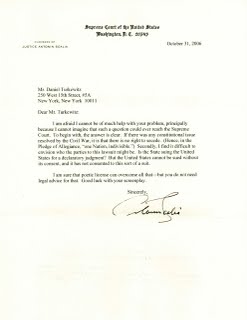 Scalia’s letter (to the left) reads:
“I am afraid I cannot be of much help with your problem, principally because I cannot imagine that such a question could ever reach the Supreme Court. To begin with, the answer is clear. If there was any constitutional issue resolved by the Civil War, it is that there is no right to secede. (Hence, in the Pledge of Allegiance, ‘one Nation, indivisible.’) Secondly, I find it difficult to envision who the parties to this lawsuit might be. Is the State suing the United States for a declaratory judgment? But the United States cannot be sued without its consent, and it has not consented to this sort of suit.
“I am sure that poetic license can overcome all that — but you do not need legal advice for that. Good luck with your screenplay.”
Constitutional issues are not “resolved” by the use of force. Presumably they are resolved when conflicting interests consent to the moral authority of the document and its methods of resolving disputes. If at some future date an Idaho or New Hampshire were to secede, it is no argument to say the issue was resolved at Appomattox or to quote the Pledge of Allegiance as a founding document. The legitimacy of that secession will hinge on how much moral weight people give to preserving the Union at that time. The word of Scalia is neither timeless nor holy.
However Scalia is correct in one important respect. Yes, the moral question about the right to secede was not settled in 1865, but the political question was. Among many other things, the Civil War represents a major shift in power between the States and the Federal government. Without the political right to secede, the States’s side at the negotiating table has continually weakened. An old maxim in chess–that the threat is better than the execution–could no longer help States push back against expansionary Federal command and control. This is not to say that all Federal interventions have been bad–as with enforcing the Civil Rights acts, the Feds can effectively protect the rights of citizens against state transgressions–but the overall trend has greatly diminished state-level policy experimentation and has helped stifle value pluralism, two of the highest virtues of a federal system. We seem to live in the great age of centralization and conformism. The tragedy is that the distance between knowledge on the ground and decision-making power at the top has never been greater.
What exactly is the ideal form of federalism? And, without the right to secede, is it possible to maintain it? Are there any backdoors to restoring the balance of powers? Today’s posts will discuss these issues from a variety of angles.
Taking Your Business Elsewhere
This post by Mike Gibson is part of Secession Week 2010: Economic Secession
Competition is the freedom to act differently from others. It’s also the opportunity to offer higher quality goods and services at lower cost. The socially desirable gains from open markets and competition are legion, yet when it comes to regulatory or tax regimes, many nations express condemnation at the thought of competition. What Adam Smith said about cartels in businesses–that they rarely meet without conspiring against the public–could also be said of the G20 and their attempts to stifle tax havens.
You can lampoon “Going Galt” all you like, but hardly anyone waxes morally indignant when people take their business elsewhere. And this isn’t just over the choice between the iPhone or Droid. Righteous boycotts are a perennial rage. The perceived moral repugnance of a person or a firm or even the state of Arizona is reason enough to drop them. I just heard today that sales at BP gas stations is down 20 percent because people, irrationally or not, feel they ought to rebuke BP by filling up elsewhere. Such is their prerogative. We’re all economic secessionists now.
What many people express about BP, Thoreau applied to governance:
If a thousand men were not to pay their tax bills this year, that would not be a violent and bloody measure, as it would be to pay them, and enable the State to commit violence and shed innocent blood. This is, in fact, the definition of a peaceable revolution, if any such is possible. If the tax-gatherer, or any other public officer, asks me, as one has done, “But what shall I do?” my answer is, “If you really wish to do anything, resign your office.” When the subject has refused allegiance, and the officer has resigned from office, then the revolution is accomplished.
Indeed, before Obama’s inauguration, many on the left were against the war in Afghanistan and Iraq. Afterwards Hopenchange and Captain Charisma turned out to be more of the same. Jon Stewart recently satirized the civil liberty destroying shenanigans of O’s Bush doctrine. Yes, businessmen may lie, but not inveterately like this. The market disciplines. Politicians, on the other hand…well, you can’t take your business elsewhere, so what do you expect? Instead you must accept that you are morally implicated in the wrongs conducted at the state level. You forfeit your autonomy on the wish of a vote.
It doesn’t have to be that way. The law is a product for which people and firms can shop, irrespective of geography. This also has beneficial, pro-growth consequences. (Here’s one interesting introduction to the topic. Here is another.) You can embrace tax havens, tax competition and jurisdictional arbitrage. Let the market discipline the state. Let people chose the laws that serve them best. You can boycott the state by taking your business elsewhere. As I said in the introductory post this morning, if you can’t count on elected officials, learn to starve the beast yourself.
The Cato Institute’s Dan Mitchell excels at explaining the beneficial economic consequences of tax havens. His blog is a great resource on tax-related news and data. He also offers a number of accessible videos Here is but one:
Monetary Secession
This post by Brad Taylor is part of Secession Week 2010: Economic Secession.
I don’t think it’s too much of an exaggeration to say that the bulk of human progress we’ve seen in recent centuries has been driven by reductions in transaction costs. Large-scale cooperation through trade and the division of labor have only become possible with the development of a number of technologies.
One important such technology is money: without a medium of exchange, trade could only occur with a double coincidence of wants. Prosperity requires a good which is easily transportable, divisible, scarce, and readily recognizable and measurable. Historically, gold and silver have often served this purpose, becoming generally-accepted mediums of exchange. Of course, there’s no need to actually hand over gold or silver when making a transaction: a credible promise of a real commodity in the form of a paper note serves the same purpose while being more easily transportable and divisible.
Today, most governments claim a monopoly on the provision of money within their borders. In the past, government money was generally backed by real commodities: a $1 bill was really a promise of a certain amount of gold. That’s no longer the case, and there is little preventing a government from printing lots of money. This means that we can never be sure what a $1 bill will be worth, in terms of real goods, in the future. Judy Shelton explains:
Inflation is the enemy of capitalism, chiseling away at the foundation of free markets and the laws of supply and demand. It distorts price signals, making retailers look like profiteers and deceiving workers into thinking their wages have gone up.
A currency with high and uncertain inflation is less useful as a medium of exchange. If we mentally unbundle government functions, we can think of individuals opting out of their government’s currencies and choosing using an alternative – whether produced by another government or by private institutions – as partial secession. We see such monetary secession fairly often, even when governments go to great lengths to protect their monetary monopoly.
Dollarization
One type of monetary secession results from the fact that there are large differences in the quality of money issued by governments around the world. While many Americans justly complain about the Fed causing inflation in the U.S., the U.S. dollar is a far better product than many foreign alternatives. The Zimbabwean dollar under the control of Mugabe, for example, became a rather poor product indeed. By printing huge amounts of money, the Zimbabwean government removed the scarcity of its currency and made it a next to useless medium of exchange. At one stage, prices were doubling roughly every 24 hours and therefore signalled very little. The graph below shows the path – in logarithmic scale! – of the Zimbabwean dollar’s exchange rate against the U.S. dollar.
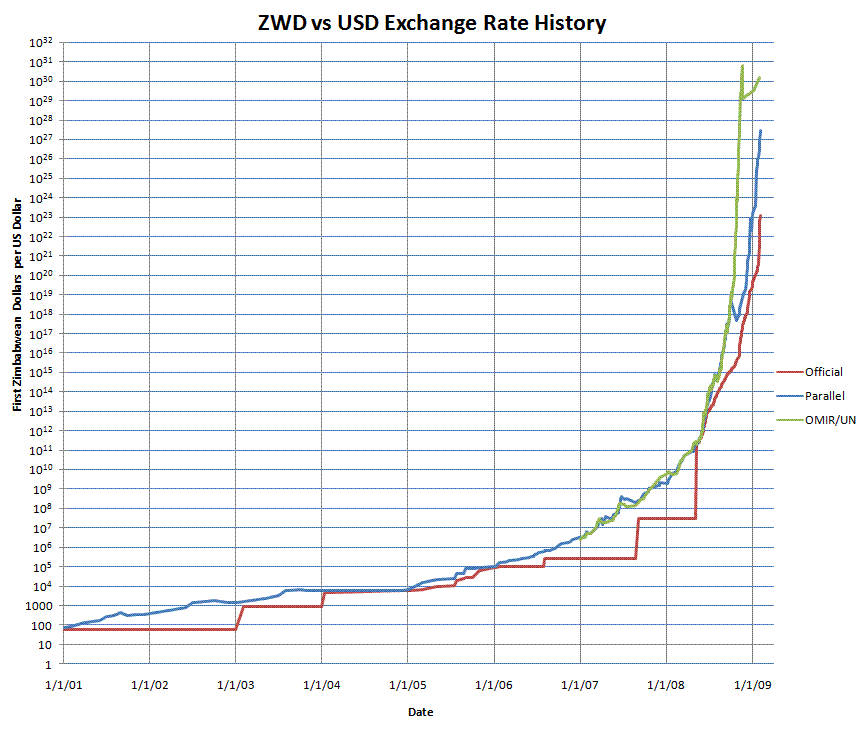
The U.S. dollar is of much higher quality than was the Zimbabwean dollar and is an already established product which does not require any local innovation. As such, many Zimbabweans began using U.S. dollars to make local transactions. Since the government tightly controlled the importation of foreign currency, monetary secession had to be a black market process. Steve Hanke summarizes the process:
Ashes are all that is left of the Zimbabwe dollar — a remnant of paper money. During Zimbabwe’s hyperinflation, foreign currencies replaced the Zimbabwe dollar in a rapid and spontaneous manner. This “dollarization” process was legalized in late January 2009. Even though the Zimbabwe paper money remnant circulates alongside foreign currencies, its real value is tiny, its use is limited, and its value against the U.S. dollar is cut in half every two days.
It’s interesting to compare this type of monetary secession to the idea of charter cities. Economist Paul Romer thinks setting up enclaves of relative economic freedom in poor countries, often based on the rule-sets of successful countries such as Singapore, will give locals a chance to migrate a short distance to the charter city and effectively live under the rules of a much richer and more distant country. Dollarization and charter cities both give those living with the worst products in the governance market to upgrade to the best currently available. In contrast, private currencies, like seasteading, would create the conditions under which the quality of the best products would improve.
Private Currencies
Even absent hyperinflation, the slow inflation of currencies and uncertainty as to their future value has costs. As with all goods, a competitive market for currencies is likely to increase product quality. Private firms, lacking the coercive powers of the state, would need to back their currencies with commodities to attract customers. This is how physical private currencies such as the Liberty Dollar and digital currencies such as e-gold have operated. Unfortunately, governments don’t like competition and both Liberty Dollar and e-gold have run into problems with the authorities, the former for, well, competing with government and the latter ostensibly for making life easier for criminals.
Given the difficulties of competing with an established monopolist, some are taking other approaches to monetary secession. Community currencies allow people to use an alternative locally while still using the national currency when trading farther afield. Another option is to trade directly in commodities such as gold and silver. Since there is no currency acting as an intermediary, there is much less potential for government control. Looking further into the future, it might be more likely that the current money monopoly is undermined by people opting out of the system by using technology to fly under the radar. Creating secure and widely-accepted digital currencies would be an important part of that effort.
In any case, monetary secession is difficult when the state doesn’t want you to secede.
An Agorist Roadmap
This Guest Post by Kyle Bennett is part of Secession Week 2010: Economic Secession.
So, you want to secede? Your differences with some government or other are irreconcilable, and you want a divorce, but you don’t know how? The usual methods are messy, and involve lawyers. You’ll spend a lot of money and time, years of draining effort, endure painful negotiations, and hope that at the end of it all, you’ve convinced enough of the right people to sign off on your wishes. You’ll have no idea if, when, and at what cost the final victory will come. You may even have to fight a war before it is all over.
Would you like an easier way? A way that puts you in control, that allows you to secede entirely on your own initiative? Do you want to start right now, from where you currently live, without the hassle of figuring out how to divide the house? Do you want to spend your time and money building a new life and a prosperous future instead of buying your ex’s lawyer’s next BMW? Do you want to separate in a way that deprives your ex, the state, of the resources it needs to keep hounding you?
Agorism may just be the answer you are looking for. Think of it as a DIY divorce, free from political and legal wrangling and compromises among competing factions, and without the risk of a power vacuum into which the next up and coming wannabe tyrantcan step. The resources you use remain yours, and build over time. They are not spent on flyers and events and donations, they are invested. They are invested in you.
What is a state, really? It’s a bunch of people, operating under a certain set of rules, perhaps with a shared culture and set of norms. It is a set of mechanisms for enforcing laws, regulating economic activity and money, maintaining geographical integrity, and collecting resources to do all of this via taxation. Some of these things are necessary to any kind of society, others are nothing more than means arbitrarily chosen by a state to try to create the first set of things. They are the wrong means.
The great insights of market anarchism are that rules can be enforced by individuals without centralized law, that markets can self-regulate economic activity and money, that taxes are just theft that allow the non-productive to live off the work of the productive, and that geographical integrity is only necessary to the flawed means chosen by states.
Agorism has a simple answer to freeing one’s self from those flawed means: Just stop. Don’t participate in top down legal enforcement, start enforcing the rules you need for your life from the bottom up, with your own resources. Don’t allow economic regulators to rule your life and your trade and your money, regulate them yourself via markets, relationships, and real money such as silver. Start paying for the things you need yourself, while refusing to pay for those things that others want. Free yourself from the bonds of geographical monopolies and declare that wherever you are, right here and right now, is your own country of one. Let a billion nations bloom.
OK, you didn’t really expect a free lunch, did you? It’s never that simple, except in principle. It takes work, sweat and toil, risk, and planning ahead to achieve the things you want, even those things you have a right to. It’s a process, not a single event. There are basically two processes, done in tandem, and that build upon each other. One is reducing those areas of your life that fall under the control of the state, and removing the remainder from state control. The other is moving those things into another realm, one in which you are in control, you make the decisions, and you reap the rewards. The first reduces the power the state has over you, and over others, by draining resources away from the state that would use them against you. The second builds a new life, the kind we were told as kids was possible in a “free” country where you could be anything you wanted to be. And it creates a society, and a culture, that will already be in place and moving forward on that happy day when states begin collapsing all around us.
Reducing your “lifestyle footprint” in the state controlled sphere frees up your time to act in the free domain. It makes you more agile, more flexible, better able to respond to both opportunities and threats. Are you in debt? Eliminate it, as soon as humanly possible. Debt is the greatest enslaver of mankind. Do you maintain a rich lifestyle dependent on a high income? Cut back as far as you can stand. You won’t have to give those things up for long, you are only reducing them on one side so you can build them up on the other. Is your job tying you down to a fixed schedule, W-4 or 1099 forms, bosses or clients who will never go along with your agorist goals? Re-orient your career to a freelance, or purely entrepreneurial form, or even a different field entirely.
At the same time, begin building yourself up on the free side of life. Learn to handle silver. Just buy a little every so often at first. Learn the pricing structure of bullion and “junk” US Silver coins. Learn how silver feels in your hand, and that satisfying llittle “tink” sound it makes when struck. This is the beginning of your agorist nest egg. Start learning new tradable skills, different than the ones you currently make your living with, to allow a greater range of options. Seek out like-minded people and opportunities to trade. Learn to explicitly assess your trust in them, and to communicate that trust to others in an objective way free of malice or gossip. The most basic infrastructure of agorism is relationships and trust. It is never too early to begin laying those foundations.
Consider your earliest interactions as practice, as opportunities to share in the learning of skills that will be needed as you move to a more and more agorist lifestyle. Make free, unhindered trades for the fun of it, and to learn the details and techniques that make such trade move more smoothly. Use this to build up a network of trusted associates, and maybe some not so trusted. Look for fellow travelers in your community, who may not care about agorism per se, but are willing to work outside the system. Learn to keep your data, communications, and plans secure through encryption, and to selectively reveal them to others based on trust. Learn to think of the pricing of goods and services in terms of silver or gold, rather than dollars.
Most agorists are currently operating in this stage zero of agorism. It doesn’t look like much from the outside, and there is a constant itching to get out there and do something. However, If you have debt, if you maintain a rich lifestyle, the demands these place on you will thwart your efforts to free yourself at every turn. If you don’t have a network of friends and trading partners, you’ll find your opportunities for agorist expansion limited. This is the stage for preparing the ground, laying foundations for future building. It’s a time of learning skills and techniques, of meeting new people who share the agorist vision. It is a time for learning to think and act in a new way, for getting used to ignoring the state and becoming comfortable with the risks and the opportunities that entails. It is a time for learning to think of creative, bottom-up market solutions instead of top-down coercive solutions.
As your abilities and options grow, you will begin to use these networks and skills to get real work done, to build income and capital. You will begin to need some kind of physical and/or formal abstract infrastructure to facilitate your activities. The main categories of infrastructure are in the areas of security, currency, trade, transportation, communication, dispute resolution, and land. Build what you need, as you need it, but don’t build any one area out fully in anticipation of future needs. Let them grow organically, holistically, and in sync with each other, to serve the needs you have at any given stage of your own agorist development. Co-opt existing infrastructure when you can, or when you need to until you can build your own. Also, remember that others will need this infrastructure as well, so there is entrepreneurial opportunity there.
Success will breed more success. Those on the political fence will begin to see greener pastures on our side, misery, fear, and want on the other. The slow trickle of resources being withdrawn from state control will become a stream, then a torrent, then an exodus. Government will become weak, then crippled, then entirely impotent. One day you’ll wake up and realize that the state has withered on the vine, that you have built a new society and a new culture free from its incessant interference in your economic and social life.
We are now approaching six centuries after the printing press freed information and inquiry from the control of the elites in state and church. The world has built societies that those elites could never have imagined. What could we build within a mere six decades of the dawn of the internet and its freeing of information and relationships from the bonds of mass and distance? Would we recognize it if we could see it today?
It won’t take six decades to start to see real results in an agorist life, if we start today. We can begin to see them almost immediately. We can do it, but we can’t do it for you. Each of us has to build that world for ourselves. We can cooperate in the effort, we can mutually benefit from voluntary trade, we can build on each other’s successes and innovations. But we have to build it, we cannot wait for others to build it for us. Those who do wait will find themselves excluded from it, until such a day as it is all around them and they are dragged kicking and screaming into it. It is inevitable, and necessary if the human race is to survive and to continue advancing, to continue prospering. But inevitable does not mean imminent. It won’t happen until somebody picks up the tools and starts the work. It can happen in our lifetimes if we make it happen, but it won’t happen until we do.
Secession Week 2010: Economic Secession
Welcome to the fourth day of Secession Week 2010! The special on today’s menu is economic secession.
Today’s Posts
- Kyle Bennett: An Agorist Road Map
- Brad Taylor: Monetary Secession
- Mike Gibson: Taking Your Business Elsewhere
From elsewhere in the blogosphere:
Last year, Patri touched on similar topics in his post on Non-territorial Secession.
Introduction to Today’s Topic
The term “economic secession” was a coined by John T. Kennedy to refer to the tactic of avoiding paying taxes or obeying regulations in an effort to reduce government control:
The implementation of economic privacy is the implementation of the means of economic secession. And when those means are available they will be utilized. … [I]f the means of economic privacy are available they must choose between keeping their own money in their own pockets or voluntarily turning it over to government.
Then you’ll see economic secession on a grand scale.
This idea that anarchists can defeat the state by ignoring it and depriving it of resources is the central tenet of agorism, a school of market anarchist thought developed by Samuel Edward Konkin III. Agorists see counter-economics – the use of black and gray markets – as a revolutionary act and as a path to a stateless society. Think of it as starving the beast yourself, instead of depending on elected officials to starve it for you.
 In fact, the American revolution might best be thought of as an economic secession that preceded a political one. Colonists regularly flouted numerous mercantile restraints on trade–whether it be the Navigation Act, the Molasses Act, the Stamp Act of 1765, or the Tea Party generating Tea Act of 1773. Smuggling was rampant and admired. Some historians say otherwise, but John Hancock did more than sign the Declaration, he also made a fortune channelling his inner Han Solo.
Of course, economic secession of which agorists would approve need not be motivated by a desire to wither the state. For most people, avoiding state taxes and regulations is simply a way of getting by. Sudhir Venkatesh shows how important the informal economy is to the urban poor Off the Books:
Whether one is starting or sustaining a business,“underground” institutions provide a backbone for all aspects of local enterprise, from loans and credit to advertisement. The cash economy abuts a world where trading and payment occur through verbal promises, in-kind payments, and barter. Laborers and entrepreneurs, including small business owners, general workers, equipment renters, and creditors, participate in highly intimate exchange networks, where personal connections and impersonal contractual exchanges coexist. In the ghetto, advertising and marketing, credit and capital acquisition, enforcement and regulation, and other aspects of commerce seem as easily conducted via informal channels and outside the government’s eye as through legitimate venues where the state is the arbiter and lawmaker.
The informal economy is even more important in poor countries with inferior institutions.
We think “economic secession” is a term which can usefully be used more broadly than that. It admits differences of degree. If we consider the possibility of unbundled government, any effort to switch government service providers in the economic sphere can be thought of as partial secession. Arnold Kling has pitched this idea as “virtual secession“:
The problem with physical secession is that it is very difficult to achieve critical mass. There is probably not much overlap between the people you want to live with and the people who want to choose your particular form of government. The vast majority of us put up with government we dislike in order to live in proximity to people with whom we want to work and play.
With virtual secession, you could still live in San Francisco or Manhattan or Silver Spring while seceding from much of the government at the city, state, and Federal level. You and your next-door neighbor might belong to very different governmental units.
Suppose, for example, that instead of having your taxes allocated for you by legislators, you were given a list of programs and could choose how to allocate your taxes. What percent of your taxes should go to TARP? What percent should go to fund the mohair subsidy? What percent should fund DC school vouchers? What percent should go to Barney Frank’s affordable housing initiatives?
As today’s posts will explore, incremental economic secession could involve opting out of low-quality government currencies or moving business to jurisdictions with better rules and/or lower taxes. We hope to show that breaking the cartel on government services providers is as morally right, and as socially beneficial, as breaking up OPEC.
This post by Brad Taylor is part of Secession Week 2010: Culture And Secession
As I suggested in today’s introductory post, we seriously undersell the advantages of political decentralization and endogenous boundary-making when we ignore group identities and focus exclusively on the potential of jurisdictional competition to increase the quality and range of products in the governance market.
People treat governments as much more than mere service-providers. The people’s romance, as Dan Klein calls it, sees government not simply as a set of rules but as the expression of some mystical general will. The desire among the Québécois, Flemish, Southern Sudanese, and numerous other groups to break away from the states which currently govern them can be explained only partially in terms of a desire for a different bundle of policies. To a large extent, consumption of a particular rule-set, like the consumption of many other goods, is socially motivated.
The knee jerk reaction of many liberals and libertarians is to reject exclusionary group identities as irrational, harmful, and inadmissible in our intuitive cost-benefit analyses. This, of course, is itself highly illiberal: people care about identities and it’s not our place to prevent their expression.
While parochialism might always cause problems, its harm is amplified in the large democracies we see today. As Bryan Caplan has argued, democracy provides no check on our evolved xenophobic prejudices. Politics isn’t about policy, but status: we vote to increase the status of our tribe at the expense of the other guys. Democracy tends to exacerbate this tendency.
Given that our parochial stone-age brains are here to stay, we should prefer those institutions which minimize the costs of the people’s romance. Rather than fighting nationalist movements seeking to align state borders with the boundaries of group identities, we should be supporting them. John Stuart Mill made what remains the best argument for this type of nationalism 1861: when you allow each nation to have its own state, you reduce the tyranny of the majority:
Free institutions are next to impossible in a country made up of different nationalities. Among a people without fellow-feeling, especially if they read and speak different languages, the united public opinion, necessary to the working of representative government, cannot exist. The influences which form opinions and decide political acts are different in the different sections of the country. An altogether different set of leaders have the confidence of one part of the country and of another. The same books, newspapers, pamphlets, speeches, do not reach them. One section does not know what opinions, or what instigations, are circulating in another. The same incidents, the same acts, the same system of government, affect them in different ways; and each fears more injury to itself from the other nationalities than from the common arbiter, the state. Their mutual antipathies are generally much stronger than jealousy of the government. That any one of them feels aggrieved by the policy of the common ruler is sufficient to determine another to support that policy. Even if all are aggrieved, none feel that they can rely on the others for fidelity in a joint resistance; the strength of none is sufficient to resist alone, and each may reasonably think that it consults its own advantage most by bidding for the favour of the government against the rest.
While we want to carefully avoid arguing for the necessity of culturally pure states, we need to take the problems caused by diversity in a democracy seriously. The problem with simply insisting that we need nation-states, of course, is that national identities are never well-defined (and many group identities are not geographically-concentrated). Identity groups overlap and we each belong to many groups at many different levels. How can we to make states match salient group identities without creating pointless ethnic segregation at the behest of a few racists? In general, we need to make state boundaries more dependent on individual preferences.
Given sufficiently low barriers to secession, libertarians shouldn’t treat nation-states merely as something of instrumental value in preventing the tyranny of the majority. People get genuine satisfaction from having their state represent their tribe; we should not begrudge people their nationalist sentiments if they can be indulged without causing harm.
Since the power of exit will make individuals pay the cost of intergroup violence and place limits of preference heterogeneity, a decentralized competitive market for governance will produce a more harmonious world – even if everybody chooses to retain their tribal identities.
Don’t Threaten Anyone’s Homeland
This post by Patri Friedman is part of Secession Week 2010: Culture And Secession
From a great article in The Atlantic about Paul Romer’s Charter Cities:
IN JULY 2008, ROMER MADE HIS first trip to Madagascar’s bustling capital, Antananarivo. Madagascar’s government was anxious to attract foreign investment, and it understood that a credibility deficit held it back. In an earlier bout of openness, the island had lured in foreign garment firms, but then the political climate turned hostile and the firms fled; now the government was having trouble enticing them to come back. Faced with this obstacle, the Malagasy authorities were open to unconventional arrangements. To boost investment in agriculture, they were ready to lease a Connecticut-size tract of land to Daewoo, a South Korean corporation, for 99 years.
…
Romer made his pitch for a charter city, and Ravalomanana responded that he wasn’t sure one was enough; if Romer could identify two rich countries willing to play the role of government trustee, it might be better to launch two parallel experiments. The president and the professor agreed that the new hubs should be open to migrants from nearby countries as well as to locals. They rose to examine a map of Madagascar on the study wall. Ravalomanana suggested building the first city on the island’s southwestern coast, which was largely uninhabited because of its dry heat. To Romer, the site sounded very much like the coastal locations that appeal most to the world’s affluent as vacation spots.
…
Even as Romer was meeting with Ravalomanana, the president’s main political opponent was sniping at the proposed lease of farmland to Daewoo, and the idea of giving up vast swaths of territory to foreigners was growing increasingly unpopular. The arrangement was denounced as treason, and public protests gathered momentum, eventually turning violent. In late January 2009, protesters tossed homemade grenades at radio and TV stations that Ravalomanana owned; looters ransacked his chain of supermarkets. In February, guards opened fire on marchers in front of the presidential palace, killing 28 civilians. At this, units of the army mutinied. Soon, Ravalomanana was forced out of office.
The first action of the new government was to cancel the Daewoo project, and Romer’s plans in Madagascar were put on hold indefinitely. But the larger question was what, if anything, this disappointment signified for Romer’s whole approach. The riots appeared to demonstrate the explosive sensitivities surrounding sovereignty and land—sensitivities that are not confined to Madagascar. Indeed, versions of the Daewoo story have played out elsewhere. In the late 1990s, for example, Fiji’s government decided to bring in a British nonprofit to manage its mahogany forests, and an indigenous leader launched a revolt under the slogan “Fiji for the Fijians.” The rebellion was hypocritical: as the Oxford economist Paul Collier recounts in his book The Bottom Billion, the indigenous leader had himself backed a rival foreign bid to manage the mahogany. But the venality of the rebels’ motivation didn’t change the fact that a demagogue could easily attract support by railing against territorial concessions to foreigners.
I’ve already talked about this issue in my post Avatar, Property Rights, and New Nations, before the Madagascar example came to light. It is clear that humans have a very strong wired attachment to their land, and are very sensitive to anything that seems like taking their land away. While we see a general decline in violence in the world and in politics as we get wealthier and political shenanigans have less and less impact on people’s lives, making bloody revolution less appealing, the threat of losing part of one’s homeland still has the power to inspire violent reaction.
So this is a serious potential obstacle for any movement that aims to create a new country – it must somehow avoid pressing this button. For example, a frequent alternative strategy people propose to seasteading is to simply move a bunch of politically like-minded people (libertarians, say) into a tiny country and take it over. I think this is a horrible idea, because foreigners taking over a country is extremely likely to trigger a violent response.
It’s also a potential problem for movements like the Free State Project, although they seem to have avoided it so far by picking a state which is naturally sympathetic and so doesn’t feel like it is being “taken over”. (The tiny number of people who have moved so far, 829 as of today, is probably also a factor. Greater success would be more likely to trigger a backlash).
This is one reason why I favor approaches using empty territory. For example, Charter Cities specifically target empty territory, and will be built with the explicit permission of the host country. Ideally, as Michael Strong suggests, the host country will get a share of the profits via lease revenue or real estate ownership inside the Charter City, thus letting them share in the wealth, and feel like participants in the process. Unfortunately, as Bryan Caplan points out, the combination of homeland defense and anti-foreign bias can still kick in. This does not make Charter Cities impossible, it merely means they must be marketed in a sensitive way as a supplement, not a replacement, to the local community and culture.
And here we come to one of the great advantages of frontier solutions like my seasteading, or eventual spacesteading. By taking area which is not only unoccupied, but unclaimed, which no tribe has an emotional attachment to owning, we avoid pressing this button. By getting our sovereignty through the flagging system, where we add new “territory” to the flagging country, rather than a country giving up something it has (like in Charter Cities, buying an island, or secession), we avoid pressing this button.
This is not to say that seasteading is the best option – it has major disadvantages, like the high cost and difficulty of building on the ocean, and the lack of endorsement/monitoring by an existing country (which will give instant credibility to a Charter City, credibility seasteads must slowly earn over time). But it at least avoids this powerful pitfall – it does not threaten anyone’s homeland with an invasion of foreigners.


 Let A Thousand Nations Bloom