The Aphorisms of Nicolás Gómez Dávila
Here are some of my favorites:
- 1,088: “Democracy is the political regime in which the citizen entrusts the public interests to those men to whom he would never entrust his private interests.”
- 1,312: “Dying societies accumulate laws like dying men accumulate remedies.”
- 1,323: “Political blunders repeat themselves, because they are the expression of human nature. Successes do not repeat themselves, because they are the gift of history.”
- 1,269: “The two terms of the democratic alternative today—oppressive bureaucracy or repugnant plutocracy—are canceling each other out. Combining into a single term: opulent bureaucracy. At once repugnant and oppressive.”
- 1322: “Universal suffrage in the end does not recognize any of the individual’s rights except the ‘right’ to be alternately oppressor or oppressed.”
- 1,288: “No folktale ever began this way: Once upon a time, there was a president…”
- 1,284: “The more complex the functions which the state assumes, the more subordinate the bureaucrats on whom the citizen’s fortune depends.”
“Opulent bureaucracy” could be the phrase of the year. Hat tip, Moldbug.

Crowding Out Government
Arnold Kling has a great post at Econlog on possible strategies libertarians might take to improving freedom. Arnold prefers a secessionist or “bye-bye” agenda, by which he means competitive government:
The idea is to enable people to escape the power of monopoly government. This could be all-out escape, as in seasteading or charter cities. Or it could be incremental escape, as I propose in Unchecked and Unbalanced, with vouchers, charter communities, and competitive government, meaning mutual associations and standard-setting bodies in which people enter and exit voluntarily.
Under competitive government, you would not have an FDA, but you would have several private companies that certify pharmaceuticals. It would be up to individuals to decide which certification companies to trust. You would not have government-provided deposit insurance and bank regulation, but you would have several mutual associations to which banks might belong. It would be up to individuals to choose a bank in part based on confidence in the mutual association to which the bank belongs.
I think the idea of incremental escape from government is an important and promising one. The way Arnold frames the approach, though, seems to imply that we need to reform existing political institutions in order to introduce competition. Given the problems of democracy and the ineffectiveness of folk activism, that’s unlikely to happen. The neat thing about seasteading is that we don’t need to change many minds and can leave existing governments exactly as they are. Voucher systems, charter communities, and the replacement of the FDA with private companies all lack that important quality.
Another option is a-political incremental secession within the boundaries of existing states. Instead of seeking to change the state to allow or encourage competition, we simply ignore it and do our own thing. The problem is, of course, that private provision of many goods has been crowded-out by government. In some cases, private provison is illegal; in others, it’s just difficult due to the fact that those wishing to secede are forced to pay twice for services. With sufficiently inefficient government, though, people will switch to private providers even in the face of punishment or double-payment.
We see this happening all the time: parents – even very poor ones – enrol their kids in private schools even when they can send them to government schools as zero marginal cost; residents upgrade their local governance services; and people who don’t like product regulation turn to black and gray markets which rely on reputation and trust. These people aren’t making these decisions out of an ideological commitment to freedom, but because private solutions better meet their needs. This could provide those of us who do wish to increase freedom with some leverage.
If people are given a concrete example of private provision of some good and the option of switching, they’re more likely to buy the argument for freedom. It would take a pretty impressive feat of self-deception to maintain that government is better at providing some good even as you’ve switched to private provision. (Of course, humans are capable of some impressive feats of self-deception.) As private provision increases, there will be some tendency for the demand for government to decrease. Experimental economists Mark Isaac and Doug Norton call this, in the context of charitable giving, the “reverse crowd-out” effect. They see it as possible that:
a renewed commitment on the part of a citizenry to private institutions of charity and compassion could “crowd out”, that is “replace” the decades-old predominance of government, especially the federal government, as the primary engine of social welfare.
Isaac and Norton don’t find any experimental evidence that voluntary provision crowds out coercive provision in the particular lab conditions they use. Whether we can expect reverse crowd-out to happen in reality is not obvious and depends primarily on the answers to two questions:
- Can we create institutions to compete with the state when the odds are so strongly stacked against us?
- Will people really reduce their expressed demand for government when given more efficient voluntary alternatives, or is the human capacity for hypocrisy too strong? People are likely to vote with their feet for the best option; will they also vote this way with their ballots?
Eric S. Raymond: Why I Am An Anarchist
Hat Tip to Leif Smith’s Explorer’s Foundation, a wonderfully idiosyncratic resource, copied in its entirety from Raymond’s website:
William Shirer’s The Rise and Fall of the Third Reich is one of the most subtly horrific pieces of writing ever uttered. The single most chilling paragraph in a book that does not flinch from describing Nazi atrocities is this one:
On August 19, 1934, 95% of the Germans who were registered to vote went to the polls and 90% (38 million) of adult German citizens voted to give Adolf Hitler complete and total authority to rule Germany as he saw fit. Only 4.25 million Germans voted against this transfer of power to a totalitarian regime.
With this vote, the position of Führer as an amalgam of President and Chancellor — the elevation of Adolf Hitler to the status of dictator — was formally and democratically approved by the German people.
Hitler’s program was not a secret; nor were the means he proposed to use. 90% of the people voted for Mein Kampf and the Nuremberg rallies and the repudiation of the Treaty of Versailles and Kristallnacht; the mandate was overwhelming.
Since I first published this essay, some people have cited Shirer to different effect, that Hitler actually gained supreme power by an act of the Reichstag on Match 23 1933, and was already dictator at the time of the 1934 elections. This is a quibble. The particular route by which Hitler was able to subvert the Weimar Republic’s democracy is far less important than the simple fact that he was able to do so. In fact, accepting the argument that his coup was only supported by a minority of the German people would only make the conclusion of this essay sharper and more painful.
I do not find it surprising that establishment historians and political scientists have largely failed to confront these stark facts. For to do so would be to expose the shakiness of the assumptions that underly our own political system.
The Weimar Republic’s 1934 elections wrote a grim and final epitaph for the theory that constitutional democracy is a reliable guardian of individual liberty, or even sufficient to prevent deliberate government genocide of its own citizens. The demonstration is given more point for Americans by the fact that the Weimar Republic’s constitution was explicitly modelled on that of the United States.
The American form of constitutional democracy was invented by the founding fathers of the United States because all previous systems had been found wanting. The verdict of history since has agreed with Winston Churchill’s epigram that democracy is a terrible form of government, but eight times better than any other.
But constitutional democracy itself is not proof against the short-sightedness and moral blindness of its own people. This is not a new insight; two centuries ago Gibbon’s Decline and Fall of the Roman Empire, the book which effectively founded the modern study of history, found there its major theme.
What the willful self-destruction of Weimar Germany demonstrates is that the terminal instability of democracy is not a marginal or distant phenomenon. A modern, educated, civilized, and cosmopolitan people in the heart of the liberal West can — and will, at the behest of even a single, sufficiently skillful demagogue — surrender their liberty and condemn millions of innocent victims to mass death.
In doing so, it raises a trenchant question. If constitutional democracy has failed so catastrophically to solve the problem of government, what system possibly can?
No one has yet improved on Max Weber’s definition of government as an organization claiming a monopoly on the licit first use of force in a specified geographic region. The question of good government reduces to this: who can be trusted to wield the first use of force wisely and morally?
We already knew that kings, priests, emperors, and autocrats of all kinds have failed this test, as have noble classes and other oligarchies. We know from the aftermaths of the French and other revolutions that the sovereign people, unchecked by constitutional restraint on their tribunes’ use of force, can be fully as arbitrary and vicious as any tyrant.
The terrible lesson of Weimar Germany is that constitutional restraint doesn’t work either. One does not actually need Weimar Germany to make this point; the history of the U.S. itself should be sufficient to demonstrate it, at least to anyone honest enough to admit that the Founding Fathers did not intend for us to suffer under the weight of a stifling regulatory bureacracy, a redistributionist welfare state, and the IRS. But Weimar makes a more persuasive example, because even those willing to defend the U.S. Government’s escalating abuses of power will hardly defend Nazi Germany.
I struggled with this question for years after I read Shirer. It’s one that throws all the central problems of politics and moral philosophy into simplifying relief. For reasonable men may differ on what positive goods governments should aim to secure for their citizens. Reasonable men may differ even on what sorts of catastrophe and deprivation governments should aim to prevent. But it is hard to see how any political arrangement that can condone the genocidal massacre of its own citizens can be considered acceptable or sane.
If no government is institutionally stable against the folly of its citizens, is ‘no government’ the only answer? Must we give up centralization of power entirely to prevent future Dachaus and Treblinkas? This is the anarchist prescription; if we cannot prevent all violence, at least we can deny would-be Hitlers the mass army, the machinery of state coercion, the social instruments of genocide.
The Founding Fathers of the United States thought they had found a way to successfully head off the degeneration of governments into pathological monstrosities: ensure that the people remain armed, and teach them that it is part of their duty as free citizens to check the arrogance of government — by threat of armed revolt or by actual revolution, if need be. Thomas Jefferson would have asked why the Jews and Gypsies of Germany allowed themselves to be disarmed by Nazi gun-confiscation laws without rising in revolt — and, more pointedly, why the soi-disant civilized nations of the world did not see the confiscation of civilian weapons as a sure harbinger of the Holocaust to come.
But, in the event, they were disarmed, and thus they had no recourse when the stormtroopers came to put them on the death trains. The fatal instability of constitutional democracy killed over twelve million people. And I see nothing intrinsic in the American system to prevent a future Holocaust. Especially not when many Americans seem bent on disarming their neighbors, and dismantling the very check that Jefferson and the other Founders were attempting to build into our system with the plain words of the Second Amendment to the Constitution.
I am left with the bleak conclusion that no attempt to hold the arrogance of government in check will work — because a majority of the people themselves are too easily seduced into abandoning their own institutional protections against tyranny by the false promises and poisonous dreams of statist propaganda.
That is why I am an anarchist.
Given Amy Chua’s A World on Fire, and the genocide in Rwanda, and the democratic election of Hitler, it remains a question whether or not genocide is a bug or a feature of democracy. Perhaps we need to think more along the lines of “Open Source” in governance? Is polycentric law closer to the Open Source ideal than is the legislative territorial monopoly that remains the ideal of majoritarian democracy? Should we create a romance around kritarchy to supercede the romance of democracy?
Gibraltar Bows before the Tax Cartel
The international tax system just became a little less competitive. Gibraltar has removed the distinction between onshore and tax-exempt offshore businesses in an effort to remove the nation’s reputation as a tax haven and become a “mainstream European financial services centre.”
The state has signed 18 tax information exchange agreements and has others under negotiation. With the adoption of the Act, coupled with Gibraltar’s compliance with all EU financial services regulation, money laundering and co-operation rules, Gibraltar joins the group of mainstream European financial services centres, according to a government statement.
The Act introduces tough anti-avoidance measures and default financial and legal penalties to help ensure everyone based in the tiny state pay the taxes. …
Many previously tax exempt banks, insurance, investment, gaming and other companies will begin to pay profit tax in Gibraltar for the first time on the same basis as all other companies starting in July 2011.
Gibraltar is still an attractive place to start a business: company tax rates will be cut from 22% to 10% as the new rules are introduced, and its English common law system is about the best available in the current uncompetitive market for law.
Still, this is an indication of what happens when powerful nations work together to thwart competition. In most industries, such behavior is frowned-upon; in the market for governance, the default assumption seems to be that competition is harmful and collusion is the only response.
In the U.S., When People Vote With Their Feet…
They move to freestyle Texas and away from the Regulatory Republic of California. Ryan Streeter at the Enterprise blog has the details and he’s pulled some nice still shots from an interactive map at Forbes to illustrate the trend. Black lines indicate incoming migration to a specific county, while red lines indicate outward movement. Here’s a comparison of Travis County, TX, with Los Angeles County, CA:


Iceland to Become Safe Haven for Freedom of the Press
Though all the winds of doctrine or censorship were let loose to play upon the earth, so Truth be in the field, or soon in Iceland:
If you’re looking to say something contentious on the Internet, then Iceland is the place to go. The Icelandic Parliament unanimously passed a proposal yesterday to make the country a “new media haven” in an initiative inspired and strongly backed by Iceland-based whistleblower website WikiLeaks.
The proposal, entitled the “Icelandic Modern Media Initiative“, “resolves to task the government with finding ways to strengthen freedoms of expression and information freedom in Iceland, as well as providing strong protections for sources and whistleblowers.”
According to the text of the initiative, Iceland hopes to become the international home of news organizations worldwide by way of providing these protections:
‘The legislative initiative outlined here is intended to make Iceland an attractive environment for the registration and operation of international press organizations, new media start-ups, human rights groups and internet data centers. It promises to strengthen our democracy through the power of transparency and to promote the nation’s international standing and economy. It also proposes to draw attention to these changes through the creation of Iceland’s first internationally visible prize: the Icelandic Prize for Freedom of Expression.’
The mainstream press tends to condemn tax havens. Let’s see how much they love jurisdictional arbitrage when it’s in their wheelhouse.
Sure, Because Democrats Don’t Hire Cronies
Reviewing Jeff Miron’s new book on libertarianism, Ed Glaeser writes:
The increased appeal of libertarianism today reflects a nonpartisan view that the public sector has been deeply problematic under either party…Libertarians tend to think that the Bush years taught that all governments were flawed, not that everything would be better with a new leader who would expand the public sector.
To which Mark Thoma responds:
The lesson of the Bush administration is not that ‘all governments were flawed.’ We learned about an extreme, i.e. how bad things can be when a president sabotages government agencies by appointing cronies — people who provided important political support — to head important agencies rather than qualified, competent administrators.
Ahhh, if only all men were angels….or democrats…Cf Robin Hanson on Delusions, preponderance thereof, section, Foragers.
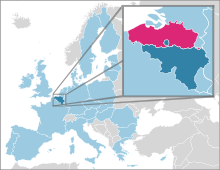
Flanders in Belgium
Large countries can emulate free markets within their borders because, within a single nation, barriers to trade are few and transaction costs are low. Regional protectionism has few supporters, particularly in the U.S.–No one in California, for instance, raises much sand about jobs getting out-sourced to Nevada, even though it happens every day. Or at the very least, no one argues against interstate competition with the same vehemence as they might over trade between nations.
The greater the extent of the market, the greater the wealth created. So you might expect a country to maximize its wealth by increasing its size, but the great trade-off in the size of nations fractures and flags that impetus, because the greater the size, the greater the diversity in values. Things fall apart. The center cannot hold. Some micro-cultures cannot be homogenized. In their book on the optimal size of nations, Alberto Alesina and Enrico Spolaore present a thorough analysis of the trade-off and it seems that Belgium is playing out this dramatic dilemma in its current election. I know little about Belgian politics, even less about the tensions between the Flemish in the north and the socialist French-speakers to the south, but I dare say the future of Belgium waffles.
From today’s NYTimes:
A stunning electoral success for Bart de Wever’s Flemish nationalist party, which won the most parliamentary seats, is a significant new challenge to the fragile unity of a federal country where tensions between French and Dutch speakers run deep, and where voters in one region cannot vote for parties in the other.
It has also injected a new element of uncertainty into Europe at an especially difficult time for the European Union, struggling with serious problems over its finances and currency.
Belgium is due to assume the rotating presidency of the European Union in less than three weeks. But it is likely to take months to negotiate a new coalition, raising the prospect that Belgium will be struggling to assemble its own government at precisely the time it is supposed to be steering Europe out of a deep crisis.
Paul Romer Mainstreams the “Let a Thousand Nations Bloom” Perspective Among the Economic Development Establishment
In a recent paper at the Center for Global Development (CGD), Paul Romer comes very close to mainstream the perspective here at “Let a Thousand Nations Bloom” among the global development establishment. CGD is very mainstream,
The Center for Global Development is an independent, nonprofit policy research organization that is dedicated to reducing global poverty and inequality and to making globalization work for the poor. Through a combination of research and strategic outreach, the Center actively engages policymakers and the public to influence the policies of the United States, other rich countries, and such institutions as the World Bank, the IMF, and the World Trade Organization to improve the economic and social development prospects in poor countries. CGD was recently ranked among the world’s top think tanks (number 15 out of several thousand such research organizations) in an independent survey-based ranking published in Foreign Policy magazine.
and by some standards even left-liberal (they are very concerned with global warming and inequality of wealth, and Foreign Policy, which ranked them so highly, ran a pro-Marxist article last year).
Although marketed as a paper on “Charter Cities,” Romer’s paper goes to the heart of the issue by explicitly advocating “exit” as an important alternative to “voice,” explicitly supporting freedom of choice while calling into question the coercive majoritarian processes of democratic nation-states. Romer’s rhetorical strategy is to use the benign language of “rules” and “meta-rules.” For instance, he calls into question traditional majoritarian democratic processes in a section on meta-rules:
Meta-rules: Rules for changing the rules
Meta-rules are rules about rules. They determine how we go about changing our rules. The kind of meta-rules that we most often think about are standard political systems that fall on a continuum between something like democracy and something like authoritarian decision-making. Democratic meta-rules require some form of voting, perhaps by referendum or a representative body, to change the rules. Under more authoritarian meta-rules, a rule change may require the approval only of an executive.
This framework allows him to shift explicitly to an advocacy of “exit” as an important alternative to “voice,”
In evaluating meta-rules, we need to be open-minded and look at a broad range of alternatives. One that is little used now, but that could be revived, involves designing entirely new systems and letting people who want to try the new system opt into it. Historically, the ability to move between countries in search of better opportunities—to vote with one’s feet—was a powerful force for progress. While modern globalization offers greater mobility of capital, goods, services, and ideas, restrictions on the mobility of people keep many people from leaving bad systems of rules for better ones. Moving forward, the effort to create new places with good rules and let people opt in could offer an important supplement to familiar democratic or authoritarian mechanisms for changing the rules.
This leads to a brilliantly benign analysis of “The Innovator’s Dilemma” and, implicitly, the importance of Creative Destruction, in rule change:
New Systems With Opt In
Rule change is a pervasive problem that shows up on many scales. Corporations sometimes have as much difficulty changing the rules as nations. IBM had a corporate culture, a rule set, that was well suited to selling mainframe computers to large businesses but was not the right rule set for selling personal computers or hand-held devices. Brand new organizations, such as Apple, emerged with rule sets that moved computing to the consumer level. As the new rule sets proved successful, customers, workers, and technologies gravitated toward them. It was not just Moore’s Law that gave us pocket computers with internet access. New entrants—with new systems of rules that people could opt into—pushed this dramatic change as well. Faced with this competition from new entrants, IBM eventually changed as well.
“New entrants – with new systems of rules that people could opt into” when applied to those rule changes that govern people’s lives amounts to advocacy for letting a thousand nations bloom. Romer doesn’t quite go this far himself; he clearly remains within his vision of “Charter Cities” in which existing nation-states allow new rule sets within their boundaries:
Suppose that leaders in a developing country pick an essentially uninhabited piece of land of this size, create a new set of rules, and allow willing participants to opt in. Changing the rules for a nation as a whole using existing political mechanisms forces leaders to persuade and sometimes coerce everyone to change what they!re doing. The potential for opt-in avoids the need for coercion or for consensus, and can therefore speed up experimentation with new rules. The use of new systems of rules with opt-in could give both developed and developing countries the opportunity to do things that they wouldn’t be able to do under the current political processes for changing the rules.
That said, he appears to be moving towards the approach of the Dubai International Financial Centre (DIFC) approach, which I have long advocated, rather than the government-to-government treaty approach with which he first introduced his Charter City concept. The DIFC approach is based on a model in which a Free Zone or Free City has significant autonomous legal authority (i.e. “new rules”) with permission from the existing sovereign nation, whereas originally Romer proposed a more neo-colonial structure in which another nation-state would have authority within the boundaries of an existing sovereign nation. Here he proposes both structures, using Schenzhen and Hong Kong as examples:
How might a new city with new rules be administered? One option would be to follow the Chinese example of Shenzhen. The new city could be an autonomous area with new rules that are administered by a city manager with strong executive powers. The city manager might have wide discretion in the pursuit of a mandate to oversee a safe and prosperous city, but he or she would ultimately be accountable to elected leaders. Another option would be to follow the example of Hong Kong and create a partnership with one or more foreign countries.
Of course in Dubai, the DIFC governor is ultimately accountable to the ruling family of Dubai rather than to “elected leaders.” I remain hopeful, with Romer, that it is possible to create islands of relative autonomy even within democratic nations. Still, his comparison of such a governance model with that of central banking is hardly auspicious:
Modern central banks use the mechanism of a strong but accountable executive with a great deal of success. We give central bankers clear mandates on issues like price stability and growth. We also give them wide discretion in pursuit of those mandates. Elected representatives don’t have a say on the rules of monetary policy, but they do get to specify the mandate and hold central bankers accountable for living up to it. In monetary policy, this system for managing monetary rules has been very effective.
My approach is rather to look for an incentive-based approach to ensure increasing legal autonomy for a Free City. That aside, Romer’s paper ends with a marvelously open-ended statement of the importance of Hayekian discovery in rule change, one that completely opens the door to Letting a Thousand Nations Bloom:
Just as there are many more technologies to discover, there are many more prosperity inducing rules to discover and many existing rules worth copying. The key challenge is to find meta-rules that encourage productive changes in systems of rules—the types of changes that will allow relatively poor countries to catch up with or surpass the rest of the world.
All in all, although Romer’s arguments are designed to support his Charter Cities, they are of sufficient generality to completely support the agenda of Letting a Thousand Nations Bloom. The fact that these arguments have been published by a mainstream left-liberal development organization is stunning. Bravo, Romer! Perhaps we will soon see widespread recognition that our work here at Thousand Nations represents that of the Most Progressive Movement on the Planet, and that Nozick was the ultimate Rawlsian.
Only much, much later it will be recognized that the anti-capitalist thought that has dominated academia for the past hundred years was, as Hayek noted decades ago, a tragic intellectual error.
Upcoming: Secession Week Blogging 2010!
There are 203 sovereign states worldwide, 797 short of the 1,000 we would like to see bloom. And revolution doesn’t add up–replacing one government with another keeps us at 203. Which brings us to that holy beast of liberty, July 4th 1776. Last year we inaugurated Secession Week, our attempt to reframe American independence as an act of secession, not revolution. (Because on that day, there was one more country than on the previous day, right?)
Well, here we come again! Starting on June 28th, Let a Thousand Nations Bloom will commemorate this glorious Secesh with a blogging marathon. Each day of that week we will elaborate on different secession-related themes. We’ll also post any links and related articles, and we’re hoping to have some guest authors along the way.
We’re using new themes this year to keep the event fresh and original:
- Monday: Introduction, Independence Is Better Than Revolution
- Tuesday: The size of nations. Is smaller better? What determines size?
- Wednesday: Culture and secession. We usually take an economic approach, but most secession movements base their arguments on group identities.
- Thursday: Economic Secession, from Agorism to tax havens. What are the ways market-based, voluntary institutions can pave the way for incremental secession from political institutions?
- Friday: Federalism And Secession and the constitutionality of secession.
- Saturday: Was the American Revolution a Mistake? We’ll don our counterfactual hats to discuss revolution skeptics like Bryan Caplan.
- Sunday: Final Roundup. We’ll circle wagons, round up the action, and launch a few final squibs and fireworks.
We also invite you to post on your blog, spread the word, or, heck, email us your own scintillating philippic. Link to us, tweet us, facebook us, suggest potential contributors, pick sides like fanatics, and argue like philosophers – It’s all good!
You may also be interested in last year’s event, which had these themes:
- Intro to Secession: Good, Bad or Indifferent?
- Current American Secession Movements
- Revolution Vs. Secession: What’s the Difference?
- Robust Federalism
- Non-territorial Secession Or: How to Change Your Government Service Provider Without Even Moving


 Let A Thousand Nations Bloom