The Founding of America and Experimental Governance
From “A Summer Seminar on The American Experiment” (PDF), this passage is rife with parallels to experimental governance systems like seasteading, charter cities, and federalism. I’ve bolded the ones that stood out to me:
That America is an “experiment” is announced by Alexander Hamilton on the flat page of The Federalist, where he says that the American people are deciding for mankind whether self-government is possible; and it is repeated by James Madison in The Federalist, where he speaks of “that honorable determination . to rest all our political experiments on the capacity of mankind for self-government.” These statements were not unique. Many other Americans, speaking just before The Federalist was written and long after, said the same, most memorably Lincoln in his Gettysburg Address. Tocqueville too looked to the New World to see the first and most complete modern democracy. He hoped the United States might be a model for Europe, not in the particulars of its laws, but as a more or less successful attempt at “the organization and establishment of democracy.”What does it mean to say that America is an experiment? As an experiment, it is first of all something chosen. America did not come about gradually in the course of time; it was founded at a certain time by certain men known as “Founders” who deliberated together in a constitutional convention. Although all looked to, George Washington to be the first president, he was not the sole founder choosing the regime by himself. The Constitution was proposed by a few, then debated and ratified by many.Second, as an experiment the American regime was something new. Although much was inherited –institutions of the British Constitution and of state constitutions, and ideas from political philosophers in Europe –America was not a, regime devoted to tradition. Its best inheritance-the space of a continent-was an opportunity. The first Americans, the Puritans, chose to come to the New World, and they were followed by waves of immigrants. These immigrants came over to escape persecution and poverty in their homelands, but they were not mere refugees or exiles wandering where chance might take them. The Puritans came purposefully to the new world to live a life of their own; later immigrants were attracted by the promise of America. The essential Americans have not been those born in America so much as those who chose it, or those, once in America, who left for the frontier. Today, Americans pick where they will live; few of us live where we were born, and none of us does so without ever thinking of moving.Third, the American constitution is an experiment on behalf of all mankind. It would fail if it proved not to be valid for all peoples but for Americans alone because of their particular circumstances or national superiority. Whereas the English pride themselves on “the rights of Englishmen,” Americans take pride in the rights of man or, as we say today, in human rights. American say to the world: “You can have what we have, and we are superior only because we have shown this Americans are not content with liberty merely for themselves, but they would be untrue to their principles, especially the right of consent, if they were to attempt to force their way of life on others as do most other revolutionaries. So they tout it or “sell” it to the world.The American experiment is an experiment of an hypothesis. When America was founded, one could not be sure that self-government would work. At that time the question was not “decided,” as we tend to believe today. And it was an innovation to found a nation by constructing a government that had not yet been tried indeed to make its founding the trial of a theory as yet untested in experience or tradition. American political practice has not merely been shaped by theory, but it was deliberately intended to serve as the test of theory.

- Another Dan Mitchell video on the moral case for tax havens.
- Andrew Montford’s The Hockey Stick Illusion–“It exposes in delicious detail, datum by datum, how a great scientific mistake of immense political weight was perpetrated, defended and camouflaged by a scientific establishment that should now be red with shame.”
- Video of David Friedman speaking on market failure at the 2010 Free State Project Liberty Forum.
- In Nature, psychologist Paul Bloom pleads for more research on how deliberation and storytelling influence our moral judgments. Meanwhile, MIT neuroscientists have discovered that by sticking a magnet against your skull behind your right ear, you impair your ability to make moral judgments about the intentions of others.
- Eric Falkenstein on Envy: “What if economists have it all wrong, that self interest is primarily about status, and only incidentally correlated with wealth? A lot, it turns out.”
A Line In The Sand, Pointing To The Sea?
I started out highly skeptical about it, but I have come around to where I think of the tea party movement as the last best hope for America. If they fail to elect a Congress and a President who truly are committed to shrinking deficits and shrinking the government, then those of us with a libertarian bent will be reduced to dreaming about seasteads or somesuch.
I like my title for this post so much that I don’t know that I can improve it by writing any more, but I’ll try :).
One of the things that I like about seasteading is that it offers hope for when times are darkest. The worse the American health care system gets screwed up, the more customers for Salvare. The more disempowered Americans feel, the more likely they’ll move to seasteads. In other words, seasteading is a counter-cyclical political asset. Global warming, sovereign defaults and zombie plagues will drive the world to our floating safe havens.
Our intuition is to look down on doomsayers, even when their predictions come true, due to suspicion that they may have helped make doom happen. But if you understand Modern Portfolio Theory, you realize that the truth is just the opposite. Counter-cyclical projects like seasteading reduce the world’s overall risk profile. They are like insurance, kicking in just when they are needed the most.
Unfortunately, this can make it tough to find supporters, because most people prefer to put their efforts into attempting to salvage the current system rather than insuring against its failure. And because things are going bad so slowly (there’s a lot of ruin in a nation!), people will keep redrawing the line of “this country has gone to hell”, finding new rearguard battles to fight, and finding a new hope, rather than turning to system-level fixes and credible alternatives.
That’s why it’s important to set people up years in advance, getting them to commit to lines in the sand. Ask them: “How far is too far?”, “What would make you give up hope for America getting better?”, get them to think about the long-term arcs of history rather than simply whatever they are incensed about and hopeful for right now. This helps ensure that people don’t fight a hopeless rearguard action forever, but instead begin looking for, creating, and supporting the alternatives to a system which is clearly doomed over the coming decades.
Arnold’s statement conveniently illustrates this. If the Tea Partiers do manage to elect enough fiscal conservatives to avert the trainwreck, I will be very surprised but also very happy. If not, well, apparently The Seasteading Institute will have won a new member.
The Aristocracy of Pull
The phrase is Rand’s. It refers to an economy based on patronage, log-rolling, the chain of command, and favor banks. The historian Gordon Wood says the American Revolution was so radical for its time–in fact, unprecedented–mainly because it eliminated the aristocracy of pull. Pre-revolutionary society was deferential to king, to kin, to family patriarch. Personal relationships dominated both economic and political affairs. Access to honors and offices was determined by social connection alone.
Whereas now…
- “Nearly 2,000 House of Representative staffers pulled down six-figure salaries in 2009, including 43 staffers who earned the maximum $172,500 — or more than three times the median U.S. household income.”
- “A day after Rep. Bart Stupak, D-Mich., and ten other House members compromised on their pro-life position to deliver the necessary yes-votes to pass health care reform, the “Stupak 11” released their fiscal year 2011 earmark requests, which total more than $4.7 billion“
- The Government Pay Boom: “It turns out there really is growing inequality in America. It’s the 45% premium in pay and benefits that government workers receive over the poor saps who create wealth in the private economy.”
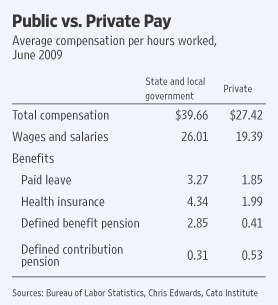
From WSJ
Arnold Kling fulminates:
I believe that the elites have so mistreated the American people that we should declare that a state of war exists between America and Washington.
Call it whatever you want, as long as it wakes somebody up from their dogmatic slumbers. This is getting ridiculous.
Tax Competition 101
I came across this video which concisely explains why international tax competition is a good thing.
What If Economists Were in Charge?
The latest Freakonomics podcast asks GMU’s Russ Roberts, Mart Laar (two term prime minister of Estonia), a high-end call girl, and Patri. Stephen Dubner starts off with some poll data from Zogby on how Americans feel about their congressmen. Evidently Americans felt better about OJ Simpson when he was on trial than they currently do about congress between two consenting rent-seekers. Another interesting fact from the Call Girl: the more money men pay for prostitutes, the less interested they are in sex and the more interested they are in strange behavior and companionship. Hiiiyaaaaaah!
Democrats Dump Anti-War Lovers
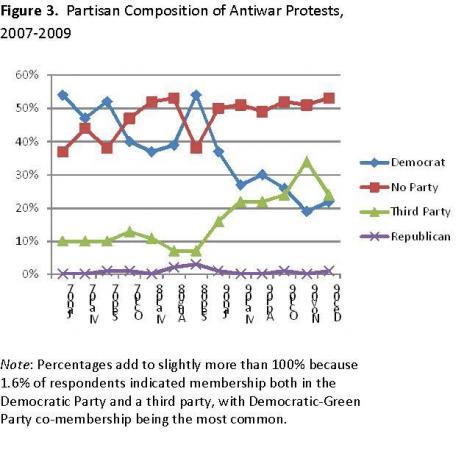
Democratic participation in anti-war movement sharply drops after the Obama inauguration.
Moral intuition precedes reasoning. We make snap judgments and our inner Dershowitz casts about for reasons to make our case. People can change their minds, yes, but by and large we are confabulating post hoc rationalizations based on some mixture of cultural prejudice and cognitive bias. That’s the rough conclusion from folk like Jonathan Haidt and Michael Gazzaniga.
Which is why I’m not surprised by the findings in this interesting working paper by Fabio Rojas. It appears Democrats left the anti-war movement once Obama was in office. Rojas sums it up at his blog:
The key argument is that the decline of the antiwar movement can be attributed, in part, to the fact that Democrats have stopped using the peace movement as a platform for anti-Bush sentiment. In other words, at its peak, the ranks of the antiwar movement were swelled by partisans. Once Obama won the presidency, and other issues emerged, the movement shrank when Democrats stopped showing up.
My overly simplistic theory is that members of the voting Donk loathed George Bush (moral intuition) and then looked around for the most readily available reasons (post hoc rationalizing on war). Now you might say that’s not true. They hated Bush because of the war. But how can that be? Obama has not dramatically changed course in either Iraq or Afghanistan. If these wars were such flagrant moral wrongs five years ago, how come they cease to be after the inauguration? As long as “our guy” is waging it, war is okay? The truth is that they became anti-war because they loved Obama. Not the other way around.
This is something libertarian minded voters should keep in mind now that Republicans are paying lip-service to the virtues of small government and fiscal responsibility. Just as the anti-war movement was dumped, I wouldn’t be surprised to see Tea Party enthusiasm drop after someone like Mitt Romney gets elected.
The Levers of Wealth and Freedom
The newest debate at Cato Unbound is a good one. In their opening essay, David Schmidtz and Jason Brennan want to dispel a “big myth” about liberty, the big myth being the supposed incompatibility between positive and negative freedom. As a quick refresher: positive freedom refers to our capabilities; negative liberty refers to non-interference; many philosophers since Isaiah Berlin’s seminal essay believe a state cannot aim to achieve both. Pursuing one seems to destroy the other, so they say. But, to the contrary of this received wisdom, Schmidtz and Brennan write:
We think both negative and positive liberty matter. Negative liberty matters in part because it is a highly effective, if imperfect, way of promoting positive liberty.
They are not the first to square this conceptual circle. John James Cowperthwaite called it positive non-interventionism. The result is Hong Kong. Isaiah Berlin may have been a tenured Oxford don, capable of fine-grained conceptual analysis with a first rate prose style, but Cowperthwaite sowed the seeds of Asia’s growth for the next 50 years. Philosophers were also quite taken aback by the advent of quantum mechanics. But then again, who wasn’t?
This is as good an opening as any to criticize myopic philosophers for not thinking “meta” enough. (Philip Pettit’s follow-up essay and John Christman’s are guilty of this as well.) It is baffling and unfortunate. Instead of thinking about a system of systems, they focus on a single system of governance and how we should evaluate it. Phrases about what particular governments and societies ought to do are peppered throughout. And this may be an important first step–no doubt we ought to understand which values we want the particular institutions we live under to embody–but these philosophers stop far too short of the big question: what meta-institutions will maximize or establish our highest aims and values?
For instance, which is more likely to increase positive liberty or enlarge the sphere of non-domination for more people more quickly?
- Our existing system of nation states perpetuated as is.
- A global consolidation of nation-states into a single world government.
- An open-ended entrepreneurial system in which the number of nation-states is increased over the next few decades by means of peaceful secession, seasteading, Free Cities, Charter Cities, and other approaches to the entrepreneurial creation of new sovereignties.
I agree whole-heartedly with each essayist that this is an empirical question. The matter cannot be decided with conceptual analysis from an armchair. But it is a question they all fail to ask. So what does history say?
Well roughly and in the main, in any single nation it supports Schmidtz and Brennan’s contention: the best means for increasing the set of our capacities is by establishing negative liberty as the national rule set for governance. I say “roughly” because I take negative liberty to approximate the conditions measured by such indices as the Fraser Institute’s index for economic freedom, which takes into account the security of property rights, the rule of law, the size of the government, access to sound money, free trade, free minds, and so on. And over the last 50 years or so, there is a very strong correlation between a nation’s level of wealth and health and how fully it embraces economic freedom. (See here.)
But this is small scale thinking over too short a time scale.
Small digression on history–here’s a sign of tenured ineptitude. Christman saves his economic illiteracy and ignorance of history for his last paragraph. Does Penn State really promise to pay this man a salary in perpetuity? He writes:
Finally, for many of us, the track record of economic forces and the workings of competitive markets in effectively improving the lives of citizens in an equitable and morally acceptable manner, in a world where over one billion people still live on less than one dollar a day with no foreseeable prospect of meaningful improvement from market innovations, is already an obvious and dismal failure.
Ummm, yeah, citation needed? (Btw, tip to Penn State-guy: when making factual assertions it’s a good idea to base them in fact.) But he does raise a good point. There are two puzzles that promoters of positive liberty must explain: what Kling and Schulz call the Hundred-Year Gap and the Development Gap. The Hundred-Year Gap refers to differences in the kinds of goods and services available now as compared to those available a century earlier. It also involves comparing improvements in the length and quality of life for the average person across that time. I’ll also include knowledge about Nature and the universe, since the greater our knowledge, the more we’re able to tease out her secrets for our benefit. And on these measures, over the last century positive liberties have multiplied exponentially.
The Development Gap compares these same concerns across regions today. For example, the average income in Africa is less than $2,000 a year per person; in the U.S. it is greater than $30,000. Quality of life measures are even worse for people in poor regions. Diseases easily treated in the West kill millions in Africa and elsewhere. On nearly all measurements that approximate positive liberty, these regions are failing.
Admittedly there are some positive liberties that cannot be measured in wealth or health. Perhaps tolerance, I don’t know. But even for these less tangible concerns, the disparity between a century earlier and today holds just the same. Across regions, too. (Pace Christman, a tenured prof in a wealthy country, I’m not really concerned with debating the desirability of wealth and health as essential components of well-being and fulfillment. I take them as given.)
The positive liberty enthusiast cannot avoid coming to terms with this tale of scarcity and abundance. And he has to take seriously the laws, institutions, norms and practices that add fuel to the fire of growth. He also has to appreciate the difficulty of raising the poorest billion of the world out of poverty. If we’re truly concerned with positive liberty for all, as Brennan and Schmidtz and Christman appear to be, we shouldn’t limit ourselves to thinking about life within a particular nation. We need to think about what global system of nations and city-states will promote liberty with greater success than others.
Why is this important? Well for starters, there’s simply a lot of knowledge about governance we don’t have. It may be that there are more efficient ways of promoting positive liberty, especially within the context of particular regions, histories and cultures. We need some room for experimentation; we need room for greater customization in governance.
Most importantly, however, is this fact: negative liberty is not enough to promote prosperity over 100 year time spans or in developing countries. Or I should say it’s necessary, but not sufficient. There are a host of political and social obstacles that accumulate to prevent this.
At any rate on this scale and across eras and regions, what are the curbs to the discovery of new knowledge, whether it concern governance, authentic living, science or medicine? What fortifies the old at the expense of the new? What limits our positive liberties on a global scale?
Breaking Cardwell’s Law
Not all, but a good portion of economic growth is driven by innovation. And D.S.L. Cardwell observed that the creativity of most innovative societies is often short lived. The history of technological advancement is spasmodic and full of rare bursts. Britain between 1760 and 1800 or China from 130o to 1400 are epochs of great flourishing. But more often than not, these bursts of innovation peter out. Why this happens is a great puzzle. In his Turning Points in Western Technology, Cardwell is silent on this decline. He observes the rough historical pattern, but provides no explanation for it.
One plausible explanation, put forward tentatively by Joel Mokyr in The Gifts of Athena and in The Lever of Riches, is the following–the more vested interests are able preserve the status quo, the stronger resistance to innovation will become. It’s an Olsonian narrative. Because new technologies and new knowledge threaten the rents collected by current industry leaders, these leaders will exert no small effort to curb or extinguish the growth of the new. Of course, when the market is the sole arbiter of which innovations thrive, these displacements occur frequently and without resistance. To take but one example, investors in Tower Records sustained great losses on account of iTunes and had no protection against this. But if a system of governance were to allow, say, a Google to prohibit the discovery of more efficient search algorithms, then Google’s owners will work within that system to establish such a barrier. In fact, a lot of protectionism and regulation can be explained in this way: vested interests displacing the market from the role of arbiter, using instead a political process to decide what wins and what loses.
So what happens is that the innovators of today become the vested interests of tomorrow. And overtime, the barriers to entry they erect will accumulate and bring innovation to a halt. There are other obstacles I should mention as well: conservatism and technophobia, a status quo bias, tenured Penn State philosophers, the alienation some experience when dislocated by new invention, and so on. At any rate, prosperity suffers. Cardwell’s Law holds. And in the terms of this debate, positive freedom is imperiled.
But Mokyr offers a way out. And it goes like this. Innovation atrophies only for a single closed economy. But if we were to have a set of open and fragmented competing economies–a system of competing systems–then the resulting diversity, pluralism and independence will prevent the establishment from clogging the line of progress. It is for this reason that Western Europe continued to thrive over the last 500 years, while large empires like China, Russia and the Ottoman Empire did not. On this point Mokyr writes:
[Cardwell’s Law] holds for individual European societies, of course, but precisely because Europe was fragmented it does not hold for the continent as a whole. It is as if technological creativity was like a torch too hot to hold for long; each individual society carried it for a short time. So long as there was another nation or economy to hand the torch to, however, some light source illuminating the landscape has been glowing in Europe more or less continuously since the eleventh century. As Cardwell put it ‘the diversity inside a wider unity has made possible the continued growth of technology over the last seven hundred years.’
And he quotes David Hume, who in 1742 wrote that:
Nothing is more favorable to rise of politeness and learning than a number of neighboring and independent states, connected together by commerce and policy. The emulation which naturally arises among those neighboring states is an obvious source of improvement. But what I would chiefly insist on is the stop [i.e., constraint] which such limited territories give both to power and authority.
What Hume calls power and authority, of course, is what I have been calling vested interests and the forces of conservatism. And, sadly, those constraints he mentioned have been disappearing for years. We seem to live in the great age of centralization and conformism. What is to be done? How can we obtain the benefits of fragmented and open economies that Hume describes?
Let a Thousand Nations Bloom
At the Long Now Foundation, Paul Romer asked, “What if there were no new countries?”
The answer: a stagnation of positive liberty. Because as much as we would like to believe the U.S. will be the technological leader of the world forever, there is little reason to believe it can be sustained once we extrapolate from history. But if someday soon we see the emergence of new places, places where people can migrate to and where new systems of governance can be tried, we can improve the odds that the next Hundred Year Gap will be even larger than the previous and that the Development Gap will disappear.
If we want more positive liberties, both for those who live in the future and those who live in poor regions, we need an entrepreneurial system in governance. We need the number of nation-states to increase over the next few decades. Peaceful secession, seasteading, Free Cities, Charter Cities, and other approaches to the entrepreneurial creation of new sovereignties–all these are the levers of freedom and wealth. They are the protectors and promoters of positive liberty. Don’t let tenured philosophers tell you any differently.
New England Journal of Med Poll on Health Care
If Obamacare passes, NEJM reports docs may quit or go Galt or join a seastead or something:
72% of physicians feel that a public option would have a negative impact on physician supply, with 45%feeling it will “decline or worsen dramatically” and 27% predicting it will “decline or worsen somewhat.
Intrade, however, is now pessimistic about the bill’s passage.
Link Archipelago
- The Handicapper General may have found his tool. The life of Harrison Bergeron is closer than you think. “George, while his intelligence was way above normal, had a little mental handicap radio in his ear. He was required by law to wear it at all times. It was tuned to a government transmitter. Every twenty seconds or so, the transmitter would send out some sharp noise to keep people like George from taking unfair advantage of their brains.”
- Bankrupt Greeks demand positive rights: “Vasia Veremi may be only 28, but as a hairdresser in Athens, she is keenly aware that, under a current law that treats her job as hazardous to her health, she has the right to retire with a full pension at age 50.”
- Newsweek revisits Amy Chua’s World on Fire: How democracy dies in the developing world. “They saw democracy as just semiregular votes; after they won, they then used all tools of power to dominate their countries and to hand out benefits to their allies or tribe.”
- Wyoming governor signs sovereignty resolution.
- Garage Bio-Hacking in Silicon Valley. I remember Peter Thiel saying biotech would never take off until people without PhDs were hacking in garages. Who will be the Steve Wozniak of DNA?
- Nature’s Toilet: the largest meat-eating plant in the world is designed not to eat small animals, but small animal poo.


 Let A Thousand Nations Bloom