The White Book of Capitalism & Democracy
As a response to the damning Black Book of Communism, some recalcitrant Marxists have begun compiling what they believe are the crimes of capitalism. They call it the White Book. Here are some capitalist-pig crimes they cite:
- (1962-1996) The Guatamalean government, along with the United States government which played a major role of support, committed genocide and terrorism resulting in the systematic torture and murder of 200,000 people.
- (1975-1999) In the Republic of Indonesia, 200,000 East-Timorese were massacred in a campaign of genocide spanning several decades.
- A whole section on U.S. military history and nuclear proliferation, with sections on environmental destruction, poverty, and union busting to come.
After two minutes of reading this mess, it will dawn on you that all of the crimes they cite are crimes committed by nation-states. They say nothing about how markets relate to any of this. Very peculiar. Take away the words market and capitalism from their website, and it reads like a fairly orthodox criticism of state power.

Exit From the Road to Fiscal Serfdom
Tim Kane has a thought-provoking post on how the young will react when it comes time to finance Generation-Me’s entitlement debt. He says they’ll leave:
Consider: almost everyone younger than the Baby Boomers expects to get the short end of the fiscal stick. We were laughing about the unlikeliehood of getting Social Security Checks when I was in high school in the 80s. So now that the reckoning is all but unkickable, do the Boomers think their kids and grandkids will just become fiscal serfs? Think again.
The consequences of U.S. fiscal calamity will go hand-in-hand with globalization. The world is in the early stages of globalization, but already member states in the EU are feeling the effects of combining tax competition with the right of movement. A 2006 BBC report noted that nearly 10 percent of Britons lived aborad, a million in Spain. Two emigrant types dominate: retirees and workers! Here’s a more recent report from the OECD
The threat America faces is a world that competes for our greatest natural resource: it’s young. If we make the tax climate hellish, the U.S. is going to suffer outmigration as places like Canada, Australia, Brazil, Mexico, Chile realize what an opportunity they have to cream our entrepreneurial talent. If we don’t, and let the deficit spiral out of control, the dollar will fall and workers will go elsewhere for value reasons.
Kane doesn’t mention seasteads or free-economic zones or charter-cities. But if they’re around, they’ll be all the more attractive to the young and innovative. (HT: Bryan Caplan)
U.S. Census: Good, Bad or Indifferent?
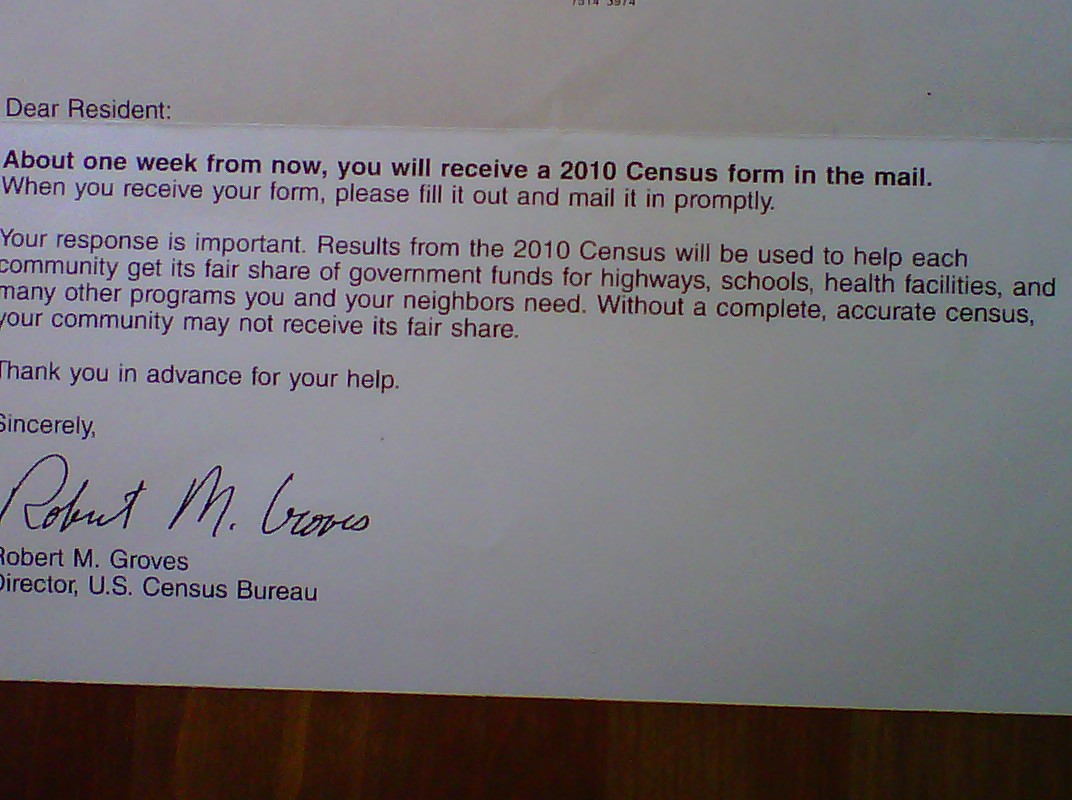
Legibility & Social Control
Thanks for the warning, Bobby! I was concerned–freightened, in fact–that I might unexpectedly receive a Census form and not know what to do with it. If the idiocy of this mailer weren’t enough, then what irritates me further is its cordial invitation to plunder a “fair share.” In case the picture is too out of focus to read, I’ll type out my invitation from Robert M. Groves:
Results from the 2010 Census will be used to help each community get its fair share of government funds for highways, schools, health facilities, and many other programs you and your neighbors need. Without a complete, accurate census, your community may not receive its fair share.
Justice as fairness–how delightful! And how silly was I to think the U.S. budget was distributed, not according to fairness and the public good, but according to power and the influence of competing interests. Naive citizen! Let thyself be counted.
The Marquis de Vauban proposed a census to Louis XIV in 1686:
Would it not be a great satisfaction to the king to know at a designated moment every year the number of his subjects, in total and by region, with all the resources, wealth and poverty of each place…[Would it not be] a useful and necessary pleasure for him to be able, in his own office, to review in an hour’s time the present and past condition of a great realm of which he is the head, and be able himself to know with certitude in what consists his grandeur, his wealth, and his strengths?
I’m reminded of a symbolic anecdote John James Cowperthwaite would tell about governing Hong Kong. He said he refused to let the government keep any kind of economic statistics because he didn’t want any policy makers to have an excuse for intervening in the economy. Counting, tracking, numbering and measuring–all these attempts to make society more legible give policy makers the illusion of great control. And the temptation to indulge in that self-deception is all too great.
It’s a slippery slope. James Scott, in his book Seeing Like the State, provides a good model for this trend. Social legibility in itself isn’t necessarily a bad thing, many public goods depend on it, but it can become the policy-maker’s gateway drug to much worse. When it’s combined with these two elements–an increasing faith in rational, technocratic control (the fatal conceit) and a willingness to use the full coercive apparatus of the state–the upshot is authoritarian tyranny. I highly recommend Scott’s book: he gives an insightful analysis of this global trend during the 20th century.
Of course, the U.S. government has not sunk so low. Authoritarian high-modernism is not its guiding ideology. But, pace Bobby Groves, I have no plans for answering his Census request. I live in California. My political beliefs are marginal. I will never receive what I believe is legitimate representation. The last thing I want to do is give Los Angeles or the state another representative or electoral college vote or whatever–it has way too much power as it is, I’m afraid. This is the best non-vote I could possibly cast. For this U.S. Census, I’m afraid you can count me out.
Link Archipelago
- Evidence for Free Willy Curse here and here and here.
- Politicians sweep midterm elections.
- Why we aren’t living in Western Civilization.
- Obsolete jobs from yesteryear: pics of pinsetters, elevator operators, icemen and others. What jobs will disappear in the next 30 years? I vote tenured professors, professional basketball players, and city desk reporters.
- Video: freak 30 foot wave crashes into cruise ship, killing two.
- Wyoming legislators pass the Cowboy Code: Talk less, say more
- Jonathan Haidt’s book proposal on political psychology: “I’ll make it clear that the terms ‘liberal’ and ‘conservative’ refer to families of views that are not necessarily united by any one belief, but that can be understood best by examining how ecological contexts (such as agricultural vs. herding vs. trading economies) activate a variety of personality variables (such as openness to experience, authoritarianism, or disgust sensitivity) to make certain philosophical positions attractive to different people.”
- NYTimes: human culture as evolutionary force.
- Michael Lewis, The Big Short: How a one-eyed man forecasted the financial meltdown and made millions.
Institutions That Kill Enterprise
Animals long held in captivity fare poorly when released into the wild. Call it the Free Willy Curse. (Keiko, the famous orca, died a year after being released into the Norwegian Sea; sadly, he beached himself after bouts of lethargy and loss of appetite.) Arnold Kling argues that many government workers fear the Free Willy Curse:
…if I am totally dependent on my employer for a job (that is, my next best alternative is something with a much lower wage rate), then I must behave very submissively toward my employer. How many people are in such a position? Government workers strike me as an obvious example–many of them would be unable to earn as much in the private sector, particularly now. So they would tend to be highly submissive.
Fearing lethargy and loss of appetite in the open market, bureaucratic time-servers entrench, erect barriers, and obsequiously bow to their superiors in the GS 13-15 pay grade. They care less about serving their customers than they do about respecting the Chain of Command. Such elective submission reminds me of a post Scott Adams wrote back in November on the Dilbert blog. He said bad management spurs entrepreneurship:
Imagine a world where managers always recognized and rewarded their most capable people. It would be hard for a rational employee to leave a great job for a ten percent chance of creating something even greater. But leaving a boss who is Satan’s learning-challenged little brother is relatively easy. And if the general economy isn’t serving up wonderful job opportunities at other companies (thanks in part to bad management) then you can see why people gravitate toward starting their own companies…Big companies with bad managers are the ideal breeding ground for entrepreneurs.
Google offers a lot of resources and free time to retain its talent because Page and Brin know their best engineers have an entrepreneurial itch. Some of these engineers still leave (I’m looking at you, Patri!) but some stay and instead work to develop their new ideas in house. Bad management inspires the entrepreneur, but the threat of exit also disciplines management.
But with governance, we see the opposite effect. Let’s suppose there were an innovative, enterprising policy maker, fresh to the Beltway. As soon as he finds he is supervised by an army of morons and Captain Joy Kill, what will he do? Can he exit and start his own company to offer a better service at a lower cost? No, no. In government, bad management whips skill and effort into submission because that skill has no where to go. There is no threat of exit.
Over the last few years, the Free Willy Curse has gone viral. What is to be done?
Free To Leave?
Some believe that individuals are free to leave the U.S., no questions asked. Unfortunately, this is not the case. A few points:
- Citizens abroad who make more income than a certain threshold (I believe about $85,000) must pay U.S. income tax equal to the amount he would pay were he residing in the U.S.. The number of countries that tax in this way–on the basis of citizenship instead of residence–is very low. (It’s gated, but see Taxing American Expats in the Economist.)
- It is illegal for a U.S. citizen to keep and fail to disclose any foreign account whose value exceeds $10,000. Failure to disclose results in a fine equal to fifty percent of the account’s value. (More info here.)
- In accordance with the 2008 Charlie Rangel bill perversely named Heroes Earning Assistance and Relief Tax (HEART), any U.S. citizen or Green Card holder who renounces his ties to the U.S. will be taxed on all his assets as if they were sold on the day of expatriation (equivalent to a mark to market capital gains tax). There are a few exceptions and thresholds, for instance the value of assets must exceed $600,000. Here’s a good summary. Here’s another.
True–these laws only apply to the well off. But the consequences affect many. Max Marty suggested I orient my question on the right of exit towards the future:
“Should individuals, groups, or businesses, seek jurisdictions with an eye towards minimizing the future cost of exiting from those jurisdictions?”
Well, the HEART Act certainly gives potentially productive immigrants and investors less reason to come to the U.S.. It also removes a powerful check on government expansion. And, if we care about such things, it takes away the right of these people to exit freely.
Exit Builds Genuine Community
Throughout 400 years of American history, some of the strongest communities have been those which made the most of exit. The earliest settlements with the greatest success were those with a strong religious element. The trend continued somewhat out West in the 19th century as well. I would bet that Seasteading, at least in its infancy, will pick up where these pioneer communities left off.
It’s easy to see why. To forgo the benefits of urban life and mutual cooperation only makes sense if the returns to exit are higher. And so in all these historical instances we see a blend, among those who have exited, of like-minded idealism and self-interest. Taken to the frontier, life is on the threshold of being nasty, brutish and short. But it is precisely because of this difficulty that solidarity builds further. Whatever vital functions a government had performed in society before, now these must be assumed by individual pioneers.
I think this is what De Toqueville had in mind when he wrote about how weakness leads to stronger association. The Frenchman says:
Amongst democratic nations, on the contrary, all the citizens are independent and feeble; they can hardly do anything by themselves, and none of them can oblige his fellow-men to lend him their assistance. They all, therefore, fall into a state of incapacity, if they do not learn voluntarily to help each other.
The flip side of this theme was picked up by Charles Murray in his book called In Pursuit. When men can oblige others to lend assistance, association atrophies:
Communities exist because they have a reason to exist, some core of functions around which the affiliations that constitute a vital community can form and grow. When the government takes away a core function, it depletes not only the source of vitality pertaining to that particular function, but also the vitality of a much larger family of responses…
“If you don’t do it, nobody will” is a powerful motivator for solidarity. Whereas “if you don’t do it, the government will” is a charitable and fraternal buzz kill. Murray says, and I agree, that people tend not to do a chore if somebody else will do it for them. Philanthropic free riding is the irrational voter by another name.
The power of exit relates to this in two ways–: it pushes people closer to a situation where “if you don’t do it, nobody else will” applies. And that is the great community generator. For the pioneer community, the exigencies of life in the wild will foster a greater reliance on others. For the society left behind, the more people exit, the less philanthropic free-riding occurs among those who remain present. If enough people leave, you are the government and the two slogans become one and the same.
Community, Exit, and Liberty
This guest post is by Gus diZerega, a contributor to both Beliefnet and Studies in Emergent Order. Gus is a political scientist/theorist with a PhD from the University of California at Berkeley. This is his response to the debate proposal.–Editor
Individuals and communities relate as the sides of a coin, each implying and depending on the other. On this I hope we all can agree, and I will proceed assuming this is so. Before I can go farther, though, I want to try and make more clear how I define terms such as community, democracy, and individual.
Individuals do not exist in a single community except perhaps in the earliest times and in the most isolated groups. The modern “Community” (capital ‘C’) is made up of countless nested and overlapping communities oriented around different values and groups of values. Such communities include families, religious groups, economic groups and professions, the arts and the schools of which they are comprised, groups focusing on hobbies, broadly and narrowly defined, language groups, groups identifying with a common history, and so on.
In a crucial sense, individuals are gestalts of the various communities in which they participate. This is not all that they are, but it is a crucial part of who they are.
As communities become more diverse the Community gradually expands to the point that it consists mostly of strangers sharing only a few things in common. Identifying criteria become more abstract.
The democratic political community is that territorial area within which members of these complex communities seek to discover, modify, and enforce rules that ideally make for harmony between the multiple sub-communities that constitute it. It can be relatively unified, like Sweden, or federal, like Canada. In modern times no single political community is entirely autonomous, as the International Court of Justice and other multi-national agencies indicate. (Significantly, only democratic governments have proven willing to give up part of their sovereignty, beginning with the adoption of the US Constitution, but hardly limited to it.)
Traditionally the democratic political community has been treated as a State by both libertarians and communitarians, getting both off on to the wrong foot. The first insightful political theorist to see that this was not the case was James Madison, but his insights were not followed up either in the US or elsewhere. With a broader understanding of what Hayek called “spontaneous orders” we are in a better position to appreciate how they are not, as well as the heavy price we have paid for treating them as if they were.
A State is a hierarchy of command, the rulers at the top, whether king or dictator, party or oligarchy, theocracy or aristocracy, seeking to impose a hierarchy of goals on the society over which they rule. A state is an organization in the sense that it can be defined teleologically. It has interests and goals.
A democracy has universal or nearly universal suffrage (most aspects of democratic politics become relevant when suffrage is universal manhood, but not all), freedom of political speech, freedom of political organization, and freedom of the press such that all voters can be reasonably exposed to alternatives to the current incumbents who can be ousted in regularly scheduled elections.
In the US case (other democracies descended from States and so are harder to differentiate, but it can be done) the equivalent of the State is the Executive Branch. It is subordinate to the legislative branch which, when push comes to shove, is constitutionally dominant while itself being subject to the requirement of regular contested elections determined by the population.
That is, in a democracy the State (Executive Branch/Functions) is subordinated to the electoral choices of individuals who each in their own way reflect a portion of the total community make-up within the political community. A democracy is not a hierarchy. Rather, it is a means by which multiple and overlapping and interpenetrating communities can seek to discover, modify, and implement basic rules they regard as optimal for the functioning of the inclusive community. We call this the “public good” and it is always a matter of discovery and modification.
Obviously there is no guarantee the public good will be discovered in any optimal sense and plenty of evidence it often is not. Organizations within this matrix are always seeking to gain control of it and insulate themselves from its dynamics. They do so by saying they seek the public good, values, or some other term that sounds good to everyone or by subordinating democratic processes to extra-democratic principles, such as control of wealth. Democracies have serious principle agent problems, and this is why some dimensions of the public good can often be best attained outside traditional political means. But just what these are is itself open to political determination. Some public values will be provided politically, and some through philanthropy, but the border between them is determined politically and pragmatically, not ideologically.
The public good is no more discoverable by an ideology or group of experts than market equilibrium is discoverable by a group of planners or scientific validity by a separate group of scientific judges established to determine whose arguments shall prevail. All of these spontaneous orders depend on all participants having formal equality and all depend on participants playing by the rules.
To argue that democracies are spontaneous orders is an unfamiliar position for many because it cuts at cross-purposes to modern ideological straightjackets on both individualistic and communitarian sides. But plenty of literature now backs the claim up, and that it is so explains why democracies, alone among all form of government, have never waged war on one another, give up portions of sovereignty peacefully, and even in important cases allowing for peaceful secession (Sweden, Czechoslovakia, and had it come to that, almost certainly Canada and many direct democracies among New England’s small towns when they had more autonomy than they do today). Others, such as the UK and Spain, have gone from highly centralized to more federal forms of internal structure. Except for times of foreign crisis and natural disaster when a hierarchy of goals is externally imposed, democracies cannot be described in terms of hierarchies of goals. And it is when such hierarchies exist, and there is greatest unanimity, that democracies act most undemocratically. This is a paradox only when we equate democracies with States.
To put this point in terms of systems theory, democracies are spontaneous orders that are in continual flux. That are variously enlarging and shrinking their boundaries by means of widespread consent rather than conquest, and are similarly acquiring and devolving decision making authority from other democratic bodies of which they are constituted. The image of stability and permanency that we associate with states is evidence of a breakdown in democratic processes. The organizations within a spontaneous order always have a tendency to seek to freeze adaptive processes at points where their dominance can be assured.
I have gone on at some length here because what I will argue is dependent on the democracies-are-not-states argument.
EXIT
Democracies have been the only governments to my knowledge that have allowed secession when a significant portion of their territory demands it. Obviously this is relevant to the issue at hand. The US Civil War was not a war between two democracies. The Confederacy was founded, as its leaders emphasized, on slavery. Because it’s fundamental principle was domination and coercion, not only did these perversions leak into the rest of Southern society (which they continue to poison) the Confederacy also lacked the basic legitimacy, even at home, needed to make a successful secession work. The votes for secession were usually by a ruling class that held office only because they were slave owners. Had the desire for secession been truly and deeply held, then after the North had conquered the South, guerilla war would have rendered the occupation unsuccessful. There was not enough popular desire to carry on such a conflict. By contrast, when there was genuine popular demand, often the democracies allowed it. And Southern propaganda to the contrary, absent slavery there would have been no secession, because issues such as tariffs were easily amenable to political compromise.
Exit in truly democratic governments exists at two levels. First, individuals have always been free to leave. Second, entire areas, when large enough, have often been able to depart peacefully as Norway, Slovakia, and potentially Quebec demonstrate.
As a community concerned about harmonizing as best it can the diverse communities of which it is constituted, democracies are also quite justified in setting entrance requirements for immigrants. The language of universal abstract rights does not give everyone the right to move into anyone else’s community. What those rules of entrance will be are the concern of the community itself.
The major principled problem here regards populations that were conquered and incorporated into a democratic society against their will, and who are too small to be politically powerful. Scandanavian Laps, American and Canadian Indians, Hawaiians, and Australian Aborigines are the most obvious such groups. But these crimes were not the result of democratic principles being followed with regard to them, and significantly, what improvement that has occurred in their situations has been by their calling upon democratic principles which obviously constitute more than “majority rule.” (This is a very simple minded definition of democracy, but still complex enough to elude many conservatives nonetheless.)
LIMITS OF EXIT
Some individuals with a distorted sense of their uniqueness think they should not be subject to the decisions of their fellows when they disagree with the decisions. But the most basic means by which people relate to one another in modern society depend on this process they reject. In the hard core individualistic view, virtually all or all relations are defined in terms of property rights. However, determining a property right is a political decision. Always.
All property right are defined not by the things to which they attach, as we usually think, but by the relationships which right-holders are enabled to pursue when they own a property right. Property rights define realms of potential relationships that a person is free to pursue. My property right to my gun does not allow me to fire it in a city in most cases because the community has determined there is too much danger to others. Even if I fire it in the air, I cannot tell where the bullet will descend. So ownership of firearms, which is a constitutional right, is NOT open to recreational shooting in cities. No sane firearm owner wishes it to be. Certain things are not allowed but this does not take away a right that would exist were it not denied politically. Property rights are always embedded in community relations. Robinson Crusoe did not need property rights until Friday came along.
The same holds true when I play my music. After certain hours neighbors have a right not to have to hear it. Why? Because of a community decision that could have been otherwise and still been as justified. Because what is or is not justified is the decision of the political community, as is the fact that earlier in the day they could not prevent me playing my music so long as it did not exceed a certain (higher) level.
The only limits to what a democratic community can decide are property rights are the most basic human rights, which this paper is assuming. If someone is in serious disagreement about a law that the community in which they are in is making, and the community is reasonably democratic, they have several options:
- They can emigrate if another community more to their liking will take them.
- They can convince a large enough portion of their neighbors they are right, and seek secession.
- They can seek to convince enough residents that they are right to get the law overturned.
- They can violate the law through civil disobedience and use that to dramatize the issue and get people to think more wisely about it – the Thoreauvian solution.
What they cannot legitimately do in a genuine democracy (meaning where a reasonable opportunity exists by which they can seek peacefully to persuade others) is to act violently in resistance. Just where this line is crossed is often difficult to determine, and people will disagree about it. But it is a fateful one that should only be crossed when the issue is serious enough, as our own Declaration of Independence emphasized when justifying separation even from an undemocratic power. Lunatics and sociopaths to the contrary, that line has not been crossed in the US.
A democracy is a rare achievement that cannot simply be taken for granted. It’s value lies in having an entire political community cross that fateful boundary between being an organization of domination that seeks and flourishes on oppression and war, to an emergent process where organizations are limited in their power and always open to challenge. Those who seek to turn a democracy into an organization are the worst enemies of civilization it is possible to reasonably imagine.
The nature of this project guarantee subtleties will be ignored or given what some feel insufficient weight. Almost every paragraph makes claims others have written books denying, except for the central claim that democracies are spontaneous orders. That is usually ignored. Maybe the debate will deepen our understanding (mine included) of some of the issues involved. A bibliography of more detailed analyses of many of these arguments can be found at www.studiesinemergentorder.com.
In Praise of Civil Societarianism
Arnold Kling coined the term, I’d like to return to it. The idea is that a necessary condition for freedom is a robust and diverse civil society. Not only do these voluntary non-market institutions satisfy our innate need for community, but, when strong enough, they provide a powerful check on centralizing and authoritarian tendencies in governance. They also serve to shape character, establish rites of passage, and provide aid and care to the worst off. Communitarian thinking is most useful when addressing the importance of these institutions to our well-being. The philosophy is at its worst when this is used to rationalize a pervasive, soul-crafting national government.
I highly recommend Robert Nisbet’s 1953 book The Quest for Community. It’s a conservative’s Road to Serfdom, so you can expect insightful social commentary and thought-provoking literary references, but little in the way economic history or explanation. Still, the book makes some compelling points. Nisbet explains the rise of totalitarian government as the outcome of two facts: the hollowing out of civil society and the inveterate human need for a group identity. When all the intermediary institutions between the individual and the state are razed, Nisbet says the individual finds refuge from the resulting alienation in the State. Patrick Deneen at the Front Porch Republic has a good summary of the thesis:
Nisbet saw the modern rise of Fascism and Communism as the predictable consequence of the early-modern liberal attack upon smaller associations and communities – shorn of those memberships, modern liberal man sought belonging through distant and abstract State entities. In turn, those political entities offered a new form of belonging by adopting the evocations and imagery of those memberships that they had displaced, above all by offering a new form of quasi-religious belonging, now in the Church of the State itself. Our “community” was now to be a membership of countless fellow humans who held in common an abstract allegiance to a political entity that would assuage all of our loneliness, alienation and isolation.
This is not too far from the last presidential campaign; each party serves as a community and candidates present themselves as a salve to assuage feelings of hopelessness. In fifty years the trend has not abated.
I’m not as certain as Kling that a stronger civil society will act as an effective check on government power. Maybe at the city and state level. But the Feds dwarf everyone. That’s not to diminish the importance these institutions have for our well-being. Penn State football serves a very valuable social purpose. But the benefits of community will always seem picayune when compared to multiplying vices of national stagflation.
Debate Round Up (so far…)
Let me rephrase Mike’s question as follows:
“Should individuals, groups, or businesses, seek jurisdictions with an eye towards minimizing the future cost of exiting from those jurisdictions?”
From the comments, Adam Knott:
Bottom line, in asking other people for a right of exit, we are not only asking for permission to embark on a peaceful society—thus demonstrating how little we value it—we are asking others essentially to change their religious beliefs, something none of us are willing to do. I think we are making a huge mistake.
The idea that a nation can survive solely on contracts, as elegant a solution as contracts are, is lacking in several respects, the two main being fecundity and martial capability. These are two necessary aspects of continued existence for a nation that secular ideologues don’t like to address, but are of the utmost importance for the continued existence of a nation. It would take immense technological improvements for this not to hold.
Entrepreneurship, social or otherwise, is starting to languish. The resources we use to play king of the mountain don’t get used on positive social change. As a result, we’re increasingly disillusioned, polarized and angry. I say enough already. And there is a way to end it.


 Let A Thousand Nations Bloom