Avatar, Property Rights, and New Nations
(This won’t be much of a spoiler, but if you want to know nothing at all about the movie, stop reading now.)

A lot of criticism has been written about the simplistic, hackneyed plot of Avatar (including by me, or this guy summing up the Patriot anti-Avatar sentiment). And I agree with most of it – I think all those awful themes were there in spades. But (ever the contrarian) I’d like to offer a couple counterpoints.
First, while the movie signaled many values of Ludditism, anti-trade, anti-profit, and anti-progress that I disagreed strongly with, let’s not forget that at the heart of the movie is the idea that it is wrong to initiate violence to take or destroy other people’s land and property. That just because someone else has something you want, and you have bigger guns, that doesn’t make it OK to go take it. If we view the story as a mirror for deep aspects of the human psyche, I find it very promising that the center is respect for property rights. (Kinsella agrees, and Andrew says it’s all about the importance of knowledge over resources.)
And most promising for the future of small-scale, entrepreneurial government is that it is specifically respect for property rights to your homeland – that of all the crimes against property, aggressing against a homeland is portrayed as one of the worst. It is so bad that an entire world unites to fight back – because an aggressor who destroys one homeland may destroy more. A strong human bias towards respect for the territory of a tribe is just what we want, given that we’re seeking to carve out new territories.
This also shows the importance of making your new territory someplace empty – whether on the frontier as in seasteading, or on empty land as in Charter Cities. Otherwise, you risk triggering the associated defense bias – people feeling that their homeland is being taken away from them. This problem shows up in a number of alternative strategies for improving existing systems:
- Winning in a large existing country, whether by revolution or election.
- Taking over a small third-world country.
- Concentrating power to take over a state, like the Free State Project.
Each of these may result in people feeling like they are losing their homeland, which is not good. We want those working with us to feel like they are fighting on the side of good as part of an epic battle for the future of the world, but we DO NOT want those who might work against us to feel the same thing. They should see our struggle as orthogonal to their own – perhaps good, perhaps bad, but certainly nothing to gather the tribes over.

New Cities From Scratch

Songdo, South Korea--City of the Future?
We’re starting to see an emerging market for city-scale development. Gale International, a US-based firm, is teaming up with companies like Cisco to build new, green, tech-friendly cities from the ground up. Fast Company’s Greg Lindsay has a think piece on their efforts to create a city in Songdo, South Korea, inside one of Korea’s Free Economic Zones. The nut:
As far as playing God (or SimCity) goes, New Songdo is the most ambitious instant city since Brasília 50 years ago. Brasília, of course, was an instant disaster: grandiose, monstrously overscale, and immediately encircled by slums. New Songdo has to be better because there’s a lot more riding on it than whether Gale can repay his loans. It has been hailed since conception as the experimental prototype community of tomorrow. A green city, it was LEED-certified from the get-go, designed to emit a third of the greenhouse gases of a typical metropolis its size (about 300,000 people during the day). It’s an “international business district” and an “aerotropolis” — a Western-oriented city more focused on the airport and China beyond than on Seoul. And it’s supposed to be a “smart city,” studded with chips talking to one another, designated as such years before IBM found its “Smarter Planet” religion.
The article introduces an important trend to the public, but unfortunately it’s plagued with statements that are either economically ignorant or biased or both. For starters, consider this false dilemma in the dek:
Are these companies creating a smarter metropolis — or just making money?
Dooooo what now?–Wait, you mean you can’t do both? Abu Dhabi seems to think you can. Or maybe, instead of the authoritarian high modernism of Brasilia, there is a closer, more relevant example, like say, I don’t know…Hong Kong, Singapore or Shenzhen or something. Next, if you prefer, consider this widely pessimistic buncombe:
“Cities are becoming unsettled,” warns Saskia Sassen, the Columbia University sociologist who’s the leading expert on cities’ collision with globalization. “They will be the sites of new wars — wars for water, for a clean environment, and not to mention room for some 700 million people displaced by climate change.” Sociologist Mike Davis prophesied in his apocalyptic Planet of Slums that “the cities of the future, rather than being made out of glass and steel … [will be] instead largely constructed out of crude brick, straw, recycled plastic, cement blocks, and scrap wood.”
The first war on drugs was fought with guns; the second will be fought with….sticks and stones!! I have nothing particular to say against these sad dog scholars, but it’s baffling that the article doesn’t include any thoughts from economists. Not one. Forget Ed Gleaser, or heck, even Paul Romer. No thoughts as to why anyone would want to live in a city. In fact, the article doesn’t mention–not once–a reason as to why people are going to move or operate a business in Songdo at all. The author doesn’t say it’s located in a Free Zone and that there are incentives meant to lure businesses, such as tariff, income and corporate tax exemptions for the first 3 years, among other encouragements. (I wonder if the Radiant City, Brasilia, offered that?) Instead, we have Pip Coburn:
“Cities are highly complex systems, and one of the elements of highly complex systems is that when you monkey around with them, their predictability goes to zero,” says Pip Coburn, a technology analyst…And when it comes to something as complex as cities, he says forget it. “If you’re trying in advance to define a future city, you’re out of your mind. You’ll spend years and money disrupting people’s lives.”
The truth, of course, is that simple rules can create complex systems. Even in the law. And the plan in Songdo, if I remember the article’s headline correctly, isn’t to change existing cities, but to create them from scratch. Intervention is fraught with unintended consequences and blunders. But that’s not what this is about. Instead, what we have sounds more like a review of Metropolis.
The DIY Industrial Revolution

Local Motor's Rally Fighter: the first "crowdsourced" car
It’s not online yet, but in the new issue of Wired, Chris Anderson dilates upon the coming era of mass customization. In a phrase, “Atoms are the new bits.” By combining open source design, rapid-fire 3D printing, and online marketplaces, the era promises to deliver one-of-a-kind user generated goods. And we’re not just talking trinkets. We’re talking about cars like the one above, made by Local Motors, the first open source car company to reach production. The nut:
Transformative change happens when industries democratize, when they’re ripped from the sole domain of companies, governments and other institutions and handed over to regular folks. The Internet democratized publishing, broadcasting, and communications, and the consequence was a massive increase in the range of both participation and participants in everything digital–the long tail of bits.
Now the same is happening to manufacturing–the long tail of things.
Or, hardware is the new software. More than anything else, I’m interested in what this trend implies: decentralization of power. Today cars, tomorrow state governments. If innovative companies like Local Motors hollow out dinosaurs like General Motors, and the public sees the good in this, then it’s not that difficult to imagine the same spirit spreading to politics. We’ll just have to see.

Heads Up On Libertopia 2010
 The festival is scheduled for July 1st through the 4th. Both Patri and Michael Strong will be speaking, along with other luminaries like David Friedman, Randy Barnett, Hans-Hermann Hoppe, Roderick Long and Nathaniel Branden. If you get your tickets before February 12th, you’ll get a discount. If you’re a student, even better.
(Patri adds: The speaker list for this conference is strongly tilted to structural analysis and activism – lots of polycentric law proponents and theorists – I’m psyched!)
Heritage Economic Freedom Index: Autocracy Wins Again
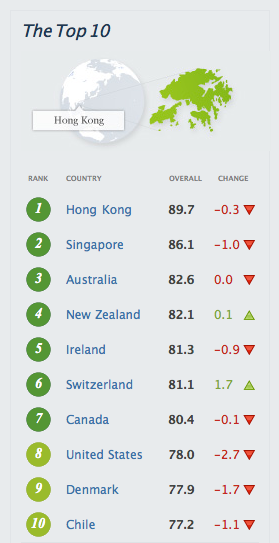 I see Mike Gibson has already beat me to the first post (“Canada Now Boasts North America’s Freest Economy”), on the declining status of the US, but I’ll still chime in with some comments.
The key point I want to make is that the top two countries on the list are not democracies.
Singapore is a “one-party democracy” which was basically ruled by LKY for decades. Regardless of your position on Bryan Caplan’s idea that a one-party democracy can be stable w/o political repression if the country is small enough, in practice the result of one-party rules is that it functions as an autocracy. And a damn good one!
And Hong Kong, once the fiefdom of Sir John Cowperthwaite, is now a special zone run by non-democratic China. In neither case was it a democracy.
Also, we can clearly see the “Crisis & Leviathan” effect – 8 out of the top 10 countries saw economic freedom decrease, the US had the greatest plunge, and the average country dropped by 0.6 out of 100.
Let this serve as your annual reminder of my thesis about economic freedom in the post-1912 world: Functioning democracies bring moderate governance quality and moderate economic freedom, a great improvement in many cases over their previous form of government. But they do not bring high levels of economic freedom, and in fact, democracy is antithetical to a truly free market. (This is due to structural issues such as the consistent triumph of concentrated interests over dispersed ones.)
Instead, we see the highest levels of economic freedom from countries ruled by a single strong, competent, benevolent individual – which is Moldbug’s current suggestion. Perhaps rule by prediction market will prove better – and in fact just based on modern trends towards networks, groups mechanisms, and so forth, I think it is highly likely that in the long-term, some form of aggregation will beat autocracy. But democracy is not that form, for unlike markets, it aggregates ignorance, not knowledge.
The idea of being ruled by autocracy may trigger a negative emotional reaction in you, and with good reason, considering the horrors of the past. But those horrors were in a world without free movement. As long as our autocrat must compete for citizens, rather than enslaving them, then we will get Starbucks, not Stalin.
“Canada Now Boasts North America’s Freest Economy”
I’m guessing Wee Willie Wilkinson is even happier he’s Canuck. The new Index of Economic Freedom is out and the U.S. is falling off the charts:
The U.S. lost ground on many fronts. Scores declined in seven of the 10 categories of economic freedom. Losses were particularly significant in the areas of financial and monetary freedom and property rights. Driving it all were the federal government’s interventionist responses to the financial and economic crises of the last two years, which have included politically influenced regulatory changes, protectionist trade restrictions, massive stimulus spending and bailouts of financial and automotive firms deemed “too big to fail.” These policies have resulted in job losses, discouraged entrepreneurship, and saddled America with unprecedented government deficits.
Here’s the kicker:
for the first time in the Index’s 16-year history, the U.S. has fallen out of the elite group of countries identified as “economically free” by the objective measures of the Index.
No to Charter Cities in Haiti
Jonathan Wilde and Alex Tabarrok asked. Romer replies:
Contrary to what some have suggested, a charter city in Haiti is simply not an option at this time. A charter city can only be created through voluntary agreement. Under the current conditions, the government and people of Haiti do not have the freedom of choice required for any agreement reached now to be voluntary…
There is a natural complementary approach that is a much better bet than giving colonialism another chance—letting Haitians migrate somewhere with better governance and rules…
Competitive pressure from emigration might also speed up progress toward better governance in Haiti. Demonstrated successes for Haitians who live together in other places with better rules might offer a model for reform that people in Haiti could follow. Even then, good governance may not emerge there. But if there were places where all Haitians could go, no one would have to be trapped by this failure.
There are clear limits on the number of Haitian immigrants that nearby jurisdictions are currently prepared to accept. But if nations in the region created just two charter cities, they could accept the entire population of Haiti as residents. There are many locations close to Haiti where these new cities could be built, but for now, Haiti itself is the one place we should not consider.
Seasteading Gets You Agorism (and whatever else you want to try)
Thinking about seasteading and how it relates to agorism (I did a post that barely touched on this a while back, in response to Patri Friedman) again, I think what I see what my intuitive objection is to the current seasteading model. It seems to me that the current “seasteading” approach seems to be modeled on the currently existing nation state. And indeed, most seasteading proponents seem to be at least quasi-statist in their thinking. Certainly they don’t strike me as a bunch of hard core anarchists.
A more anarchist/agorist approach to seasteading to me would be a colony of small ships, essentially houseboats but maybe with a bit more range, who trade goods and services amongst each other outside of the purview of any sort of governing body at all. One of the major advantages of this approach, to me, outside of the obvious one that you don’t need millions and millions of dollars to get started, is that you also don’t provide an obvious, centralized target for government reprisal.
There are several different threads here. One is about seasteading strategy. I posted my thoughts on the reasons I prefer large-scale capital-intensive seasteading to the approach above on the seasteading blog last year, and it generated a ton of discussion, as it’s an area of great disagreement. So while the “agorist” approach suggested is a good one, it is not new to the seasteading movement. Rather, it is one that many seasteaders believe in – see Vince’s great Seasteading Manifesto to start. It’s not my favored approach, but I would be delighted if agorists starting building single-family seasteads.
The next is about culture – are seasteaders quasi-statist? Actually, in my experience, proponents of private polycentric law[1] are the people who most often understand the political theory behind seasteading. I don’t know if they are a plurality of seasteaders, because such people are rare, but certainly many seasteaders believe in private polycentric law.
Lastly, if we’re going to compare seasteading and agorism, I think seasteading has two major advantages over agorism/polycentric law:
First, it is more meta. Whatever your preferred political system, seasteading lets you try it. If you are right that it’s a great system, it will be a great place to live and attract lots of people. Seasteading gives you agorism. And with a special extra bonus: if you find out that your favored political theory is actually not so great to live under, while you’ve been learning that, other people will have been testing other things – and maybe one of them will have found something that works.
Second, it has a realistic path to success. It bypasses the state by using technology to open a frontier, instead of hopelessly fight to beat the state on its own territory. The agorist idea that small grey markets will ever end the power of the state is sheer lunacy. While both are rebellions against the status quo, seasteading cleverly avoids a direct challenge. Dealing with waves may be hard, but beating the state at its own game – using violence to control territory – is much harder.
And these same two points apply to futarchy, Moldbuggian Monarchy, and much much more. Whatever weird political system you like, whatever clever incentives for efficiency you have found, unless you have a fabulously clever way to make it in the interests of politicians to enact a policy that renders them less powerful[2], seasteading is probably your best bet. It’s the meta-answer because it produces an ecosystem of competing governments, while each of these specific proposals is merely a hypothesis about a single form of government which might be superior if we could somehow enact it.
[1] For many reasons, I prefer this term to “anarchy”
[2] I’ve heard of exactly one such idea – Michael Strong’s Free Zones w/ equity for dictators “Georgist Endgame” strategy.
Romer on Haiti?
Now that Haiti’s largest city is leveled, its population reduced by a meaningful fraction, its government powerless to do much of anything, and the world watching, I want to know what Paul Romer thinks. Is there an opportunity here for a charter city? Can outsiders help rebuild Haiti with a different set of rules?
Thoreau on Democracy and Moral Responsibility
Via the Anti-Democracy Agenda, I see an interesting paper from Leigh Kathryn Jenco suggesting Thoreau hammered out a democraphobic political philosophy in his transcendental cabin at Walden. From the abstract:
Most commentators see Henry David Thoreau’s political essays as an endorsement of liberal democracy, but this essay holds that Thoreau’s critique of majoritarianism and his model of civil disobedience may intend something much more radical: when his criticisms of representative democracy are articulated in more formal terms of political and moral obligation, it becomes clear that the theory and practice of democracy fundamentally conflict with Thoreau’s conviction in moral autonomy and conscientious action. His critical examination of the way in which a democratic state threatens the commitments that facilitate and give meaning to the practice of morality intends to reorient the focus of politics, away from institutions and toward the people such institutions were ostensibly in place to serve. His critique stands as a warning that becoming complacent about democracy will inhibit the search for better (perhaps more liberal) ways to organize political life.
You can find Jenco’s whole paper here. Our bent in these pages tends to stress the consequentialist arguments in favor of a market in governance. But we are moral pluralists. It’s good to keep in mind that there are rights-based and virtue-based arguments that lead in this direction as well, if you care about that sort of academic complication.


 Let A Thousand Nations Bloom