Fighting For Entry
Arnold Kling posts “a grand unified theory” of his bitterness:
I want to propose a new definition of market failure. For me, market failure exists to the extent that innovation is blocked by incumbents. If innovators can succeed by out-competing incumbents, then the market is working. If incumbents have a self-reinforcing system that keeps out innovators, then we have market failure.
Yes! This is closely related to my “barrier to entry / high cost of switching” story for why government is bad, and Arnold brilliantly points out how it applies to many other industries as well:
Suppose that we have a group that wants enormous political power. The group rewards people who justify its power by calling them “experts.” It punishes those who question its power by dismissing them as “hacks.” If you want money and status, you want to be labeled as an expert. In order to be labeled as an expert, you produce analysis that justifies concentrated political power for the elite group.
This process is self-reinforcing. It is like the Harvard-Goldman filter. That filter says that only “reliable” people are allowed to be bank CEO’s or policymakers. A requirement for being “reliable” is sharing the views of other “reliable” people as to what constitutes reliability.
It is like the tenure system in academia. Who gets tenure? Above all, it is people who support the existing tenure system.
Note that this situation can only become problematic when the incumbents choose who will take over power from them. The great thing about the market is that if firms can overcome whatever barriers to entry there are, and if consumer switching costs are reasonably low, it’s the consumers that end up choosing. Hence, customer-focused innovation can be rewarded. But when power transfers or reputation transfers are determined by incumbents, they reward stability and a maintenance of the moat.
A good question to ask about any industry is: who chooses the next generation of winners? Google and Facebook succeeded because tons of people used their services. The customers chose, and those companies are customer-focused. Ben Bernanke succeeded in wielding lots of power because politicians and bankers liked him. It should not be surprising that he turned out to be politician and banker focused.
To pound on my structural drum, this viewpoint has the same implications for the fields Arnold mentions as it does for government: structural interventions rather than folk acvitism. Our folk intuition is to blame people – to think the problem is bad people controlling a field. But:
Ben Bernanke is one of the most decent people I have ever met. Yet he is part of the moral rot. As Scott Sumner has pointed out ad nauseum, most economic theory favors rules over discretion in monetary policy. Yet Bernanke’s ad hoc, discretionary actions and departure from rules are what made him the Person of the Year, everybody’s hero.
We need to fix incentives, not find the right people. The incentives will find the right people for us – and reward them for doing the right thing. Currently, the incumbents find the wrong people and reward them for doing the wrong thing.
Private Knowledge Vs. Public Knowledge
Arnold Kling hits another home run today with a post on market failure. He offers a definition where failure represents the victory of entrenched interests over disruptive invention.
If innovators can succeed by out-competing incumbents, then the market is working. If incumbents have a self-reinforcing system that keeps out innovators, then we have market failure.
One of Hayek’s great insights was to suggest that market prices align decision-making power with knowledge. The further apart the requisite knowledge is from a person making a decision, the less prosperous that system will be. This is another way of looking at Kling’s contention: the more we reward incumbents and discourage new entry, the more we assume the established leaders have all the knowledge necessary to make productive decisions. The corollary is that we assume away whatever knowledge individual innovators might have.
The desire to imitate established interests and ignore private information inhibits the deliberative power of a democracy. I don’t have the book at hand, but there’s a fable described by Cass Sunstein in Why Societies Need Dissent. (It’s really an experiment he describes that demonstrates our willingness to trust the group over our own judgement.) Since I can’t cite the original, let’s call it the fable of the two urns.
- In Urn A, the experimenter has placed 99 balls, 66 of which are RED, and 33 of which are WHITE.
- In Urn B, the experimenter has placed 99 balls, 66 of which are WHITE, and 33 of which are RED.
Nothing distinguishes the appearance of one urn from the other. They look identical. Then the experimenter takes one of these urns and places it on a table at the head of a classroom. Next to the single urn, he places a piece of paper.
Now he instructs the subjects to line up one by one. When a subject steps up to the urn, he pulls one ball out. No one else can see what color ball this person has pulled. After looking at the ball, the subject writes down on the piece of paper which urn he thinks this urn is—whether it’s Urn A or Urn B.
If you pull a red ball, then the rational choice is to say it’s Urn A. And if it’s white, you ought to guess Urn B. (Because you ought to assume you had a higher probability of choosing the dominant color from either urn.)
Let’s say that the first 4 subjects act in this fashion and each has pulled a white ball. Accordingly, they’ve guessed Urn B. When the fifth guy steps up to the urn, he pulls a red ball. Now he looks down at the piece of paper and he sees that the first four have guessed Urn B. Acting on his own information though, the fifth man ought to guess Urn A and write it down. But in light of the group’s list of guesses, he may choose to disregard his own information and instead guess Urn B with the group. (Remember, he doesn’t see what color ball the others have pulled, only which Urn they think it is.)
What is the rational thing to do for this fifth man? Guess Urn A or guess Urn B? What if the fourth man reasoned exactly as he did? If we tally all the votes at the end of the pulling, and that determines the group’s Urn choice, what’s the optimal rule each person should follow when making a guess?
Story Appeal and Public Choice
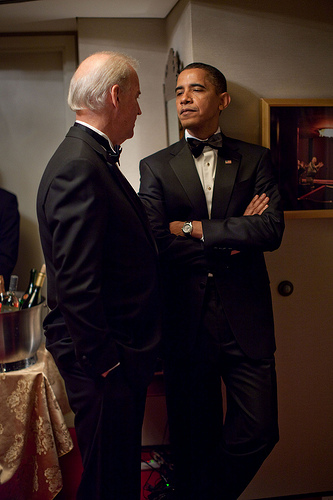 Let’s set this up for an adult discussion group. Study the items in this scene. What is the intended effect? Advertisment or reality show? Back stage at the West Wing?
A commenter at the White House Flickr site says, “Damn, Obama looks like James Bond.” And, on the other end of the spectrum, Ann Althouse and Glenn Reynolds see a tired man worn down by months of log-rolling–the expression of a long suffering and only-too-understanding foster parent…
Either way, why must we see a story in this picture? I don’t think a bias to story can be avoided. The puzzle is why. For better or worse, stories continually spring from the imagination. Show a series of unrelated film shots and the mind will force a pattern onto them. (1) A guy standing on a corner. (2) A shot of fog. (3) A shot of a guy saying, “It’s crazy this time of year. (4) A car approaching. Your mind will create the thread and finish it. Images flash in a dream and upon waking we want to know what they mean.
Forget modernist, Joycean anti-plot bull shittake for a moment and repeat after me: a story is a the progression of incidents that occur while the protagonist is pursuing his goal. Whatever obstacles he struggles with on the way to achieving that goal is…wait for it…dramatic conflict.
So whatever story you’re telling yourself about Obama clusters into the meaning of this picture. Maybe you see him as a Hegelian synthesis of history. Your mind supplies the back story. You assume he’s overcoming antagonists on the way to a higher synthesis. Or, instead, you assume he is the antagonist thwarting your own pursuit. Obama as James Bond…it doesn’t have to be James Bond, the main point is that people cast political leaders in the protagonist’s role. The illusion, of course, is that there’s a story here.
Consider mad man David Ogilvy’s creation:
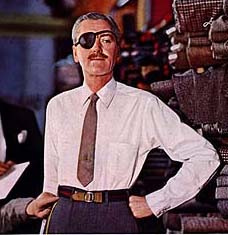 Part of Ogilvy’s genius was to realize that if you have nothing to say about the product, then focus on the user. If you can’t change the product, change what it means. Create something with a little mystery–he dubbed it “story appeal”–and let the audience fill in the rest. The eye-patch was a last minute addition to this 1950s campaign, but it was decisive. A cluster image drawing on William Faulkner and pirates…people wanted to be that kind of person. A list of the product’s superior virtues–any logical approach–would have fallen flat. After all, Geico’s lizard has nothing to do with insurance.
Democracy amplifies this effect by giving voters the illusion of taking part in a story. If you have nothing to say about the product, pay homage to the user. We want Marlboro Men and Jolly Green Giants and Pillsbury Doughboys. In a post today, Robin Hanson lists some of the ways our pursuit of high status may limit the types of governments we prefer. I suggest story appeal may be another. Arnold Kling has said our political system demands a “maestro.” Governments without active, symbolic actors would appear less attractive than those with a flair for the dramatic.
I don’t see an immediate solution to this problem. (Tyler Cowen airs some concerns on our predilection for storytelling here.)
Recent Government Decay
What few key points would you use to summarize to a libertarian the declines in the quality of governance in the last 1-2 years, in order to convey the immediate and increasing importance of competitive government? Can be US-centric, but not US-only, since the government industry is global.
I’m thinking maybe 1 bullet point about the US, say the rise in spending/debt under Obama and/or nationalization of banking & auto industries. Maybe 1 about the EU and one about the world?
Must be succinct! Comment away!
Rationality is a Virtue, Not an Assumption
Ilya Somin writes:
One underappreciated fact about the experimental and survey evidence relied on by advocates of the new paternalism is that it models voter decision-making far more closely than market decisions. Unlike market participants, voters have little or no incentive to either acquire information about the issues they decide, or to analyze the information they do have in an unbiased fashion. The same is true, to a lesser extent, of libertarian paternalist policies established by expert regulators insulated from democratic control (the “rule of experts” is often proposed as a means by which paternalist regulation can be enacted without being influenced by voter ignorance and irrationality). Such regulators may be more knowledgeable than voters. But unlike consumers, they do not have their own money at stake, and therefore don’t suffer any penalty if they make mistakes, and don’t have much incentive to combat any irrational biases they may have…
As with some other aspects of the current debate over paternalism, the relationship between markets and rationality was well-described by F.A. Hayek. In Volume 3 of Law, Legislation, and Liberty, published over 30 years ago, he wrote:
Competition . . . is the method by which we have all been led to acquire much of the knowledge and skills we do possess. This is not understood by those who maintain that the argument for competition rests on the assumption of rational behavior of those who take part in it…. [R]ational behavior is not a premise of economic theory, though it is often presented as such. The basic contention of theory is rather that competition will make it necessary for people to act rationally in order to maintain themselves. It is based not on the assumption that most or all the participants in the market process are rational, but, on the contrary, on the assumption that it will in general be through competition that a few relatively more rational individuals will make it necessary for the rest to emulate them in order to prevail. In a society in which rational behavior confers an advantage on the individual, rational methods will progressively be developed and be spread by imitation. It is no use being more rational than the rest if one is not allowed to derive benefits from being so.
One aim of competitive government is to cultivate rationality tout court–that is, for participants in a market for governance. Markets discipline irrational tendencies; elections do not. Summarizing Paul Romer’s recent talk at the AEA meetings, Tim Kane writes:
When thinking about how to accelerate economic development, the first error people tend to make “Technology cannot change.” The given tech level of a country is given. The second, and more important, error is that “Rules can change with stroke of a pen.” While there is a growing consensus that rules are the most important factor in permanent changes in a developing country, Romer forces us to accept that rules are very difficult to change. Nations in particular, even when its leaders recognize the need for rules to change, have difficulty making them happen.
I take the first error as a status quo bias. Of course, it’s easy to see how a market open to innovation rectifies the problem. A list of long dead S&P 500 companies will attest to that. The second error–the stickiness of rules–makes perfect sense because there’s no market to discipline irrational adherence to counterproductive law. Elections, unfortunately, don’t provide meaningful feedback. So combined and left unchallenged over decades, these biases enshrine the status quo. A true paternalism, one that cultivated virtue in its subjects, would build safeguards against that. The same way we prevent children from voting because we assume they’re too ignorant to know which policies are best.
At Foreign Policy, Graeme Wood writes about the handful of countries struggling to gain official sovereignty:
These quasi-states — which range from decades-old international flashpoints like Palestine, Northern Cyprus, and Taiwan to more obscure enclaves like Transnistria, Western Sahara, Puntland, Iraqi Kurdistan, and South Ossetia — control their own territory and operate at least semifunctional governments, yet lack meaningful recognition. Call them Limbo World. They start by acting like real countries, and then hope to become them.
In years past, such breakaway quasi-states tended to achieve independence fast or be reassimilated within a few years (usually after a gory civil war, as with Biafra in Nigeria). But today’s Limbo World countries stay in political purgatory for longer — the ones in this article have wandered in legal wilderness for an average of 15 years — representing a dangerous new international phenomenon: the permanent second-class state.
Wood fears what he believes this trend implies: secession, geopolitical pockets that breed violence and (the horror!) countries without seats in the U.N.. All of these quasi-countries are poor, unstable, and/or war-torn. I doubt their sovereign status is the cause of that. Still, Wood acknowledges the high price of new entry in the market for governance:
Carving land from other countries is nearly always bloody and in most cases leaves borders that bleed for decades. Somaliland and Abkhazia have existed for almost 20 years, with little indication that widespread recognition is imminent.
The article also explores the burgeoning market in sovereignty, something we’ve covered a bit before. Read the whole thing. (HT: Abel Winn)
The Perils of Democratic Capitalism
I hate to pick on them, because they’ve written a fairly lucid defense of capitalism, but I have to express slight disappointment in Steve Forbes’s and Elizabeth Ames’s new book, How Capitalism Will Save Us. What’s beguiling is that they present a highly readable introduction to some key concepts in economics; they debunk many popular anti-market fallacies; but then, having seized the castle and taken the tower, they raise a white flag and surrender everything thing they’ve gained in a single phrase. It’s very frustrating.
Here’s what vexes me so: for some inexplicable reason, whenever they mention “capitalism,” they qualify it with “democratic.” What’s the difference? No where in the book do they delineate the concept of democratic capitalism, other than with vague gestures about a people having a means to express their grievances to their rulers. In no place do they describe how plain old vanilla capitalism differs from the democratic version. It is as if the word democracy has magical powers like the relics of a dead saint–merely being near it will convey powers to those in proximity.
What’s worse, they present compelling arguments showing that economic downturns are typically caused by massive government interventions. They ably describe the harmful unintended consequences of byzantine tax-schedules, rampant regulation, occupational licensing, and price controls–they do all this with great aplomb, but then they never stop to ask why these thorns exist in the first place. In fact, everything they mention about government failure is the upshot of political entrepreneurs in the market of public choice. Democratic capitalism isn’t the answer to the ills Forbes and Ames mention. To the contrary, it’s the cause.
Markets fail. Let’s use markets. That’s a tough nut to sell to a public that believes in heroes and villains and storytelling drama. When markets fail in a democracy, political entrepreneurs–and demagogues are the best–will exploit the event for their personal advantage, first by claiming to diagnose the problem, and then by offering their remedy. “Markets fail, let’s use government” becomes the tag line for any successful politician. This is a feature, not a bug, in democratic governance. Indeed, it is the democratic politician’s professional science to whip the mob up into a mad crowd of witch-burners. Elections are wild orgies wherein each side attempts to substitute a new and worse, though largely imaginary fear for the one that previously prevailed. Insofar as he innovates, the political entrepreneur innovates problems with no solution. He’s like a psychoanalyst; there’s never an incentive to end the treatment.
Take tax-policy: Forbes and Ames highlight the wealth-destroying effects of capital gains taxes and progressive taxes, the predilection Congress has for ignoring tax incidence, the inequities of sin taxes, the inefficiencies of VATS, and tax rates penalizing two income families. This byzantine structure is not the result of central planning. No, no, it’s the spontaneous order of the democratic market place, a result not of human design, but of human action–each political actor imposing a distributed cost on the many to sell promises to the highly motivated and coordinated few. Each one of these excrescences is the solution to some imaginary problem raised in a previous election. That’s democracy, love it or leave it or constrain it.
The sad fact–other than the relentless indifference of the universe–is that merely electing the right people will do nothing to change this in the long run. Forbes and Ames complain about profligate government spending. They are very pessimistic about the coming debt tsunami. They admit “government tends to politicize and not solve economic problems.” But then they offer no way to freedom. I hear whispers of folk activism in the wings.
Our solution: don’t hate the player, hate the game. Let’s just call it capitalism and rejoice in its simplicity.
Reminder: Recommendations Page
Just a reminder that we have a recommendations page containing the works most relevant to competitive government.
“Envy Is Ignorance, Imitation Suicide”
Peter Thiel has said that Rene Girard is the greatest philosopher since Kant–mainly, I take it, because Girard appears to have been the first to emphasize the self-impoverishing consequences of imitation. The quote above is Emerson’s, but the theory belongs to the Frenchman.
With that in mind, I turn to Eric Falkenstein, who writes:
I argue that people are primarily driven by envy as opposed to greed (see here), so they are mindful of their relative, as opposed to absolute, position, and this leads to doing what others are doing as a mechanism of minimizing risk.
For Falkenstein, it seems envy motivates imitation. His post is on the topic of envy in general, but for his theory to have the explanatory power it claims, it also has to include some account of why envious humans wish to imitate their rivals. That’s a surprising connection, and since that is precisely what Girard’s theory of mimetic desire explains (his book on Dostoevsky was edifying), I’m beginning to see more merit to Thiels’s praise than I at first imagined. This may be the first time in history a French literary theorist has something interesting to say about finance. And yes, I’m as shocked as you are.
In his book on finance, Falkenstein proposes a “relative-status” theory of envy to explain misguided risk-taking and in his post, he highlights some other anomalous facts explained by this. To chose but a few: people tend to over-invest in their home countries, even though a truly diversified portfolio would have a more international flavor; people gain little happiness in comparing how well-off they are to those living 100 years ago (or to those living in undeveloped nations); people gain satisfaction in seeing a high status member of the tribe brought down to size, hence the strange support for wealth-destroying redistributive policy, and so on.
But what does this have to do with letting a thousand nations bloom? All political philosophies are rooted in assumptions about human nature. Some gel with human instincts. Others do not. Adam Smith was the first to describe how the pursuit of self-interest can lead to socially desirable outcomes. It is unfortunate, given its prevalence, that envy doesn’t have comparable spill-over effects. Falkenstein writes:
John Adams made sure the USA had many republican features because he worried that “There never was a democracy yet that did not commit suicide”, an opinion first articulated by Thucydides in the fifth century BC. I think this is because mob rule unleashes the envy of the masses, which brings down the best, and in the process the talented tenth, the elites, that drive anything worth cumulating upon in the realm of ideas (and thus, art, science, and technology).
There is a greater place for understanding the role imitation and envy play in political philosophy. If we’re going to re-evaluate the rational actor model, Rene Girard is a good place to start–not the rational pursuit of self-interest, but the irrational pursuit of unenlightened self-enslavement. Demagogues and academic philosophers thrive on creating the illusion that your neighbor’s success comes at the cost of your own and that the prosperity of a country requires tearing that man down. Envy is ignorance, imitation suicide.
Why Do People Move To Texas?
Some new Census Bureau figures are out–file this under more evidence for Tiebout competition among States. Michael Barone has a fairly good summary:
Interestingly, several Northeastern states — New Jersey, New York, Massachusetts, Maryland, Connecticut and Rhode Island — continue to attract large percentages of immigrants, but even they (except for Massachusetts) suffer from domestic outflow. Public policies — high taxes and welfare benefits — may account for these seemingly contradictory trends…
No. 3 in percentage population growth in 2008-09 was giant Texas, the nation’s second most populous state. Its population grew by almost half a million and accounted for 18 percent of the nation’s total population growth. Texas had above-average immigrant growth, but domestic in-migration was nearly twice as high.
There may be lessons for public policy here. Texas over the decades has had low taxes (and no state income tax), low public spending and regulations that encourage job growth. It didn’t have much of a housing bubble or a housing price bust.
We’ve written previously about some of Texas’s competitive virtues here.


 Let A Thousand Nations Bloom