Myth of the Rational Lobbyist
Reviewing Caplan’s Myth of the Rational Voter today, stats-prof Andrew Gelman writes,
It is too much to expect any player in the political system to be entirely rational–Ansolabehere and Snyder (2003) argue that even lobbyists are not particularly rational in their campaign contributions.
That’s an obtuse non-sequitur. If lobbyists aren’t rational, then it’s too much to expect the public to be? Strange moral reasoning, professor! Still, I hadn’t really thought about irrational lobbyists. Because they have a stronger motivation, are highly coordinated, are more highly educated, and more likely to track the consequences of their vote-buying, I would assume that the irrationality of special interests is less than that of the public’s. I’ll have to look more closely at Ansolabehere and Snyder.
But Gelman misses something more important here. It’s not simply that voters are irrational. It’s that they’re inveterately irrational in predictable ways. If they were randomly irrational, then we would expect their votes to cancel each other out. Some of the irrational would vote poorly, and some would mistakenly vote well. But because their idiocy is random, we would expect these two groups to cancel each other out, leaving the remaining five percent of the well-informed electorate to settle the matter.
Alas, that’s not what happens. Sadly, people aren’t randomly irrational in the voting booth. In fact, they’re irrational in roughly four ways–the four biases Caplan mentions: anti-market bias, xenophobia, make-work bias and pessimistic bias.
So to go back to the lobbyists, it’s not enough to say that they’re irrational, too. Because, mutatis mutandis, the lobbyists aren’t randomly irrational either. Insofar as they are poorly skilled at achieving the goals they aim to achieve, we should expect lobbyists to act in line with the same biases Caplan mentions. Gelman completely skips over that.
Link Archipelago
- Robin Hanson finds Santarchy wanting in morals. Santa wastes his talents and technology delivering toys to kids instead of using his powers to help the worst off.
- More Evidence for real world Tiebout competition. “Americans are moving from states with higher regulatory burdens to those with more economic freedom.”
- Ten Reasons to Leave the E.U.
- Research on private policing in San Francisco.
Santarchy on a Seastead: To Believe in the Spirit of Santa is to Believe in Free Trade

Santarcho-Capitalism?
Little did you know, but Santa Claus runs the ur-seastead. And if you believe in Santa kids, you ought to believe in free trade. Pass the egg nog, and listen to Santa Baby.
Flying no flag of convenience, the guy uses ice floes around the North Pole to support and cloak highly mobile capital and productive labor; with a flair for anarchy, he disregards all laws of intellectual property to create an abundance of goods that he then feels free to distribute according to a little understood moral code; his superior logistical system flagrantly disregards all national borders and crosses them with impunity; and no parent tells kids that there ought to be a tariff on Santa; indeed most welcome Santa’s gifts with joy. All the guy asks for in return is milk and cookies.
Yes Professor Caplan, intuitive, basic economics does exist. Let me revise your elementary lesson with holiday cheer. To distill the basics, you once wrote:
Counterintuitive claim: Free trade makes countries richer, even if the other countries have big advantages like cheaper labor or more advanced technology.
Intuitive version: We’d be better off if other countries gave us stuff for free. Isn’t “really cheap” the next-best thing?
Here’s my Santarcho-Capitalist revision:
We all wish there were a Santa and know we’d be better off if he gave us stuff for free. Isn’t “really cheap” the next-best thing?
All right, Santa’s surveillance system is a little sketchy, but we all agree the guy’s well-intentioned. And we still reserve our right to be naughty. Nobody can take that away from us!
A Note on Health Care: Stop Wage-Enslaving Me Bro!
As you well know, there’s a major sausage-fest going on in Congress over health-care. Ezra Klein and Yggie are pulling their best Colonel Jessup, saying that however grotesque this health bill may be, nevertheless it saves lives. And who’s going to deny that, You, You Lieutenant Weinberg?
It boggles my mind that after only one state level experiment with insurance mandates, many have decided to go national with the sucker, and extrapolate–never mind that the consequences of Massachusetts’ foray include such parting-gifts as rationing, additional tax-burdens for the middle class, higher than anticipated costs, debt for safety-net hospitals, and, to put the cherry on top, massive debt for the state as a whole. Whatever happened to federalism and value pluralism?
IOZ and Julian Sanchez have sane perspectives on the national health care debate and the motives of those promoting it. IOZ nails it:
Universal, tax-funded health coverage has been transmogrified through the usual Washingtonian alchemy into an insane mandate that uninsured individuals purchase, at great personal expense, extremely shitty insurance plans…Instead of using public funds to provide direct subsidies of medical treatment, you have private wealth confiscated through the threat of legal sanction for the purpose of increasing the market penetration of private companies. You’ve replaced a program of individual welfare with a system of corporate welfare paid for by the very individuals whose economic status would make them the recipients of the individual welfare you claim to seek.
I’d like to add a personal note to all of this drama. I have been without health insurance for about a year and a half. That was a deliberate choice I made because I had to take a risk to enter a start-up mode of sorts. And to do that, I needed every penny I could scrounge. I still do for the time being.
I do not believe there’s a mature conception of justice that requires transferring money from me–the young, relatively poor, entrepreneurial, and healthy–to the old and unwell. Or if there is, that’s not a state I want to live in. Forget politicians who like to appear generous precisely because they are not. Mandates are dandy, but to discipline these hacks, exit is king.
Nauru Recognizes Abkhazia: Commoditizing Sovereignty
Nauru…became the fourth country to formally establish diplomatic relations with Abkhazia, effectively recognizing its sovereignty…In talks with Russian officials, Nauru requested $50 million for “urgent social and economic projects,” the newspaper reported, citing unnamed Russian diplomats…In 2002, Nauru severed diplomatic relations with Taiwan, coincident with a reported pledge of $130 million from China. Three years later, it switched again, prompting a Chinese official to grumble that the islanders were “only interested in material gains.”
(The NYT, via Adam Selene)

As I see it, part of the path to A Thousand Nations is the trend of “commoditizing sovereignty” – small countries realizing that their membership in the club of nations is one of their most valuable assets. As the article says: “There is no question of morality here,” Mr. Markedonov said. “It’s the smallest country in the world. It has no potential, just to trade in independence. Independence is a commodity — people will trade it.”
Small countries can extend their umbrella of sovereignty to other states, startup states, and “WSLEs” (Weakly State-Like Entities), through means such as ship flagging and diplomatic recognition, in return for cash. This will help the long tail of nations get even longer.
This suggests another difference between seasteading and charter cities – seasteading will most likely seek partnerships with small countries, while charter cities seem to be envisioned as operated by large countries, Canada being the example Paul Romer uses. Small countries like Nauru have much greater incentive to help political entrepreneurs hack the sovereignty system than large nations. Of course, their recognition / assistance is much less meaningful, because they are less powerful. Small countries will be an easier starting ally for a startup nation, but let’s not forget that new countries such as the USA depended on assistance from the great powers of the day for the resources to get established.
From Poverty to Prosperity: an ATN Book Review
Kling and Schulz on the origins and causes of wealth
Gentle reader, do get yourself a copy of Arnold Kling’s and Nick Schulz’s new book on revamping the sweet science of economics. It’s a wonderfully concise introduction to development, economic history, the roots of progress, wealth-creation, entrepreneurialism, and innovation–all this and more. In between chapters, the book features informative interviews with a handful of economists, ranging from Robert Solow and Paul Romer to Joel Mokyr, Edmund Phelps and Douglass North. It’s a great introduction to their work. Highly recommended.
Many of the book’s key concepts incite the imagination of the competitive government enthusiast. Kling and Schulz do not really broach the subject, but one cannot help but see how one system works–as say, with the importance of technology and entrepreneurialism to improving the quality of life–and then imagine applying it to government. Government, Inc., after all, is just one kind of industry.
Cardwell’s Law For Governance
Cardwell’s Law says that no nation remains technologically innovative for long. It is a truth rarely acknowledged that with great stability comes hard mental and political cholesterol. Vested interests, wanting to hold fast to their dominant position, will erect all sorts of impediments to stifle would-be challengers. Innovation flags. Stagnation ensues. Life is worse for all.
Fortunately those trends failed to gain supremacy in the West during the last 200 years or so. The theory of history that Kling and Shulz present casts the co-evolution of rules and technology as the main drivers for improving our standards of living. And underlying the importance of rules and technology are the institutions and norms of behavior that foster them. The more a society opens itself up to change, the more a society encourages entrepreneurialism, the more likely it is that our quality of life will continue to improve. It is a virtuous cycle of positive, if disruptive feedback.
Why cannot this same model apply to governance? If national rule-sets are a technology, then Cardwell’s law plausibly holds here as well. In the industry of governance, there is little competition, no new entry, and rarely any exit. At a global scale, vested interests reign at the expense of innovation and progress. And yet we know there are better rule-sets that will improve our standards of living. Those rules we know of, we can’t enact, because of democratic sclerosis. And those rules we know not of, we can’t experiment to find. To make matters worse, we fail to encourage entrepreneurship in legitimate politics whatsoever.
Not having studied economics formally, I was surprised to learn from Kling and Schulz that the idea of entrepreneurship lies outside the orthodoxy of the discipline. So much worse then for the government-law providing entrepreneur who lies outside every theory of political philosophy but ours!
David Ogilvy, the famous advertiser of the 50s and 60s, wrote that you can judge a company by how many new, beneficial products it brings to market. The same might be said of governments and national rule-sets. We’re dealing with nearly extinct volcanoes here.
Innovation is an anarchic, tempestuous and unpredictable muse. Her gifts come without warning. But if we want all the good things in life–more time with those we love, more vacations, more art, more achievement, more heroism–we have to court her.
We have to have a society that welcomes and celebrates new products, new ideas, new entry into any market, and quickly moving capital to finance their creation. We want a society that isn’t satisfied with a better way of shipping ice blocks from the north to warm climates in the south. We want a society that invents refrigerators and air conditioners. To continually improve our quality of life, we need anthropogenic category 5 gales of creative destruction on all levels. Kling and Schulz do a wonderful job of highlighting all that.
Now we just have to apply it to national rule sets. Good luck!
This guest post comes from Michael F. Martin, a Thousand Nations regular, and a blogger at Broken Symmetry.–editor
Toward a Libertarian Theory of Intellectual Property
We libertarians, being libertarians, are seldom to be found in agreement on first principles when it comes to anything, especially legitimate roles of government. But if there were one principle to which all libertarians might agree, it would be this: that government, in carrying out its legitimate roles, should minimize costs. The costs of government include not only the more obvious direct costs in the form of taxes and redistributions of property, but more importantly the much larger and more pernicious indirect costs of distortions to private institutions and organizations. (I follow the convention of some economists in distinguishing between the rules that define activity among a group of people (“the institutions”) and the group of people itself (“the organization”).) When government intervenes to benefit a particular group in society, even for noble of reasons, it can also undermine private institutions that have evolved to bring order, private institutions that may reflect a broader and more stable consensus than can be achieved even by a representative democracy. At the margins of government reach, communities can and do by consensus ignore legal norms, thereby avoiding the distortions caused by the undermining of locally stable cultural norms. We Americans should be as proud of the ranchers in Shasta County, California who ignore California trespass law as we are of the Founding Fathers who disobeyed the laws of a more ancient and powerful sovereign.
But true to libertarian form, I mean to challenge this most basic of libertarian principles. For through my study and practice of intellectual property and antitrust law, I have come to the view that a broader proposition should be embraced: That all institutions in society, in carrying out their legitimate roles, should minimize costs.
Why the need for this broader proposition? In short, because great benefits may be gained by keeping the same skeptical and minimalist eye, which libertarians naturally keep on government, on all institutions in society, whether public and private. By focusing on government costs alone, libertarians have been blind to the costs of private institutions. In the end, what difference does it make whether an oppressive institution is called public or private? What libertarians are in favor of is more freedom, not less government.
Some readers might object: How can a private institution be costly like government? The cost of government — so these readers might say — is coercion. And by definition, no private institution can be guilty of coercion.
My answer is that this objection begs the question. Both public and private institutions interfere with individual liberties. The constraints that parents place upon the liberties of their children — mental, emotional, and physical — are not different in kind from the constraints that governments place upon their citizens. Parents’ rules are not just because parental; governments’ rules not unjust because governmental.
A stubborn reader might nonetheless persist: If not different in kind, then in degree. Government coercion is at a scale (of millions of people) and to a degree (of taking life) beyond private coercion. A glance at twentieth century history confirms it.
There can be no doubt that twentieth century history put a stink on government. But did it leave private institutions smelling like a rose? More importantly, the stubborn reader has already conceded my point by acknowledging that the scale and degree of coercion — rather than public or private status per se — is what makes government costly. By this reasoning we can dismiss libertarians who argue against intellectual property simply because it is a government institution.
Having cleared away distractions, the more difficult question can be addressed: Does intellectual property play a legitimate role at minimal cost relative to alternative institutions? The question has both moral and economic dimensions. Whether the role played by a given institution is legitimate is moral. Whether there is not a better institutional form for accomplishing a given legitimate role is economic. Intellectual property law should be favored by libertarians both for its moral and economic merit.
The Moral Case
The best argument ever made for the moral and economic merits of intellectual property was made very close to 150 years ago in Jacksonville, Illinois, where Abraham Lincoln gave a lecture (one in a series; multiple versions of which are available online). Lincoln’s lecture “On Discoveries and Inventions” concludes with famous words: “Before [the patent system], any man might instantly use what another had invented; so that the inventor had no special advantage from his own invention. The patent system changed this [by securing] to the inventor, for a limited time, the exclusive use of his invention; and thereby added the fuel of interest to the fire of genius, in the discovery and production of new and useful things.”
What did Lincoln consider the moral case for patents? To punish theft. Without a property right in an invention, anybody who devoted the time and effort at inventing would be at the mercy of any dishonest character who managed to learn enough about the invention to copy. To Lincoln, that seemed unamerican. To Lincoln, the great difference between the United States and the nations of Europe was the result of “Discoveries, Inventions, and Improvements,” which in turn “are the result of observation, reflection, and experiment.” In the United States, inventors earn rewards.
Some are skeptical of Lincoln’s premise. Wouldn’t people spend time in “observation, reflection, and experiment” even without the rewards of intellectual property?
Some people, yes. But for Lincoln the question was not whether inventing could go on without intellectual property. Clearly it had in Europe, Greece, and Egypt. (Although interestingly, the first patent system emerged from renaissance Venice.) For Lincoln, the question was whether we ought to protect the livelihood of people who spend their time in “observation, reflection, and experiment.” Lincoln never worried, as did Thomas Jefferson, that ideas wouldn’t spread fast enough if intellectual property punished copyists.
The Economic Case
The economic case for intellectual property is the most difficult. The economic theory taught in law schools relies heavily on the principles of neoclassical economics, emphasizing equilibrium and the allocative efficiency of markets. The recent paper by Bessen and Maskin provides an illustration. A careful mathematical model is made of the net present value of patenting given a stream of innovations and the costs of licensing intellectual property. But no theory or model is given for the source of the stream. Many neoclassical economists seem to assume that inventions are an inevitable consequence of market competition. No particular attention need be paid to inventors. If the invention is efficient, an inventor will invent. Even F.A. Hayek seems to have fallen into this circular reasoning. More careful observation and reflection on inventing results in a calculus of costs and benefits in clear favor of intellectual property.
It is supremely ironic that Hayek opposed intellectual property because it was Hayek who founded the economic theory of institutions and organizations that reveals the economic case for intellectual property. In particular, it was Hayek who first wrote about the problem of coordinating dispersed bits of information held by individuals in society. It was Hayek who first explained why decentralized institutions should be favored over central planning. What Hayek understood was that the costs of information gathering and processing increased with scale much faster than even the most well-run central planning could handle. At best, the result of central planning at scale are institutions badly adapted or poorly timed to resolve disputes. At worst, central planners are corrupted by incumbent authorities or vocal minorities into serving an elite group in society.
By contrast, decentralized institutions in the form of privately adaptable rules provide a scalable, accessible mechanism for resolving competing claims to scarce resources. The archetypal Hayekian decentralized institution is market price. By looking at market price signals, a dispersed group of individuals through society can coordinate a variety of activities associated with production and consumption without a single meeting, much less an election. The story has been told of Nixon being introduced to a central planner in China who simply could not grasp how there was no need for his job in the United States. Those days seem ancient!
But what is it exactly that makes decentralized institutions superior to central planning? Is it the fact that central planning is done by government? Consistent with the analysis given above, the answer is no. First, whether public or private, central planning is less efficient than decentralized institutions. Institutional religion, for example, is not exempt from the problems of central planning that plague governments. Governments simply limit the damage that can be done by the central planning of institutional religion. The Founding Fathers struck a unique balance through the First Amendment, permitting the United States a unique equilibrium between religious and government institutions. (But maybe it’s better to say that the First Amendment was a consequence of the unique equilibrium that existed rather than its cause.) Conversely, decentralized institutions are not perfectly private. There can be little doubt, for example, that a threshold level of government is necessary to markets for insurance, much less complex derivatives.
What makes decentralized institutions superior is their structure and dynamics. Decentralized institutions comprise a set of rules that underdetermine the outcome of competing claims to scarce resources. In many cases, the rules are mutable — i.e., subject to renegotiation among parties and counter-parties. As a group, the individuals subject to constraint by decentralized institutions get feedback earlier and more often than do the individuals subject to rule by central planners. Moreover, the process of variation, selection, and retention of rules that seem to work well for subject individuals means that decentralized institutions actually learn and adapt to changing circumstances.
Intellectual Property as Complex Adaptive System
The most compelling economic case for intellectual property is that it provides a decentralized alternative to centrally planned alternatives, such as prizes, grants, or even tax credits. Intellectual property does not determine economic outcomes. Rather, like other systems of property and contract law, it constitutes a market whereby outcomes are determined through repeated private interactions. Intellectual property law is a substrate on which a network of inventors, entrepreneurs, and established companies coalesces into an ad hoc organization formed with a particular social goal. The cooperation of legally separate NFL teams to license the NFL brand on an exclusive basis to Reebok — now on appeal to the Supreme Court in the American Needle case — provides only a hint of what can be accomplished when dispersed organizations band together through intellectual property rights to accomplish specific goals. The formation of patent pools for the licensing of drugs developed for treatement of HIV/AIDS are another.
Although Lincoln would not have chosen these terms, we can be sure that he nevertheless had this decentralized network of intellectual property rights in mind when he argued in favor of the patent system 150 years ago. In his extended argument, he identifies the patent system as the fourth major stage in the progress of civilization. Lincoln identified speech, writing, and printing as the first, second, and third stages. What all four stages have in common is their status as decentralized institutions. All are subject to renegotiation over time through an evolutionary process. As I have noted elsewhere, had he anticipated their invention, Lincoln almost certaintly would have added internet protocols as a fifth stage. Perhaps intellectual property should be called the fifth and internet protocols the fourth.
Elsewhere I have made the argument that the patent system should be understood as an evolving complex system, and that important problems with current system could be solved by understanding patents in those terms. In the terms presented here, my argument is that decentralized institutions constitute a complex adapative system, although to avoid the somewhat unfortunate terminology I often abbreviate this to “systems theory,” a moniker embraced by a diverse group of venerable authorities including Mihalyi Csikszentmihalyi, Douglas McGregor, and W. Edwards Deming.
In this post I cannot provide an appropriate introduction to systems theory. I must instead assert that a comparative institutional analysis conducted within the framework of systems theory strongly suggests that a decentralized institution like intellectual property is constitutive of innovation in ways that alternatives such as prizes or grants could never be. Whereas prizes or grants are made (in a best case scenario) when the prospective value of an invention comes in view for the central planners, intellectual property permits a dispersed group of private individuals and organizations to invest in new technology. Whereas the internal rate of return to investment in new technology would be negative (for easily copied technology) or too small to incur opportunity costs (for almost any technology), the security of intellectual property rights promises the possibility of outsize rewards for a limited time. We are all gamblers in view of the uncertain future. Intellectual property simply encourages a gamble on investments that promise even larger social benefits over the longer term. In this limited regard, anaologies to secured credit, derivatives, and insurance markets are not inapt. All of these institutions facilitate the creation of wealth — in a literal sense — by facilitating divisions of labor and voluntary exchange that would otherwise be impracticable.
Given the scope of its impact, even ten years is too short a time to evaluate the relative costs and benefits of a intellectual property. But historical evidence for the net benefits of intellectual property is not hard to find looking across the longer span of history. As noted above, the patent system was born in renaissance Venice, and carried out across the European continent by artisans who sought a reasonable reward for time spent perfecting a particular skill. Although the English and American patent systems got off to a bad start by failing to honor the basic quid pro quo of public disclosures of knowledge in exchange for limited exclusive rights, by the mid-nineteenth century (the Patent Act of 1836 to be precise), the patent system had taken on what is substantially its modern form. Interestingly, the concept of trade secrets as intellectual property rights emerged around the same time. The industrialization that took place in the United States subsequent to 1836 is at least comparable in scope to the fifteenth century renaissance in Italy.
In the past, libertarians have simply misunderstood intellectual property to be merely government-granted privilege. Libertarians should be in favor of intellectual property because it promotes freedom through private enterprise at a scale and to a degree anticipated only by speech, writing, printing, and the Internet.

Hey, Over Here, The Real Long Tail of Politics!
 Big ideas are simple ideas and five years ago none spread as quickly and as pervasively as Chris Anderson’s Long Tail. Like all insights, Anderson’s is fruitful and others were quick to steal, adapt and apply it to other domains beyond those envisioned in the book. (Not to mention that referring to it signaled intelligence and a hip oneness with techno-geek-speak. At the time, this was only slightly more frequent than applying the theories of Michael Lewis’s Moneyball beyond baseball.)
So remember the Long Tail of politics? Yeah, why force the binary in politics, right?!? Because the idea seemed so exciting and new–it had the aura of a Silicon Valley zeitgeist–many pundits applied the appellation to their preferred candidate. We were told that Barack Obama captured the long tail of politics. Some interpreted it as a fundraising tool for plundering candidates who could give the appearance of caring about niche, long tail issues. Newsweek called Ron Paul the Long Tail Candidate.
Now Arnold Kling had a hand in starting this, but what’s interesting to me is that all the pundits missed the point of Kling’s contention. He wrote:
The Long Tail is not the political center. It is not a third party waiting to form. It is not a coalition. It is not a “silent majority” of either the right or left. It is simply every variety of political belief that does not fit within the two major parties.
To satisfy the needs deep in the long tail, Kling proposed “Virtual Federalism,” which entails (gasp!) letting people choose their political jurisdiction, rather than having it dictated by geography. And yet, what everyone seemed to miss was that by participating in American politics, you are by definition forcing the binary, which could serve as our new slogan here:
- DON’T FORCE THE BINARY: NOT YES, NOT NO, BUT PLENTY
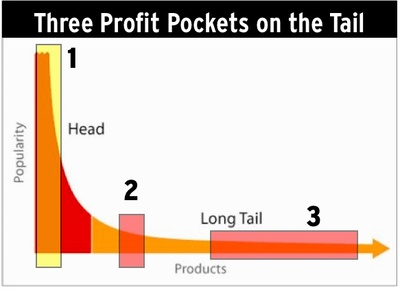
Take a look again at the graphic above (from Kevin Kelly). It represents the profit-making elements of a Long Tail economy, whether it be songs, books, websites, movies and so on. When explaining the Long Tail, Kelly points out that almost everyone makes a switch in what they’re talking about. In pockets 1 and 2 in the graph, people talk about creators. And in politics, they’ll talk about candidates. But when people get to explaining the Long Tail in pocket 3, they switch and stop talking about creators. Instead they start talking about aggregators of other creators’ work. “What happens to the creator?” Kelly asks. His answer:
The creator is dropped when we get to the long tail “pocket of profit” because the long tail is not profitable for the creator. It’s profitable only for the audience and aggregators.
Kelly’s talking about money-making opportunities here, but I think what he notices offers a good way into the idea of going meta in politics. Instead of products like books, songs and movies, think of governance and political philosophies. (It’s beyond me why Marxist professors don’t wake up and see themselves simply as a local car dealer, flogging the newest model from some intellectual Detroit.) Anyway, by going meta, and thinking at a systems level, you grow less interested in individual creators and more fascinated with aggregators. How to pitch competitive governance? Simple: it’s Amazon and Netflix for politics. And unlike Kelly, I think in governance, the best political system is the one that extends the shelf space all the way down the long tail to all three profit pockets. Too bad governance can’t be mailed to you in a red-envelope with a return slip, though it should be obvious that Seasteading is one attempt to do this.
So let me reformulate Chris Anderson’s thesis to this:
Forget coalitions led by a few megahit politicians at the top of the polls. The future of governance is in the millions of niche markets at the shallow end of the bitstream.
Link Archipelago
- Kevin Kelly’s TED talk based on his upcoming book. “Technology is anything useful that a human mind makes. It’s not just hammers and other other gadgets, but it’s also laws and cities…” And, “the answer to bad technology is better technology.”
- A very cool debt clock.
- “Great cities have long been built by great gamblers, and Dubai’s sheik may well be the second greatest city-builder — after the Chinese government — of our age. Many of those gamblers have ended up bankrupt, but their structural legacies remain, providing the space that connects humanity and facilitates the success of our urban world.”– Ed Glaeser on the lessons of Dubai
- When the government acts as a VC with other people’s money, the kingmaker DOE may kill innovation.
- Eric Falkenstein on Paul Romer’s Growth Theory.
- The co-writer of Pulp Fiction sends himself back to jail with a Tweet.
Mass Customization meets Health Care
Editor: This is a guest post by Max Marty, who conducts business research for TSI.
Henry Ford didn’t invent the car, and he didn’t make fabulous advances in automotive engineering. Where Ford did make breakthroughs was in the process of building a car, and it was these breakthroughs that drove costs down to create a value proposition that consumers (and Ford’s competitors) couldn’t ignore.
Today, the same innovations might finally be happening in Health Care, as we can read in the WSJ article The Henry Ford of Heart Surgery: In India, a Factory Model for Hospitals Is Cutting Costs and Yielding Profits. Dr. Devy Shetty has managed to successfully implement inexpensive, mass produced, individually tailored cardiac surgery at his specialty hospital in Bangalore, India. His facilities perform twice as many surgeries per year as the biggest cardiac hospitals in the U.S. while maintaining lower estimated risk-adjusted mortality rates and charging a tenth to a fiftieth the cost of comparable procedures in the states. And best of all, Dr. Shetty won’t stop there, he is already looking to establish a hospital in the Cayman Islands, bringing Americans one step closer to affordable high quality health care.
So what would U.S. healthcare look like given that sort of competition? What sort of process innovations could U.S. companies and individuals develop to give customers an even better deal than Dr. Shetty can provide? Robin Hanson has proposed municipalizing medicine as one way of getting a more competitive market. Unfortunately, politics has prevented such competition from fueling process innovation as of yet, but perhaps Dr. Shetty, and others like him, will soon look to the sea to expand their market reach and provide us with the sort of price and quality package which only a functional market can provide.


 Let A Thousand Nations Bloom