Peter Leeson on Development and Capitalism
In a new paper, the George Mason economics professor makes the case that capitalism is the most progressive force in development. Consider it additional evidence for Paul Romer’s free economic zones. From the abstract:
An increasingly popular position holds that although markets can be important contributors to development, they can also undermine it. Evidence for capitalism’s effect on development is ambiguous and mixed. We should therefore be cautious and modest advocates of markets. I call this view “two cheers for capitalism.” This paper empirically investigates this view. I find that citizens in countries that became more capitalist over the last quarter century became substantially wealthier, healthier, more educated, and politically freer. Citizens in countries that became significantly less capitalist over this period endured stagnating income, shortening life spans, smaller gains in education, and increasingly oppressive political regimes. The data unequivocally evidence capitalism’s superiority for development and merit its unqualified endorsement. Full-force cheerleading for capitalism is well deserved and three cheers are in order instead of two. I conclude with a few thoughts about why some academics insist on pretending otherwise.
Emphasis mine.
The Goldman Sachs-U.S. Treasury Merger Ad Campaign
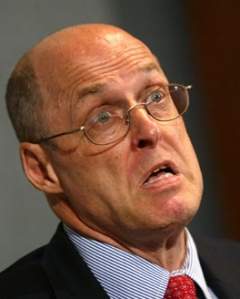 Inspired by my co-blogger’s excellent post on Goldman’s plundering of the U.S. Treasury, I thought I’d poll our audience for the best slogan for their ad campaign. Vote among these or create your own in the comments!
Goldman Sachs And The Double Bind of Reform
“In short, the typical organization for collective action within a society will, at least if it represents only a narrow segment of the society, have little or no incentive to make any significant sacrifices in the interest of the society; it can best serve its members’ interests by striving to seize a larger share of a society’s production for them. This will be expedient, moreover, even if the social costs of the change in the distribution exceed the amount redistributed by a huge multiple; there is for practical purposes no constraint on the social cost such an organization will find it expedient to impose on the society in the course of obtaining a larger share of the social output for itself.” – Mancur Olson, The Rise and Decline of Nations
So it turns out that the media has finally realized – surprise surprise! – that Treasury has become a Goldman Sachs subsidiary. Here, Max Keiser colorfully refers to Goldman Sachs as scum:
And Matt Taibbi stumbles into some Olsonian logic in his expose in Rolling Stone:
“What you need to know is the big picture: If America is circling the drain, Goldman Sachs has found a way to be that drain – an extremely unfortunate loophole in the system of Western Democratic Capitalism, which never foresaw that in a society governed passively by free markets and free elections, organized greed always defeats disorganized democracy.”
Taibbi’s fundamental point is right, of course; he’s just wrong to characterize it as “extremely unfortunate.” Regulatory capture is not a rare event in a democracy – it’s par for the course, because as Olson reminds us in TRaDoN:
“…small groups have a greater likelihood of being able to organize for collective action, and can usually organize with less delay, than large groups. It follows that the small groups in a society will usually have more lobbying and cartelistic power per capita (or even per dollar of aggregate income) than the large groups.”
But there is something to be learned from this. The standard political response to corporatism is policy-based; legislation must be passed in order to halt the transfer of wealth from average citizens towards the well-connected. And, if the current legislators are unwilling to enact the necessary policies, just kick them out and elect people who will.
The problem for these idealists is that the very special interests which legislation might be designed to neuter are an insurmountable roadblock to any actual reform. They have the money, they have the influence, and more importantly, they have the advantage of being focused. Goldman Sachs aren’t trying to broadly improve the lives of average Americans – they are simply trying to keep what they have. And when your average voter is ignorant about implementation details, you have a group of focused, motivated people, having their way with unfocused, apathetic people.
This problem isn’t just manifesting itself in the shenanigans of Goldman Treasury Sachs LLC, but in health reform and climate change legislation as well. Health reform could be a positive thing if it forced entrenched interests to engage of some form of cost control. But that won’t happen. And Waxman-Markey might have actually reduced carbon emissions if entrenched interests had to pay for the right to pollute. But now those permits will be given away.
There is no reform that can get rid of special interests. Voice is futile. So what should activists do? Make exit as feasible as possible. A cambrian explosion in government would do just the trick.
You Too Can Grow A Free Market
…and improve the lives of millions in the process. David Warsh at Economic Principles has a good article up on free economic zones. (Michael Strong wrote for us previously about them here.) Warsh connects Paul Romer’s work on developing many Hong Kongs with the lessons of Brcko, a city in northern Bosnia and Herzegovinia that had been decimated by war. Like the weed, it turns out economic growth can occur in some unlikely places. He writes:
By the time the Dayton Peace Accord brought an uneasy truce to the region, in 1995, Brčko was a smoldering ruin. A couple of years later, however, an improvised mall along a highway fifteen miles south of town was booming, a cross between a Home Depot, a flea-market and a truck-stop, open to all comers, Serbs, Muslims and Croats, gradually infusing life back into the city that lay just over the rolling hills. Once established, it continued to grow.
This free economic zone came to be known as the “Arizona Market.” How did economic freedom bloom in this unlikely place?
The Arizona Market sprung up in a matter of days after American forces set up a checkpoint on the north-south highway. As American commanders on the ground gradually overcame their fear of “mission-creep” – the disasters in Mogadishu and Haiti were still fresh in their Pentagon masters’ minds — they responded to the urgent requests directed to them by the various local ethnic communities: repair a highway, rebuild a bridge, fix the water system and, above all, enforce the law. Stop car-jackings, claim-jumpings and shakedowns in the market; protect people in their daily lives, especially from the rival governments. When the Bosnian government dispatched thirty policemen to take control, the Americans met them with some tanks and sent them back to Sarajevo.
In short, American forces established the rule of law and warded off plunder. According to Bruce Scott’s 2004 case study for Harvard Business School, in Brcko “NATO’s imposition of law and order, plus protection from local political protection rackets, led to spontaneous growth of a market with over $100 million in annual sales.” Read the whole thing. You can even view a tour of the Arizona Market here.

Aid, NGOs, and Entrepreneurship In Africa
Recently I had the pleasure of meeting Michael Strong and Magatte Wade, and somewhere in the freewheeling conversation Magatte mentioned the controversy she started with a June 19th Huffington Post article Jeffrey Sachs’ Misguided Foreign Aid Efforts. It sounded like an entertaining skewering of out-of-touch NGOs and academics, so I looked it up, and indeed it was:
On a brochure for a tour of Jeff Sachs’ Millenium Village in Rwanda, managed by one of Sachs’ Columbia University colleagues, Rule #1 is “Please do not give anything to the villagers — no sweets, cookies, empty water bottles, pens or even money.” While I’m sure the rule is well-intentioned, it captures perfectly the revolting condescension that I feel from the Millenium Villages project. Unlike the ignorant elderly woman, celebrated professors at Columbia University cannot be excused through their ignorance. When highly educated people can objectify us with a “Don’t feed the animals” sign, the only explanation is a blinding arrogance. These people are so sure that they are noble for helping the ignorant chimps, that they hadn’t even noticed just how humiliating the expression is.
Rule #1 goes on to explain the rationale for the rule, “Our desire is to encourage a culture of entrepreneurship and service provision rather than handouts.” Again, I’m completely sympathetic to the encouragement of entrepreneurship, but the situation is entirely ludicrous — American professors spending tens of millions of dollars telling villagers how they should live their lives, so that American tourists can go and watch the new feature at the zoo in which the African natives are doing just as they are told by the American experts — with the careful warning to the tourists not to contaminate the zoo display by feeding the animals. This is how Sachs supports African entrepreneurship?
As an African entrepreneur living in the U.S., just over a year ago I was approached by a representative of the Millenium Villages project. As someone who cares about Africa and who is eager to eliminate African poverty through enterprise, I was happy to meet with this person to see what we might be able to do together. Imagine my surprise when, rather than propose some kind of professional business partnership, he expected me to open up my connections so that they could sell the agricultural and artisanal products being produced in their villages. First I was stunned by the fact that they had produced goods before thinking about how to market them, something a real entrepreneur never does.
…
In my first company, Adina World Beverages, I had spent years traveling to trade shows and retail stores in order to get our beverages into Whole Foods Market, Wegmans, and dozens of other high-end retailers. As a consequence of many thousands of miles and hundreds of hours of relationship building, I had gradually built up an effective network for selling our products. I had gotten our products into retailers by paying close attention to market trends as well as to the idiosyncrasies of various buyers both retail and wholesale. Moreover, even before hitting the pavement to sell product, I had designed the entire company concept based on a prior identification of a market niche that I believed I could fill. My success at selling on the ground was directly linked to my identification of a niche prior to creating the company. I knew that the cultural creative demographic would relate to both the product and story that I was promoting.
By contrast, Sachs had begun with a self-important “save the Africans” concept, obtained tens of millions in philanthropic donations for his projects ($50 million from Soros, $15 million from Gates, etc.) and then gone on to carry their White Man’s Burden. Only after spending gobs of other people’s money did it occur to them that “Oh, maybe we need to find a way to sell the products that we are encouraging our villagers to produce.” I had seen this story before. When I began training Senegalese women to grow organic hibiscus and promised to buy it from them, initially they laughed at me, because countless NGOs had helped them grow hibiscus in the past, only to have it rot after harvest because there were no buyers for their product. The women were delighted to find that because I had, in fact, identified a niche and was an effective saleswoman, the hibiscus had found a market. But NGOs and academics rarely think in these terms.
 This reminded me of Jim Rogers‘ book Adventure Capitalism, which I recently read. In it, he becomes the first person to drive around the entire world, visiting 100+ countries in 2 years. Rogers is, shall we say, less than sanguine about aid and NGOs:
Even in countries with no roads to speak of, Mercedes service is available – often to the exclusion of things like food – thanks to all the US foreign aid, the IMF, and World Bank money being shipped in. It is no secret that this money is aimed at nourishing only those corrupt enough to get their hands on it, while at the same time fattening the bureaucrats on both sides of the transaction who diligently work the trough. And none of them is driving a Chevy.
I knew much of this from my last trip. The upcoming trip, especially as it took us through Africa, would be an eye-opening education into the workings of the latest foreign aid scam: the nongovernmental organization, or NGO. As an American taxpayer, I would be amazed to discover that a lot of the money we send to these countries goes to support Mercedes and BMW dealers and various Swiss bankers.
Later:
After cocoa, the commodity produced in greatest abundance in the Ivory Coast is to be found in the commercial capital, Abidjan, one of the more cosmopolitan cities in West Africa: NGO bureaucrats. They grow here in enormously high concentration, even for Africa. They and their like have been directing Africa’s destiny for centuries. One might wonder why so many national boundaries in these parts consist of straight lines. In Germany in 1884, at what was called the Congress of Berlin, the European powers came together and divided up Africa. They paid no attention to religious, ethnic, linguistic, tribal, national, or historical differences – the Ivory Coast, for example, is divided between a majority Muslim population in the north and those who hold to indigenous beliefs and Christianity in the south, explaining why peace in Africa may be far away. And why there will always be work for Western bureaucrats.
Rogers’ plan for Africa:
I believe Africa still holds promise. And here, I think, is how that promise can be realized. Forgive all the debt. Right now….However, part of the deal would be no more foreign aid…The people of Africa, no longer relying on handouts, would learn to fend for themselves…Presently, as we had seen in half the world, most foreign aid winds up with outside consultants, the local military, corrupt bureaucrats, the new NGO administrators, and Mercedes dealers. There are Mercedes dealers in places where there are not even roads.
One Sudanese entrepreneur, applying his talents to making easy money rather than building a productive enterprise, worked the corrupt NGO system perfectly. It was a “known fact” that slavery was rampant in northeast Africa, especially Sudan. He and a Swiss NGO found each other, and he agreed to buy slaves for the charity, which would then set them free. By the time the Swiss figured out what was happening – he was going to his friends and relatives and “buying” them, giving them good stories to tell the charity about their enslavement – the Swiss were out $20 million.
This is not just waste, the effect of aid is actually negative. First, there is the obvious problem with putting a nation on the dole and encouraging its entrepreneurs to learn to beat the system instead of creating wealth. As Easterly puts it:
The real problem is that patronizing attitudes towards the African beneficiaries of the MVs follow naturally from the ideas that inspire the MVs – that the poor are helpless victims and it is up to foreigners with superior expertise and funds to rescue them. Condescension towards Africans is both offensive AND a sign of a counterproductive approach to development.
Second, as we can learn from the work of Bruce Bueno de Mesquita, aid maintains corrupt regimes. Russell Roberts summarizes:
In the most recent podcast at EconTalk, Bruce Bueno De Mesquita and I talk about what makes dictators and democratically elected leaders tick. According to Bruce’s worldview, every leader, no matter what the system, tries to stay in office and prosper. The relentless application of this simple idea turns out to have very interesting implications for foreign aid, the relief of poverty around the world and about a thousand other things. Bruce has a big brain with a lot of interesting things to say. It’s a very long podcast (about an hour and a half) and it opens with a fairly intense discussion of the theories in Bruce’s book. From there he talks about a wide range of applications.
 Listen to the podcast to learn more, but briefly: even dictators have people they answer to (Bruce Bueno terms this “the selectorate“), so dictators need to be able to hand out favors to stay in power. The spigot of aid is a great, steady source of such favors, and thus serves to keep dictators in power.
If you are a new reader you may find this negative impact of aid surprising, but regular readers will see clearly how this fits into our ideas. Wealth comes from competitive governments producing effective institutions in the course of competing for citizens and foreign capital. Aid does not make government more competitive, it makes it less competitive, by giving dictators a revenue source they can depend on no matter how poor their economy and business climate. (Perversely, the aid may be more dependable the worse their economy and business climate!)
Aid is the reverse of bloodless instability – it Lets A Hundred Dictators Tighten Their Grips, strengthens existing corrupt institutions, and makes institutional resets harder. Which is why we instead propose “aid” such as Strong’s Free Economic Zones or Romer’s Free Zones, which increase competition for effective institutions, offer local institutional resets, and encourage entrepreneurship, rather than dependence. That’s the Thousand Nations way to truly be progressive.
How To Win Progressive Friends and Influence Them
Mike Lux, a blogger at the Huffington Post and author of The Progressive Revolution, recently took offense to our Independence Day festivities. Though we only mentioned him in passing, he nevertheless felt we had “attacked” him. He also dropped the C-Bomb. The man called us conservatives.
Of course, if by conservative, he means rebelling against the status quo, advocating for developing new countries, and dissolving stale ones, then we’ll accept that with just one, simple caveat: whenever Lux uses “progressive,” he ought to accept he’s referring to a body of thought dedicated to conserving and preserving in amber many wealth-destroying institutions and rules. Orwell might get upset, but then again, this will all disappear down the memory hole soon enough.
However, and much to our delight, we’ve got some friends at the Huff Po. Michael Strong has written there in our defense. Do check it out:
What if we could apply the power of creativity, innovation, and entrepreneurship to the problem of poverty reduction? More importantly, what if we could apply the power of creativity, innovation, and entrepreneurship to the most highly leveraged aspect of wealth creation, legal system creation itself?
This is the new frontier of poverty alleviation, one in which cutting-edge thinkers are exploring the possibility of creating new legal systems at sea, in localized free cities and zones, in granting NGOs a greater level of sovereignty, in allowing local regions more legal autonomy, and more. The leading venue for exploring this world of entrepreneurial legal system creation is cleverly named “Let a Thousand Nations Bloom,” the home to the most progressive movement on the planet, despite the fact that not everyone understands this.
Paul Romer and Competitive Government
Paul Romer, Professor of Economics at the Stanford Business School, recently gave the talk “A Theory of History, with an Application,” for the Long Now foundation, which is an excellent example of the power of thinking at the meta-system level. Here is one segment:
Here at ATN, we are not concerned with policy debate so much as we are with understanding and changing the systems that give us the poor sets of policies we see around us. Romer, while not employed by ATN (perhaps this “Stanford” place offers a better pension plan?) is clearly thinking along the same lines.
Romer’s basic argument in the talk (similar to his EconTalk interview) is that there are a few positive feedback loops that have led to exponential growth in both population and standards of living. These loops occur because ideas are not scarce – they can be shared by as many people as can gain access to the idea. (In this he is echoing Alex Tabarrok’s TED talk.) He also argues there is a feedback loop between rules and technology – but that this loop is not always positive. If there is a good set of rules, then that can lead to the generation of better technologies – for example, Edison inventing the light bulb with the positive incentives provided by relatively democratic patent law. But when there is a bad set of rules, that can inhibit the development of technology, and also inhibit the extent to which technologies can be shared between populations. As an example of this last point, Romer shows us a picture of the whole world at night, and then focuses in on the Korean Peninsula. As expected, the South is incredibly bright, with Seoul burning up the night sky. However, the North is almost completely dark – a black hole in an otherwise very bright part of the world. One set of rules is working – the other, not so much.
Bridging into his ideas about competitive government, Romer begins with some analysis about how low barriers to entry in businesses are key to technological development – that new firms are able to bring new ideas to the fore, that increase the speed of technological growth. And, like ATN, he argues that the same logic applies to governments – that countries like the Netherlands, England, and the United States, were like high-quality entrants into the government industry, which drove positive change in the sets of rules that existed in countries, and thus greated positive feedback loops with technological growth and prosperity.
Romer, clearly having been influenced by our ideas about bloodless instability, argues that we need to be able to create new countries, without the use of military force, in order to gain access to the innovation in rules that is key to economic growth.
Romer’s arguments fit exactly into the thesis of ATN. We are about creating a Cambrian explosion in government. While our preferred method is seasteading, and Romer’s is trying to create new Hong Kongs on existing land, the point is the same. Breaking down the barrier to entry in government is key to facilitating innovation and improving the standards of living of people all over the globe, not just rich people who want to live out in the middle of the sea.
Romer’s thoughts about sovereignty also parallel some of Mencius Moldbug’s. Romer asks us to rethink citizenship as a combination of residing in an area and having a voice in an area, and proposes that voice and residency can be separated, with positive results – that, for example, in Hong Kong, the residents didn’t have a voice in the government of Hong Kong, as it was administrated by the British. In formulating his idea of Patchwork, Moldbug argues that the ideal system is similar, in that the pressures governments face to serve their customers better are based on exit, and not on voice. Also, like Moldbug (and like us), Romer thinks the best place for this sort of innovation is the city-state.
Romer doesn’t explicitly mention Mancur Olson, but it wouldn’t be surprising to find out that he has read him. At the end of the talk, Romer cites Cardwell’s law, which states that ” every society, when left on its own, will be technologically creative for only short periods.” In The Rise And Decline Of Nations, Olson provides an excellent explanation for Cardwell’s law, which is that as time goes on, distributional coalitions form and squelch technological innovation and economic growth, by perverting specific rules so that they gain at the expense of the broader public.
All in all, it’s a fantastic video that demonstrates the power of the sort of structural thinking that defines A Thousand Nations, and that might well create a better world.
(This is a guest post by Will Chamberlain)
How is Journalism Like Competitive Government?
Clay Shirky offers up the first essay in the new Cato Unbound. It’s about the future of journalism, or what I like to refer to as the death of the Ivy League journalist. Yes, those halcyon days of putting in fifty hours-a-week at the Harvard Crimson, all in the hope of earning that perch on the Times’ National desk are over. That’s like trying to be a poet. Anyway, reading Shirky, I had a brainwave: the decline of the newspaper industry and the rise of open source style news offers a great metaphor for the land of a thousand nations. Here’s what I’ll do to help you out. Quoting from Shirky’s essay, I will erase every instance of the word “journalism” and replace it with “government” or “politics” or some such. I see a bright new future in this Shirky remix. Enjoy:
Because journalism government has always been subsidized, and because the public can increasingly get involved in activities too complex for loose groups to take on before the current era, journalism sovereignty is seeping into the population at large, with the models of subsidy being altered to fit that shift. The transition here is like the spread of the ability to drive, from paid chauffeurs to the whole population. We still pay people to drive, from buses to race cars, and there are more paid drivers today than there were in the days of the chauffeur. Paid drivers are, however, no longer the majority of all drivers.
Like driving, journalism governing is not a profession — no degree or certification is required to practice it, and training often comes after hiring — and it is increasingly being transformed into an activity, open to all, sometimes done well, sometimes badly, but at a volume that simply cannot be supported by a small group of full-time workers. The journalistic political models that will excel in the next few years will rely on new forms of creation, some of which will be done by professionals, some by amateurs, some by crowds, and some by machines.
Employer Mandates Bring Out The Bootleggers and Baptists

Actor playing John The Baptist. Courtesy of History Comes Alive
Brad Taylor has an excellent post at the FR33 Agents Network on how the well-intentioned often find themselves in league with extremely self-interested unions, professions, corporations, and other distributional coalitions. (A distributional coalition is a group that spends a large amount of time, energy and money on efforts to snag a larger slice of the pie for themselves, rather using those same resources on creating more pie for everyone else.) In this case, it’s the lobby for employer health insurance mandates, where the part of baptist is being played by the Center for American Progress, and the role of the bootlegger is filled by none other than Wal-Mart (the understudy is the Service Employers International Union).
Taylor nails it:
It’s fairly obvious why a progressive think tank and a union would support legislation requiring businesses to provide health insurance coverage to all employees. The statist left see the uninsured as a problem and, as with any problem, they see government as the solution. Mandates would also materially benefit union-members by artificially inflating the benefits received by current employees. In the short run, this increases the wellbeing of employed workers while increasing the cost of hiring new workers – harming jobseekers.
Inspiration for Wal-Mart?
The benefit Wal-Mart gets from employer mandates is less obvious. After all, this sort of regulation increases its costs of doing business. Wal-Mart is aware that employer mandates will not affect all businesses equally, though, and that small employers will be hit especially hard. Many small Mom-and-Pop businesses simply don’t have the resources to implement employee insurance plans, and will be forced out of business.

Another Kind of Libertarianism
Tyler Cowen categorizes the main strains of libertarianism, based on Tom Palmer’s new book, but leaves the Seasteading / A Thousand Nations approach out, as several of the commenters mention.
What should we call this strain? I wouldn’t characterize it as “seasteading” because that is just an implementation method. “Competitive government” or “Meta-libertarianism” or “Second-level libertarianism” are more accurate.
Essentially, this viewpoint states that there are three levels on which we can focus: Policies, Systems/Institutions, and Industry/Ecosystem (the market for government). We believe it is short-sighted to focus on analyzing policy and suggesting better ones, because policies emerge from institutions, and democracy is not an institution which optimizes for good policy. Reforming institutions is worthwhile, and we believe the best way to do this is by making the governing industry more competitive by lowering the barrier to entry and cost of switching providers. This has a number of advantages over other methods, like the ones listed in my Cato Unbound Essay:
- It creates specific, real-world examples to point to when debating the merits of various systems. How many millions of words of academic papers about the benefits of free-markets does it take to add up to the two words “Hong Kong”?
- Prospective customers of the new system could actually experience it physically and emotionally, rather than as a mental abstraction, which is far more powerful for changing minds. For citizens of the USSR, a single visit to the West could outweigh years of Soviet propaganda.
- It enables proponents of an alternative system (like libertarianism) to live their dream much sooner, because they only need to get a small group together to experiment with their new society, rather than convince an entire existing nation (which may never happen).
- It supports an ongoing, evolutionary process where societies learn over time, and change with the world.
- It doesn’t assume there is one best society for everyone. People can attempt to live their ideals without having to impose them on others. Not only does it embrace multiple variants of libertarianism, but other goals and methods for creating a good society. It can gather vastly broader support than any fringe libertarian ideology.
Some other advantages:
- It is humble about our knowledge of what values and institutions make for a good society. We believe the governing industry will, like any market, produce better products for its customers when it is more competitive, and it will do so even if we are currently wrong about how best to design a new nation. In other words, even if libertarianism is wrong or impossible, a more competitive market for government will still improve government.
- It includes a difficult but plausible implementation path (seasteading), whereas with the exception of agorism, none of the other strains have any realistic, incremental way to get from here to there. They may be fun to talk about and imagine, but without any realistic approach, they are idle speculation. Which means if anyone wins, we will. Floating cities are hard, but converting the United States to a Misesian, Catoian, or Hayekian culture is absolutely impossible.
We will be advocating this path, with references (lots of Mancur Olson), but little to no mention of libertarianism, in our upcoming seasteading book.


 Let A Thousand Nations Bloom