Romer Offers More Complaints in the Economist
The Honduras government agreed in December to set up the transparency commission; it included George Akerlof, an economist, and Ong Boon Hwee, a former senior executive at Singapore Power. But it has yet to publish a decree to give the body legal clout. Mr Romer deplores what he calls “an overt act of deception”. In the meantime Mr Strong has struck his own deal, for a “less far-fetched” project that aims to create jobs and cheap housing.
As I wrote in my previous post, given the public facts, that first sentence is false. The Economist is doing itself a great disservice and misleading its readers by taking Romer’s word for it.
Real Bad News From Honduras: Chamber of Supreme Court Rules New Cities Unconstitutional
In a 4-1 ruling, the chamber now sends the case to the Supreme Court for full review. (Just to be clear, this has nothing to do with the Romer’s exit.) From the AP:
TEGUCIGALPA, Honduras — The constitutional chamber of Honduras’ Supreme Court ruled Wednesday that privately run cities in the Central American country would be unconstitutional, threatening a project to build “model cities” with their own police, laws, government and tax systems.
The five-judge panel voted 4-to-1 in a ruling that goes against the Honduran government and the country’s elite.
Because the decision was not unanimous, the case now goes to the full 15-member Supreme Court, which is expected to take it up within 10 days.
The constitutional judges argued that “the foreign investment expected to be received by the state of Honduras implies transferring national territory, which is expressly prohibited in the constitution,” according to a copy of the ruling obtained by The Associated Press.
Romer’s “Resignation” Adds Credibility to the Honduran Project
That’s not the story the NYTimes will tell. At least not in its ode to Romer’s ouster. But the truth, as they say, is complicated. What’s clear is that there was never any commission for Romer to resign from. Let me say that again: there was never a commission. True, some noises were made, discussions held, ideas floated, but in the end the alleged commission and Romer’s choice in its members was nothing more than that–a suggestion. If someone provides me with evidence otherwise, I will retract that assertion. MGK–Michael Strong’s development firm–has posted a time line with citations that tell the story. Do read the whole thing. Some key points:
- March 17, 2011: An advisory commission called CORED (Comision Coordinara de las Regiones Especiales de Desarrollo) is created by publication in the official gazette. Ricardo Maduro, Toribio Aguilera, Jorge Ramon Hernandez, Mr. Sanchez, and Paul Romer are subsequently appointed to CORED. While CORED apparently never actually meets, its mission is completed with the passage of the Constitutional Statute in July 2011.
- July 29, 2011: The Constitutional Statute authorizing the creation of REDs is passed in Congress with over 90% voting in favor. As of September 4, 2012 the Government of Honduras has stated that “Any authority, rights or other ability that CORED had to influence or to be involved in the creation or management of SDRs in any way, expired completely upon the passage of the Constitutional Statute that defined all the currently relevant entities.”
Source: Coalianza/Octavio Sanchez - August 2, 2011: The domain http://www.red.hn was created by the current Registrant Organization. As of September 22, 2012 with the last update as of July 8, 2012 the whois registry for http://www.red.hn shows the Registrant Organization to be “CORED” with a non-Honduran address of PO Box 1707, Los Altos, California and a non-Honduran phone number(650-762-6619) that corresponds to the San Francisco Bay Area.
Source: “Whois red hn 9-22-12” (attached file), http://en.wikipedia.org/wiki/Area_code_650 - On or before October 14, 2011: A website appeared at http://www.red.hn that presented itself as the official CORED website. The initial post is titled “What is CORED?” and includes the statement: “CORED will post information to this website for anyone interested in tracking the progress toward the first RED.” The Honduran government did not create or control the website. As of September 4, 2012 the Government of Honduras has stated that “No official website for the Special Development Regions or for the Comision para las Regiones Especiales de Desarollo (CORED) has been created by any entity of the Government of Honduras.”Source: “red.hn Snapshot 12-13-11” (attached file), Coalianza/Octavio Sanchez
- November 3, 2011: The http://www.red.hn website posts “Economic Opportunities in the RED” in which the following statement is made: “President Lobo must first appoint the initial members of the Transparency Commission and the governor of the RED.” This statement is plainly false and not based on Honduran law as Article 78 of the Constitutional Statute makes clear: “Article 78.- In preparing the investment and development plan of an SDR, memorandums of understanding, trusts, or preparatory contracts for a public-private partnership or an international treaty may be entered. These will be executed with the SDR’s Transparency Commission, or before the formation of such board, with the organization responsible for public-private partnership in the country. In these cases it is not necessary to indicate the territorial boundaries of the SDR that wants to be created.”
- December 8, 2011: The http://www.red.hn website posts that “President Lobo Appoints Initial Members of the Transparency Commission.” This new entry coincides precisely with the December 8, 2011 release of the December 10, 2011 online edition of The Economist. This edition contains a story titled “Hong Kong in Honduras” which links to http://www.red.hn as the only reference in the article for the claim that a Transparency Commission has been created.
Source: “red.hn Snapshot 12-13-11” (attached file), http://www.economist.com/node/21541392 - December 13. 2011: The Charter Cities website posts “President Lobo Announces Transparency Commission” even though no announcement from President Lobo is referenced or linked. The language and formatting appear similar to the earlier announcement appearing on the http://www.red.hn website.
Source: http://chartercities.org/blog/219/president-lobo-announces-transparency-commission - September 4, 2012: The Honduran government signs and announces an MOU signed with Grupo MGK. Shortly thereafter Paul Romer publicly circulates a “resignation letter” from a Transparency Commission that does not exist. As of September 4, 2012 the Government of Honduras has stated that “The Transparency Commission has not been created.”
Sources: Coalianza/Octavio Sanchez
It’s understandable that an academic as respected as Romer would want to save face. With his TED talks, articles and other appearances, a lot of the establishment has been listening. He’s on the short list for the Nobel Prize. And it’s deserved. While he has brought great attention and legitimacy to the Honduran project, and for that we should all be thankful, he is nevertheless myopic when it comes to developing and executing on the core idea. But what baffles me most of all is that he wants to make trouble and squirt black ink like an invertebrate squid as he exits.
Last July, the 4th as it happens, I attended a conference in Guatemala on the Honduran RED effort. Octavio Sanchez and some key members from Coalianza were present. On the topic of sourcing investment, I asked them what their biggest obstacles were. Was it that the capital required is too large to get a commitment? Was it difficult to market the idea? Or did they have trouble meeting with investors overseas? They laughed and said all three. With some further discussion, it turned out, the problem was what I saw as the Romer problem: the first $50 billion is always the hardest. The scale at which Romer conceived the idea was ludicrous. No wonder it was difficult to move the project forward. After all, it’s hard to raise $1 billion for a U.S. investment, let alone $50 billion for something that has never been done before in a region fraught with uncertainty.
Fortunately, that meeting in Guatemala led to further conversations on ways to bootstrap and scale the project up from reasonable initial investments, orders of magnitude smaller. And it also led the momentum away from having an outside country manage or oversee the charter city’s executive function, another of Romer’s implausible proposals.
So from what I can tell, and here I admit that I don’t have all the facts, Romer was providing a lot of vision, but he was short on the details and unrealistic in his expectations. I think his ideas are admirable. His talk at the Long Now Foundation is the best I’ve ever heard on the subject of competitive governance. But with all due respect, it’d be great if he would exit the stage like a gentleman.
Let me add for disclosure that I have no affiliation beyond friendship with the MGK Group. But take that bias as you may.
My Column at Forbes
Just a heads up, I’ll be writing at Forbes on technology and the economy. Come check it out. My first two posts are here:
More on Honduras

Honduran President Porfirio Lobo
Deeper coverage from the AP:
Congress president Juan Hernandez said the investment group MGK will invest $15 million to begin building basic infrastructure for the first model city near Puerto Castilla on the Caribbean coast. That first city would create 5,000 jobs over the next six months and up to 200,000 jobs in the future, Hernandez said. South Korea has given Honduras $4 million to conduct a feasibility study, he said.
“The future will remember this day as that day that Honduras began developing,” said Michael Strong, CEO of the MKG Group. “We believe this will be one of the most important transformations in the world, through which Honduras will end poverty by creating thousands of jobs.”
And the Guardian offers the take you would expect.
Honduras Signs Deal to Create Private Cities
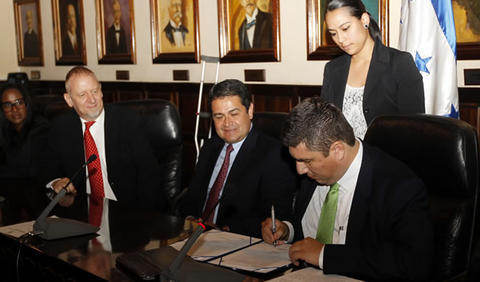 Huzzah! Congrats to many people. You know who you are. As reported by the AP:
The government of Honduras has signed a deal with private investors for the construction of three privately run cities with their own legal and tax systems.The memorandum of agreement signed Tuesday is part of a controversial experiment meant to bring badly needed economic growth to this small Central American country.
In La Prensa:
La empresaestadounidense MKG y Carlos Pineda, presidente de Coalianza, firmaron ayer el convenio para construir la primera ciudad modelo en Honduras. La inversión inicial programada por el consorcio internacional MKG Group es de unos 15 millones de dólares para edificar la primera RED (región especial de desarrollo) en Trujillo, en la costa norte hondureña.Una vez entrado en vigencia, MKG comenzará la primera etapa, consistente en desarrollar la infraestructura física, en la que se necesitarán cinco mil empleos directos y generará 15 mil indirectos, se informó. Michael Strong, ejecutivo de MKG, expresó: “La meta principal de nuestro proyecto es crear la base para una comunidad segura y próspera para los hondureños”. Strong agregó que esta es una colaboración entre diversos grupos de inversionistas, empresarios y expertos que apuntan a la eliminación de la pobreza mediante creación de riqueza en Honduras por medio de las RED.
City-Based Visas
Brandon Fuller politely suggests cities should take immigration policy into their own hands:
One idea we’ve discussed at the Urbanization Project is the notion of a city-based visa. Not all cities welcome additional immigration, but perhaps those that do could sponsor visa holders. The visa could be temporary and renewable, with a path to permanent residency and eventually citizenship. Visa holders would be free to bring their immediate family members with them.
Presumably, the sponsoring cities would have to adequately address some of the primary concerns of immigration opponents, ensuring that visa holders do not receive means-tested transfers from the federal government, commit crimes, or disappear into non-participating cities. A participating city could choose to sponsor undocumented immigrants, provided the city is willing to take on the responsibility of making them legal residents and eventually citizens.
Gawker on the Effort to Create Reddit Island
 A typically skeptical, supercilious take:
For about two years now, a group of internet nerds have been trying to move together to an uninhabited island and create a “cross between a small self-sustaining community and a tourism spot.” They met and have been organizing on Reddit, the vast news website known for its rage comics, anti-SOPA activism and a vibrant Men’s Rights community. Anyone can create a forum on Reddit, known as a “subreddit,” and today the Reddit Island subreddit has about 4,000 subscribers.
The plan is to purchase an island using funds chipped in by hundreds of Redditors. A few dozen settlers will move to the island first, living in lightweight shelters made of shipping pallets. Then—using, like, crowdsourcing or something—they’ll construct a self-sustaining libertarian technopia where download speeds are high and taxes are low. Ideas have included: Permaculture, technical school, weed farms, wind farms, on-site data center, and eco-tourism…
20 Under 20 Reminder: Fire Up The DVRs!
Just a heads up. The CNBC show on the 20 Under 20 Fellowship airs tonight at 10pm eastern time. You’ll get to learn about some very cool projects some amazing people are working on. And you can tell me my Odysseus pirate beard looks ridiculous. Please check it out!
Immortal vs. Life-cycle Political Theory
 It’s very rare that I meet a Platonist, at least outside the philosophy of mathematics. Few are willing to divert a conversation in a bar to say something serious about a transcendent order of pure ideas lying behind this very flawed reality we inhabit.
But nonetheless, an air of platonism still hangs around in political discussion. The ideal state is a cruising altitude. If only we rose through this storm of confusion and Fox News, and at last instituted just rules and institutions, then a just government would carry on in the blue skies of Reason, or Equality, or Community….forever!…with only the slightest turbulence from time to time to disturb a passenger from his soporific movie and meal.
In this model, the work of governance in the future is maintenance. Establish just laws and then work to protect them from corruption, erosion, forgetfulness, and Chick-Fil-A.
The economist Amartya Sen broke ranks from his Harvard pals in Emerson Hall by suggesting that a theory of justice need not aim for an ideal, but only for the comparatively better. Governance becomes a treadmill of transitive preferences, where we move to state C, which is better than B, which is better than A, and so on through time, never arriving, but somehow always getting better.
While I think this contrast between the Platonic ideal and the comparatively better is a good one, I want to suggest that there’s a more important, and very neglected element of political theory that needs more discussion. It is the immortal theory versus the life-cycle theory.
The Platonic theory can easily be confused for the immortal theory, in that a Platonist will fight like a pit bull to show that the pure idea of justice is, like the soul, immortal. Forever beyond our limits, it lives forever. But that’s not what I’m talking about. You could just as well have a life-cycle Platonic theory: states rise and fall, and only at their pinnacle do they instantiate the platonic ideal, before quickly declining and disappearing.
Perhaps this is easier to see in corporate governance. It may be–and I’m certain a number of McKinsey consultants know for sure–that there is one ideal system of corporate management. Companies come and go through history–look at the top ten highest valued companies 100 years ago compared with today’s top ten–and yet we can still accept that in those rare years of vitality, when everything is humming on Six Sigma Jack Welch overdrive, that firm attained a platonic ideal. But humans are humans and new technologies disrupt industries and so the firm inevitably falls, spirals, and disappears off the Dow Jones without anyone even noticing. It is accepted as given that no firm will last forever. There is a life-cycle to its existence, however well managed.
I’m interested in thinking about life-cycle theories of governance, Platonic or not. A life-cycle theory would take corruption, sclerosis, and any other malady as inevitable. It would take very seriously the biological metaphor. And instead of focusing on safeguards within any political unit, this body of theory would take a step back and think about foundings, the rise, the pinnacle, and the fall of political units. It would accept certain historical drivers as–such as human nature–as features, not bugs. And it would also think about political evolution over time.
Immortalist American libertarians, for instance, yearn to bring back the Constitution in exile. If only we could roll back the clock!
Life-cycle libertarians would accept the New Deal as inevitable. It’s part of aging. But they would marvel at the inner workings of a constitution that has enabled a state to last, and thrive, for so long. And instead of undertaking rearguard action to protect the sacred vessels, they would look for new frontiers for new foundings, knowing full well that whatever political unit is established, it will rise and, one day, ultimately fall.
The only constant, Heraclitus said, is change.


 Let A Thousand Nations Bloom