Let A Thousand Nations Bloom on Stossel
You can watch John Stossel’s interview with Michael Strong and Magatte Wade here.


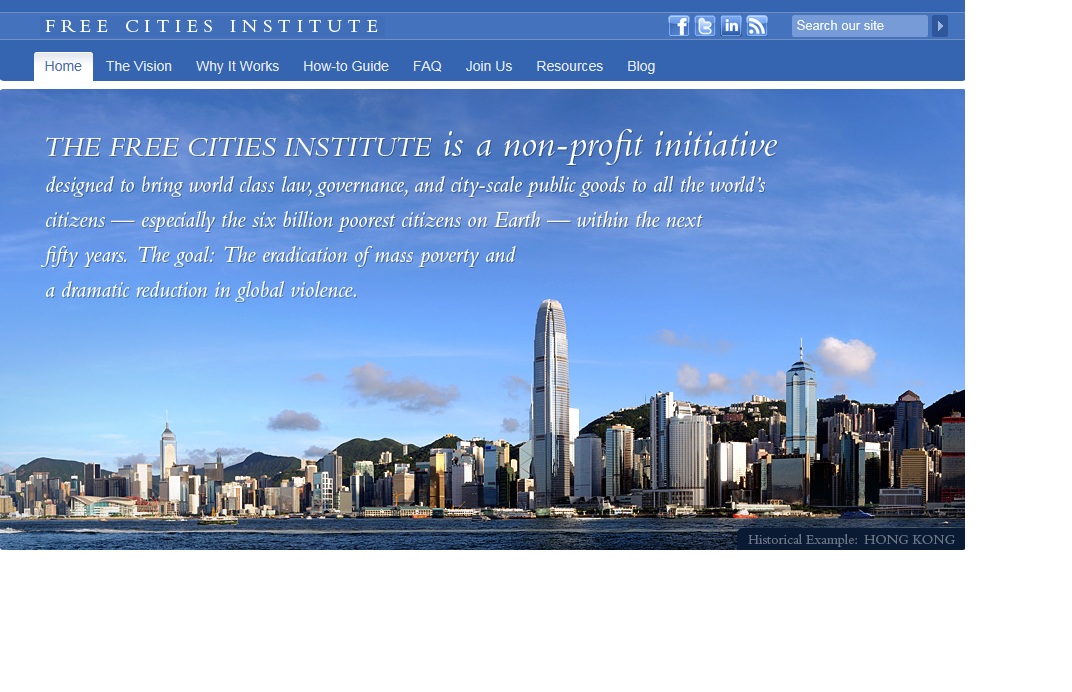
The Free Cities Institute
The gorgeous website has launched. Michael’s starting to blog over there. Lots of resources. Do check it out.
Free Cities on John Stossel, Tonight!
John Stossel’s show tonight is titled “What If Libertarians were in Charge?” and ends with an interview segment on Free Cities with visionaries and social entrepreneurs Michael Strong and Magatte Wade. They discuss the nuts and bolts of Free Cities, Native American sovereignty movements, and the entrepreneurship waiting to be unleashed in the developing world with better institutions.
Tune in tonight at 10 EST, on Fox Business, to show your support!
The Hudson Institute Discovers Free Cities and asks ‘Why Not Traditional Reform?’
Recently, the blog of the Hudson Institute posted a good write-up of Charter and Free Cities.
However, the author raises an objection commonly aired by people who first learn of the project: that Free Cities would take ‘too much time and effort’ compared to traditional avenues of reform.
But the bitter truth is that vast groups of kind-hearted and intelligent people have spent hundreds of billions of dollars lobbying and propagandizing for various mutually advantageous reforms, and for many decades. Most of these have, and continue to be, immediately stymied by governments — regardless of regime or era.
In the developing world, the hope for serious domestic reform through the ‘democratic process’ is a tragic pipedream. Even beyond the structural problems of democracy that hamper economies, ‘reform’ institutions themselves are often corrupt, and elections are often a sham.
Many legal systems already render appeal to the ‘rule of law’ impossible for the politically weak and the poor. Is it reasonable to expect a street trader in Nairobi or Tunis, destitute, beaten, and extorted daily for merely trading, to combat generations of stagnating political institutions?
Compare this traditional method with the Dubai International Financial Centre, a 110-acre model for Free Cities-style reform, which was conceived only 8 years ago and now is ranked as the 16th most important financial center in the world.
Just which process is a waste of time and effort?
Russian Firm to Build Cities in Kenya and the Democratic Republic of Congo
Fascinating Bloomberg article via Alex Tabbarok:
Renaissance Partners, the investment unit of Moscow-based Renaissance Group, plans to build a 6,400- acre city in the Democratic Republic of Congo as it seeks to benefit from Africa’s urbanization.
The Russian firm is working on a master plan for the new urban center after securing the land outside Lubumbashi, the country’s second-largest city, Arnold Meyer, Renaissance Partners’ managing director in charge of real estate in Africa, said in an interview in London. Renaissance is considering similar projects in Ghana, Nigeria, Senegal and Rwanda, he said.
“The West has peaked in terms of economic growth and the new markets are in Africa,” Meyer, 39, said. “And the main drivers of this growth in Africa are going to be cities.”
Meyer’s theory of peak Western growth is fallacious, but he’s certainly correct about the potential for cities to lift the developing world out of poverty. An optimistic interpretation is that these efforts take the hotel-resort model and extend it on the city scale. Still, two things immediately make me apprehensive. There’s a reason the Congo and Kenya have been slow to grow into prosperous countries: bad governance. With this kind of development project, there’s a hardware and a software problem. The hardware problem is straightforward. Build beautiful structures and walkways next to lovely parks. Add a transporation hub. Sprinkle a stadium on top. The really hard problem is the software layer. How are people going to behave? What rules will they abide by? If they’re merely applying the same rules that the rest of the country currently lives by, I am less sanguine about the prospects. Lastly, I wonder what people will be doing in these cities. Why will businesses operate here?
Here’s a video offering some details on Renaissance’s $5 billion Kenyan project, Tatu. On a first pass, it looks too much like a updated version of Le Corbusier’s Radiant City, the archetype of centrally planned authoritarian high-modernism. But maybe I’m only in a foul mood this morning. You decide:
Shell to Build World’s Largest Offshore Floating Facility
When there’s billions of dollars worth of natural gas underneath the sea floor, it’s not surprising these resource suckers will start to populate the ocean. From a Shell press release:
The Board of Royal Dutch Shell plc (Shell) has taken the final investment decision on the Prelude Floating Liquefied Natural Gas (FLNG) Project in Australia (100% Shell), building the world’s first FLNG facility. Moored far out to sea, some 200 kilometres from the nearest land in Australia, the FLNG facility will produce gas from offshore fields, and liquefy it onboard by cooling.
The decision means that Shell is now ready to start detailed design and construction of what will be the world’s largest floating offshore facility, in a ship yard in South Korea.
From bow to stern, Shell’s FLNG facility will be 488 metres long, and will be the largest floating offshore facility in the world – longer than four soccer fields laid end to end. When fully equipped and with its storage tanks full, it will weigh around 600,000 tonnes – roughly six times as much as the largest aircraft carrier. Some 260,000 tonnes of that weight will consist of steel – around five times more than was used to build the Sydney Harbour Bridge.
Shell has no plans to enter the market for competitive governance, as far as I know. (Which isn’t very far. Maybe this facility, called the Prelude, will operate under different laws from Australia.) Still, it’s a good way to instantiate a seasteading concept. The enormous amounts of capital involved to obtain a highly valued, but out of the way resource are a bit sobering for political idealists. The Prelude is being built, not on a dream of a new constitution, but for profit. And lots of it at that.
The Great Start-Up Theory of History
Sentences to contemplate about Steve Jobs’ retirement:
I speak often about the big sweep of history, particularly how relentless economic growth changes the human condition. And I almost always call out Steve Jobs and Steve Wozniak because their story represents a stunning refutation of the consensus paradigm of progress that held sway over serious thinkers for almost all of the 20th century, certainly the middle five decades. Even Joseph Schumpeter, the celebrated prophet of innovation and champion of the heroic entrepreneur believed that the new era would inevitably see the dominance of corporatism and its efficient R&D labs. Not until the rise of Silicon Valley and its startup culture affirmed the pioneering success of Apple did the consensus shift, quietly, as if nothing had changed. The recognition of startups, not governments, as the central actors in economic history should not be neglected after you turn this page.
In the next century, will start-up countries become the central actors in political history?
Economic History as Book Advertisement
Very well done. Sylvia Nasar’s new book, The Grand Pursuit:
Is Democracy the End of History? An Open Letter to Michael Lind
An interesting exchange is occurring over a recent article by Michael Lind in Salon on Libertarianism and Autocracy. Roderick Long at Bleeding-Heart Libertarians captures the crux of Lind’s misunderstanding when he writes:
One reason for Lind’s conflation is that he automatically translates being anti-democracy into being pro-autocracy — because he assumes that the only alternative to democracy is autocracy… libertarians don’t oppose democracy (in the conventional sense) because they hanker after autocracy; they oppose democracy because it is too much like autocracy.
In addition, Sheldon Richman poignantly questions Lind’s pairing of libertarianism with conservatism and asks whether criticism of libertarian individuals is an indictment of an entire ideology.
***
I’d like to suggest that one of the unstated premises of Lind, and many others like him, is that democracy is the end of history. We have reached the apex of social organization – and, funny enough, it looks a lot like what Lind and I were both taught in 6th grade Civics class.
You need not be a libertarian (or an autocrat) to question the wisdom of this position.
Representative democracy was a novelty in 1776 when people claimed that such a system was a utopian impossibility. But this is no longer the case. Democracy, like its predecessors, has now been subjected to criticism from many sides and for generations. We now have hundreds of years of — often rather unsettling — democratic history to attenuate our beliefs. Would Lind claim that democracies have no systemic problems that could potentially be fixed?
It is true that democracies have killed fewer of their own citizens than regimes like Soviet Russia or Communist China. It appears, though with less certainty, to be true that famines tend to be worse in non-democracies. A good democracy is preferable to violent dictatorship: but should this be considered an argument for democracy’s place as the ultimate end of institutional evolution?
After all, democracies have not always treated their citizens – or innocents at large – humanely. America interned Japanese-Americans during WWII and dropped the atom bombs. British democracy drove Alan Turing to suicide. American democracy did the same to Ernest Hemingway. Democracies imperialized; they colonized; they put innocent Africans in concentration camps; they prop up banana republics and petty tyrants the world over. They’ve dumped agricultural surpluses (a direct result of democratic rent-seeking behavior) on poor countries and destroyed the livelihoods of its residents. They have treated their own unwitting citizens as lab rats for chemical experimentation; they have conscripted generations of young men to die in wars of dubious legitimacy – then turned their backs when faced with the scars of their return.
Lind mentions Jim Crow and the Fugitive Slave Act; he fails to mention that these crimes against humanity were enshrined by democratic edict and enforced by the democratic bureaus supposedly exercising the popular will.
Economists and political scientists have rigorously shown how the incentives of democracy lead, in reality, to the rule of the many by the few, as special-interests capture a society. ‘Universal suffrage’ means little if democratic government in practice becomes the whirring machinery of corporatism and elites.
Easily one of the most inhumane traits of democracies is their tendency to seal off their institutions from other peoples. “Mature democracies” with generous welfare states like Sweden resemble a giant gated-community for blondes with blue-eyes. Restrictive immigration and labor policies leave millions of the most desperate human beings in the world languishing elsewhere. Those that do arrive are relegated to slums and unintegrated into ‘democratic’ society. If the expensive and often bloody efforts of the West are any indication: democracies in the developing world do not come easily. When they do come, they are too often hollow democracies – thin veils for a ruling cabal to exploit the populace at large.
But if Lind concedes that mature democracies tend to raise barriers to immigration and if he believes no other institutional arrangement is acceptable, then he is condemning the vast majority of mankind to an indefinite future of poverty and oppression.
Is this what writers like Michael Lind mean when they say ‘universal suffrage’? It is a universality bounded by the imaginary lines of the nation-state. Where libertarians like Arnold Kling, reviled by Lind in his article, ask for a decentralized world of free-movement and free-association of people: Lind is offering the pettiness of an American manufacturer, schmoozing in the Statehouse to extract a protection against competing, foreign upstarts.
When libertarians like Patri Friedman criticize democracy and suggest institutional alternatives, it is not from any affection for authoritarianism. Libertarians who — as Lind conveniently omits — have inherited the decidedly leftist sentiments of classical liberals and 19th century anarchists, are concerned with building a world of peace, prosperity, tolerance, and human flourishing. And so I ask those who purportedly share these progressive goals to answer honestly:
Do you believe that democracy is the end of history?
***
Update: Sam Bowman from the Adam Smith Institute utterly demolishes the factual basis of Lind’s claims and selective quoting here.
The ‘Daisy Duke’ Criterion
In the lead essay of her 2006 book Linking the Formal and Informal Economy, Nobel Laureate Elinor Ostrom has bad news: you, and I, and she, and everyone else are incurably ignorant.
Any social scientist can only know so much about their ‘subject-matter’. Popular methods often betray a fraudulent simplicity to the study of living, breathing, dreaming human beings with model-unfriendly traits like inconsistent utility functions and ever-shifting expectations about the future. The circumstances of any person’s time and place are forever hidden, no matter the view from a corner office at the World Bank.
Ostrom writes at length about these many (and deeply layered) complications facing anyone concerned with economic development:
We have repeatedly learned from many studies of policy processes that no single institutional arrangement works across diverse policy areas or even diverse subtypes within a broad policy area. Copying interventions that worked well in one country may lead to a major failure in another. ( p 8 )
But the good news is that we can still figure out ways to help those that need it most. Ostrom suggests: “a key is devolving authority to the lowest level that can take effective action related to the scale of a particular collective action problem… Go as close to the problem you are trying to solve as feasible.” (p 11)
But more than just advocating political decentralization, she offers one simple criterion for evaluating the effectiveness of policy changes and interventions: allow people to vote with their feet:
If people try to move out the net of an intervention in significant numbers, its presumed efficacy for their well-being must be questioned. If on the other hand people move into the net of an intervention (including when that intervention is reduced), this is a signal of its efficacy.
In other words, what development needs is a healthy infusion of Jessica Simpson (or maybe Nancy Sinatra): singer-starlet of the popular rendition of “These Boots Are Made for Walking.” For Ostrom, this ‘Daisy Duke’ criterion should be the guiding light of reform.
The study of informal markets and development has shown, time and time again, that people will adjust their lives to the incentives of their institutional environment. For instance, slum relocation efforts have been thwarted when people rent out subsidized suburban apartments and return to the cardboard shanties at the city center. Community ties, the proximity to their place of work, and access to credit and arbitration (often informal and community based) are powerful attracting forces. The same is true for efforts to formalize property rights or force legal reform:
The growing literature on informal trade provide examples where traders prefer to remain outside the ambit of official trade, because it is too costly and often beyond their logistical capacity to comprehend, and hence comply with ‘rules.’ … we can see street vendors, small businesses, and people who might gain formal ownership to their structures voting with their feet. If they decide to register, pay whatever taxes there are to, etc. they are voluntarily coming within the net and this is a good sign… A good test of whether an intervention is helpful or not is to know how many of the relevant population try to be outside of the net… (p 15)
The ‘Daisy Duke Criterion’ is also endorsed by the experts in Ostrom’s Linking because it provides us with a means of overcoming our ignorance. To evaluate most policies, we would need to know impossibly detailed information about people’s motivations, skills, social ties, their plans and expectations. But if we apply the ‘Daisy Duke criterion,’ we can bypass this trouble. People’s preferences and expectations are revealed by their actions. We can ‘know’ more than we could possibly discover by using the ‘vote-with-your-feet’ heuristic. This becomes our data: the ruler by which we measure the success of institutional reform.
Advocates of competitive governance should rejoice in this tacit endorsement by Ostrom. In essence, proposals like Seasteading and Free Cities are asking only to set our institutions to Ostrom’s ‘Daisy Duke’ test: allow entrepreneurship in legal systems, and let people (with cowboy boots or otherwise) foot-vote their allegiance.


 Let A Thousand Nations Bloom