Caplan to Gates Foundation, “You’ve Made a Mistake”
A cogent and pithy case for charter cities from Bryan Caplan:
Intense populist opposition aside, it is hard to graft one country’s institutions on to another’s – especially when entrenched interests fight you every step of the way. This is true in the business world as well. Competitors often try and fail to adopt leading firms’ “best practices.” Corporate culture is notoriously stubborn. In both business and politics, success often requires a clean slate. It is easier to open a new WalMart than to make the Kmart chain better. Advocates of charter cities argue that is also easier to bring in “outside management” to make a new city that works than to reform existing countries that don’t.
As the example of Hong Kong suggests, charter cities have both direct and indirect benefits.
Directly, each charter city would allow millions of people to better their lives by integration with the world economy. While critics often belittle this achievement as mere “cream-skimming,” the sad truth is that much if not most of the world’s cream now curdles in backwards farms and dysfunctional slums. If the native entrepreneurs who built Hong Kong had been trapped in mainland China, most would have wasted their lives in dead-end jobs on Maoist communes or joined the Communist elite. Hong Kong gave them opportunities to use talents that otherwise would have gone to waste.
A lot of his key points support competitive governance generally, and Seasteading, too. Enjoy.

Seasteading and the Constructal Principle
 This is a guest post by our frequent contributor and fellow radical for rules, Max Borders–Editor
The idea of competitive governance arises, fundamentally, from a desire for exit. People want out of the systems they’re in. And systems, of course, are based on rules. But most people don’t want anarchy necessarily; they simply want new rules and new systems.
Seasteading, as I understand it, is meant to provide “metarules” for the emergence of various novel rulesets that will compete for participants. That is why Seasteading should capture the imagination of entrepreneurs and activists alike. Indeed, it’s in this desire for elbow room that we also find pent up entrepreneurial energy.
Unfortunately, much of this energy will have to be spent on realizing this “right” of exit. It’s not going to be easy or costless to start ocean communities. But at least the energy involved in creating a Seasteading Community won’t go to deadweight activism. It will go both to realizing a right of exit and creating something new through the introduction of novel rulesets.
In that sense, Seasteading could be just one instantiation of what may be an ongoing evolutionary process of human social organization. It is in light of that possibility I’d like to consider Adrian Bejan’s Constructal Principle.
A New Law of Nature?
An engineering professor at Duke University is an unlikely source for a new branch of biology, economics or physics. But Adrian Bejan shook up the science world recently when he claimed he’d discovered a new law of nature:
For a finite-size (flow) system to persist in time (to live), its configuration must evolve such that it provides easier access to the imposed currents that flow through it.
The initial response to Bejan’s principle was a furrowing of brows.
But Bejan’s ‘constructal law’ is now rapidly gaining converts in areas ranging from biology to mechanical engineering. Why? Because when Bejan says “system,” he means virtually any system. And Bejan sees this principle operating everywhere: “The constructal law can be seen as a universal principle of evolution, which applies in many fields, from physics to economics.”
Whoa. Darwin would be impressed.
I was still synthesizing the insights of complexity theory when I came across Bejan’s work. Little did I realize there might be more intimate connections between emergent complexity and what Bejan was trying to tell the world. The universe, it seems, is full of currents.
These flows have objectives (e.g., minimization of effort, travel time, cost), and the objectives clash with global constraints (space, time, resources). The result is organization (flow architecture) derived from one principle of configuration evolution in time (the constructal law).
Constructal theory predicts animal design and geophysical flows, and makes evolution a part of physics. In the social sciences, there is substantial literature based on the use of optima to deduce social, population and economic dynamics. The constructal approach … links social sciences with physics, biology and engineering.
If you really want to boil Bejan’s idea down to a simple phrase, I think something like this suffices: Systems evolve according to flow. And even some of the freest nations on earth are slowly-but-surely restricting flow due to demosclerosis, i.e. that social entropy documented in the public choice literature. But if the constructal law is correct, these systems will need to evolve or pass away.
As Channels are to Rules
One afternoon Professor Bejan and I talked by phone for the first time. He’d been traveling, so he was tired. Wearily he told me the story of a recent trip to Edinburgh. Bejan had been on foot, on his way to give a talk on an academic paper. But in a flash of insight, he got his own lesson that day. And as he started to explain, he seemed to shed some of the weariness.
“I kept bumping into people,” he said — the softest Romanian accent betrayed by a smoky, tenor voice. “Why was this happening? Then it occurred to me: people in the UK drive on the left.”
The natural inclination of Scots is to mimic the rules of the road in the relative anarchy of the pedestrian thoroughfare. Bejan had been breaking an informal rule. In order to find flow, he had to adapt to channels local to Edinburghers.
“Channels are analogous to rules,” Bejan said.
I was immediately reminded of new institutional economist Douglass North who speaks of the tendency of certain institutions (rules) to ‘reduce transaction costs.’ This, of course, is econ-speak for system flow.
In his Nobel Prize lecture, North said:
Institutions are the humanly devised constraints that structure human interaction. They are made up of formal constraints (rules, laws, constitutions), informal constraints (norms of behavior, conventions, and self imposed codes of conduct), and their enforcement characteristics.
But do formal and informal institutions matter? You bet:
Together they define the incentive structure of societies and specifically economies. … Only under the conditions of costless bargaining will the actors reach the solution that maximizes aggregate income regardless of the institutional arrangements. When it is costly to transact then institutions matter. And it is costly to transact.
The rules of the game – formal or informal – are critical to economic prosperity over time. Likewise, channels within systems form over time and are critical to optimizing flow. Like fractals, you can see the constructal principle working everywhere. Bejan calls it “vascularization.”
The constructal law also predicts that ‘vascular’ designs must occur in nature, and that they must be stepwise more complex as they become larger.
To get our heads around vascularization, consider trees in terms of their form and function. In the air, why do they branch so? To ensure the inflow of carbon dioxide. In the soil, why do the roots bifurcate the way they do? To optimize the inflow of nutrients and water throughout the tree. Outflows of waste by trees ensure we get the fresh air (oxygen) we need in our human cardio-vascular systems–systems that mirror tree branches. These two sets of vascular systems have co-evolved (thank goodness).
In order to accommodate currents in the world, vascularization abounds. Tree-like configurations in everything, from river basins to the transportation networks that deliver your milk, are instances of the constructal principle at work in various domains. For any such system to persist in time, it has continuously to provide better flow.
Seasteading and Flow
I’d like to argue tentatively that seasteading, or something like it, will be a manifestation of the constructal law. That is, there are powerful human currents — the desire for elbow room, novelty and exit, as well as pent up entrepreneurial energies — that new rulesets will be needed. If territorial systems don’t evolve endogenously, evolution will occur from without.
What remains to be seen, of course, is whether the old systems will evolve to compete with the new systems, once formed. I think that’s the Seasteaders’ hope. But let me not get ahead of myself. We need to realize these new rulesets first. Seasteading is the best hope for doing that in the near term.
Max Borders is a writer living in Austin. See his “Radicals for Rules” clip and full talk here.
The Inevitable Imperial Presidency
Harvey Mansfield reviews a new book by legal scholars Eric Posner and Adrian Vermeule:
According to Posner and Vermeule, we now live under an administrative state providing welfare and national security through a gradual accretion of power in executive agencies to the point of dominance. This has happened regardless of the separation of powers. The Constitution, they insist, no longer corresponds to “reality.” Congress has assumed a secondary role to the executive, and the Supreme Court is “a marginal player.” In all “constitutional showdowns,” as they put it, the powers that make and judge law have to defer to the power that administers the law.
Carl Schmitt enters as the one who best understood the inevitability of unchecked executive power in the modern administrative state. He saw that law, which always looks to the past, had lost out to the executive decree, which looks to resolve present crises and ignores or circumvents legal constraints.
The authors appear to believe that this accumulation of power is both desirable and unavoidable. (As an aside, this makes the likelihood of projects like Seasteading more probable, as the vested interests overestimate the resilience of the status quo and underestimate efforts to subvert it.) The one check on executive power they cite is public opinion. Now I haven’t read the book, but if they’re calling the US Gov the administrative state, then they ought to consider the bureaucratic apparatus constraining the power of POTUS–that is, the administers. Foseti made this point quite well:
The vast majority of the employees of the government, like me, are unelected and – for all intents and purposes – cannot be fired. Focusing on the 0.0001% of government employees that get elected (obviously!) misses the remaining 99.9999%. Virtually everyone thinks that it’s possible to “change” government while maintaining 99.9999% of its employees. This belief is obviously retarded.
Who is sovereign? Yes, the executive, but his power is circumscribed by an army of civil servants and mandarins.
Posner and Vermeule offer up Carl Schmitt as the explicator of the current constitution. It is odd that such mainstream legal theorists would chose a man who rationalized the Nazi grasp for power, but I applaud their honesty. Schmitt was famous for defining a sovereign as he who decides the exception. As the exception becomes the rule–and the old rule, the exception–the Constitution is remade. What you think the constitution is and what it actually is are not the same thing. Welcome to the present.
I Hate to Ruin Your Dialectic, But
Nicholas Wade previews Francis Fukuyama’s new magnum opus on the evolution of governance:
“My argument is that the rule of law comes out of organized religion, and that democracy is a weird accident of history,” he said. “Parliaments in Europe had legal rights, and it was a complete historical accident that the English Parliament could fight a civil war and produce a constitutional settlement that became the basis of modern democracy.”
In a parallel universe with no feudalism, European rulers might have been absolute, just like those of China. But through the accident of democracy, England and then the United States created a powerful system that many others wish to emulate. The question for China, in Dr. Fukuyama’s view, is whether a modern society can continue to be run through a top-down bureaucratic system with no solution to the bad emperor problem. “If I had to bet on these two systems, I’d bet on ours,” he said.
This account of democracy’s development makes it sound like a lucky, freak mutation that led to world domination. This could be true. It’s certainly interesting. The more you see our current political configurations as accidents of history, the more likely you’ll see a greater opportunity to create new forms. One thing Fukuyama excels at is in explaining the path dependencies in the history of political thought and in detailing the limits human nature might impose on the design space.
But by contrasting China with the U.S., Fukuyama forces a binary assumption about the possibility space of all forms of good government. Sure, the bad emperor problem is real. But so is legal democratic plunder. There is monotheism (one emperor), there is polytheism (everyman an emperor), but need I remind this neo-hegelian that there’s also atheism (no man an emperor)? Fukuyama seems to have left behind the inevitability thesis of his earlier work, The End of History and the Last Man. But he still appears to argue that democracy as a whole represents the ne plus ultra of political theory. Surely there must be other freak mutations that might lead to even more successful forms of governance?
I suppose it all depends on how you define democracy. In that space alone, there are a myriad of possible forms.
Anyhow, in his study on the concept of the Great Chain of Being throughout history, Arthur Lovejoy noticed a bias in every age to assume that it had reached the maximum level of diversity. Though I have not read his book–(and I am excited to)–I’m inclined to think Fukuyama makes the same mistake.
Seasteading in The Freeman
Patri and I have an article in the latest edition of The Freeman. Here’s the intro:
Libertarians have done a wonderful job of pointing out the inefficiency and cruelty of government and identifying some of the causes. We know that current policies are bad; we know that such policies are the inevitable outcome of unrestrained democracy; and we even have some ideas about what would work better. The most fundamental problem with government and the most promising form of activism have been largely ignored, though. If we want liberty in our lifetimes, we need to think more carefully about why we have bad government and how best to improve things.
To think about this question, we need to avoid being either too romantic or too cynical about governance. While readers of this publication are at no risk of being romantic about government, there is a chance of excessive cynicism. Government currently works very poorly, but this doesn’t need to be so. Competition would force providers of governance to offer high-quality rules and public services at a reasonable price, unleashing institutional innovation and making the world a much better place.
So far, most libertarians have been hacking at branches, while a few come tantalizingly close to striking at the root. We’re going to try to convince you that the root at which we should be striking is a tangled mess of barriers to entry and costs of switching in the governance market. The ax we should be using is the technology to settle the ocean.
We’ll also be doing an online Q&A for The Freeman’s Idea Room on March 8. You can ask questions now!
More on Honduras’s Charter City in the Making
In case you missed this in the WSJ last week, Mary Anastasia O’Grady wrote up a good column on the Honduran effort to build a free market city:
The idea is simple: A sizable piece of unpopulated government land is designated for use as a model city. A charter that will govern the city is drafted and the Congress approves it. A development authority is appointed by the national government. The authority signs contracts with the investors who will develop the infrastructure. The city opens for business under rules that act as a magnet for investment.
Sound fanciful? Perhaps, until the chief architect of the plan, 35-year-old Octavio Sánchez, points out that “model cities” are nothing new. “What I love about the concept,” President Porfirio Lobo’s chief of staff tells me in an interview, “is two things. First, that we will employ the best practices from similar projects around the world that have been successful. Second that it is entirely voluntary for people to move in. They are the ones who will protect it.”
Who is Octavio Sanchez? A John James Cowperthwaite in the making? The process isn’t very clear to me, but I wonder how likely it is that the Congress will approve a Hong Kong like charter. We shall see in the next few months.
This week Mr. Sánchez and Mr. Lobo will travel to South Korea and Singapore, where they will analyze successful model cities to aid in drawing up the first charter. They will also be looking for investors. Mr. Sánchez says that it is important that more than one model city is launched so that rule designers will have to compete.
Rules. Competition. It sounds like he reads this blog.
Honduran Charter City on the Verge
Paul Romer writes:
The passage of the amendment is a decisive first step toward creating in Honduras the kinds of opportunities that migrants seek up north, but in a place where families can stay together, be safe, and enjoy the full protection of the law. The specifics have yet to be determined, but discussions have centered on a site large enough to accommodate a city that could eventually grow to 10 million people. As large as this sounds, it is small compared to the annual flow of migrants from the region into the United States.
Coverage in the WSJ.
Help Us Name the Seasteading Book
Here. You could win $100, a signed copy, and an acknowledgement.
Silver Democracy: Extinct Volcanoes in Japan Sap Economy
Here’s a good illustration of how to stagnate your economy–redistribute wealth from the young and creative to the stale and old:
An aging population is clogging the nation’s economy with the vested interests of older generations, young people and social experts warn, making an already hierarchical society even more rigid and conservative. The result is that Japan is holding back and marginalizing its youth at a time when it actually needs them to help create the new products, companies and industries that a mature economy requires to grow…
“Japan has the worst generational inequality in the world,” said Manabu Shimasawa, a professor of social policy at Akita University who has written extensively on such inequalities. “Japan has lost its vitality because the older generations don’t step aside, allowing the young generations a chance to take new challenges and grow.”
This is why limiting the scope of sovereignty is morally important. As each generation passes, more people accumulate into politically invincible budget-dominating demographics. With the option of voice all but silenced before the apparent moral authority of pensions for the old, the only hope for the young is to exit:
Mr. Horie finally quit — not just the temporary jobs, but Japan altogether. He moved to Taiwan two years ago to study Chinese. “Japanese companies are wasting the young generations to protect older workers,” said Mr. Horie, now 36. “In Japan, they closed the doors on me. In Taiwan, they tell me I have a perfect résumé.”

Tyler Cowen has a new ebook coming out this week. It’s called the Great Stagnation. I’m eager to read it, but based on Tyler’s own description, it appears he echoes some claims Peter Thiel has been making about the lack of innovation we’ve seen since the early 70s. For Thiel’s take here’s a TED talk on the topic and a WSJ interview. iPhones and laptops are palpable, so people tend to doubt these arguments. After all the unseen–what hasn’t happened–is difficult to adduce. But back in 2009 Michael Mandel pointed to some telltale signs:
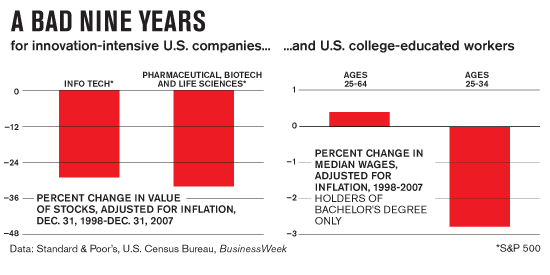
The Age of Innovation?
Cowen explains why median wages in the U.S. have been stagnating since the 70s:
I’m also persuaded by the median income numbers because they are supported by related measurements of other magnitudes. For example, another way to study economic growth is to look not at median income but at national income, gdp, or gross domestic product, the total production of goods and services. Charles I. Jones, an economist at Stanford University, has “disassembled” American economic growth into component parts, such as increases in capital investment, increases in work hours, increases in research and development, and other factors. Looking at 1950–1993, he found that 80 percent of the growth from that period came from the application of previously discovered ideas, combined with heavy additional investment in education and research, in a manner that cannot be easily repeated for the future. In other words, we’ve been riding off the past.
I’d like to add to Cowen’s argument. An economist named Benjamin Jones at Northwestern University looked back over the last 100 years and delved into some interesting data sets on Nobel Prizes, patent filings, and almanac entries. He collected data on the age at which an inventor brings about his first discovery, the average age of a scientist’s greatest accomplishment, and the productivity lifespan of innovators and scientists.
Here are some facts worth considering from the Jones research, that I believe supports the Thiel-Cowen thesis that technological progress has not been proceding apace:
- Innovators today are older than they used to be. Over the last century, the mean age at greatest achievement for both Nobel Prize winners and great tech inventors rose by about 6 years.
- The mean age at which innovators launch their first inventions has increased by 8 years over the course of the century, rising from a mean age of about 23 in 1900 to approx 31 in the year 2000.
- Despite the later and later start, there has been no compensating shift in the productivity of innovators beyond middle age, meaning the late start has truncated careers. We do not see any rise in innovating among 50 and 60 year olds, although people are now more productive in their 40s.
- His data suggests innovation potential is highest approx between the ages of 27 and 42. But the peak has shifted from about age 32 in 1900 to 40 by end of century.
- He estimates a 30 percent decline in life-cycle innovation potential over the 20th century.
- Death of the renaissance inventor: specialization has increased in patent filing. More and more people are working in teams that require a greater division of intellectual labor. And fewer and fewer inventors are making jumps from one patent category to another.
Big takeaway: “The shorter the period that innovators spend innovating, the less their output as individuals over their lifetime. If innovation is central to technological progress, then forces that reduce the length of active innovative careers will reduce the rate of technological progress. This effect will be particularly strong if innovators do their best work when they are young.”
These facts ought to give us pause. Jones postulates that the main reason we see an age shift is because the frontiers of knowledge are farther and farther away. The shoulders of giants are higher. The low fruit has been taken. Because of how complex and specialized our knowledge has become, Jones says the young must spend more and more years training and acquiring knowledge to reach the cutting edge.
Now it may be that the “burden of knowledge” is heavier than it used to be. But my own take is that we shouldn’t confuse the accumulation of credential crud for the difficulty of reaching the frontiers of knowledge. On the macro scale, we often cite the Mancur Olson thesis that special interests sap the dynamism of economic growth over time. I believe the Jones data and Cowen’s arguments present further evidence supporting the Olson story. For instance, why should we believe PhD programs are designed to efficiently move students from ignorance to the frontier of knowledge as quickly as possible? Academics are not mainly truth-seekers. They’re incentivized to pursue other aims such as pleasing their advisors, their tenure review panel, or a grant making body. These aims do not coincide with discovering new and useful knowledge. Secondly, we can go back further. A lot of education from K-12 to college core requirements is a waste of time. How much of this knowledge is relevant to future work making discoveries? If anything, Jones should suggest we try to make education more efficient.
But I digress. In all this discussion, Cardwell’s Law looms in the background. No country stays technologically superior forever. As yesterday’s innovators becomes today’s vested interests, stagnation follows. There are reasons for that. All of these arguments–Thiel’s, Cowen’s, Jones’s–suggest we may need a thousand nations sooner than we think. We will soon find not the singularity, but the stagnation is near.


 Let A Thousand Nations Bloom