Ten Practical Steps Towards Creating a Nozickian Utopia of Utopias
This guest post comes from Michael Strong. He is the CEO of FLOW, Inc., and the author of Be The Solution: How Entrepreneurs and Conscious Capitalists Can Solve All The World’s Problems. Michael will be speaking at the Seasteading Conference in September–Editor
The how-to-guide for letting a thousand nations bloom, in ten steps:
One: Create a new city in the developing world using a private developer that provides World-Class legal and physical infrastructure for the city, and distribute dividends from the city to the government and people of a given nation as well as health care and education for the city. Create a sliding scale whereby the proportion of dividends going to government and citizens changes over time from equal shares to 100 percent citizens shares. For instance, the city could be owned 60 percent by the private developer, 20 percent allocated to education and health care, and 20 percent to government and citizens. Initially this last 20 percent could be divided equally between government and citizens, with gradually shifting over the course of 30 years to all 20 percent going directly to the citizens (Thanks to Mark Frazier of Open World for proposing similar vesting strategies). To get a sense of the possible scale of such cities, New Songdo City in South Korea is a $35 billion development, the largest private real estate project in the world. A key difference between the Songdo project and Free Cities as proposed here is that the Songdo project, although it is in a Free Zone, relies on existing Korean law. The single greatest advantage that the proposed Free Cities will have (similar to Romer’s Charter Cities), is that they will run a world-class legal system (U.S., Singapore, Hong Kong quality or better). Because most developing nations have legal systems that provide significantly weaker business environments than do those nations ranked most highly on economic freedom indices, a change in legal system within a Free City located in a developing nation should provide a significant gain in previously unrealized wealth creation possibilities.
Two: Create a second, third, and fourth such Free City, and so on. Encourage the replication of Free Cities based on a similar model on the grounds that it is a proven technique:
Although one can make a libertarian case for allowing individuals to make their own decisions with respect to education and health care, many developing world nations do not have adequate pipelines for talent or adequate institutions for contemporary health care. Insofar as they rely on the legacy institutions designed by the mainstream establishment, their institutions will not be optimized for progress in the 21st century. Moreover, insofar as existing mainstream organizations – academic, NGO, journalistic, and multi-lateral institutions – use education and health care statistics as metrics of progress, we want our cities to outperform existing legacy institutions quickly and decisively. Insofar as the Free Cities are managed as for-profit institutions, they will have an incentive to optimize their education and health care systems. In the long run, with thousands of Free Cities, we will gradually discover the extent to which city-level, for-profit Free Cities are an appropriate decision-making unit for diverse services vs. the extent to which they delegate such decision-making to their city’s citizens. Some Free Cities will want to more centralized control of such services, others will want less. Some corporations and some private communities are highly centralized, some are highly decentralized.
Three: Finance an intellectual, activist, and public relations movement on behalf of this strategy for alleviating poverty around the world. One way to do this is to allocate a portion of each new city development project to fund intellectual, activist, and public relations content producers on behalf of the Free City movement. For instance, if each of a series of content partners to a Songdo-scale development received .1 percent of the deal, each such content partner would receive $35 million. The combination of privately funded universities, think tanks, activists and NGOs, and public relations organizations, all of whom find their financial destinies tied to that of the Free City movement, could find themselves receiving reliable revenue streams in the hundreds of millions, and then billions of dollars over time. Ideally their funding would be tied to the annual GDP growth of the Free City or to the value of equity shares in the corporation managing the Free City. The cumulative scale of such funding dwarfs the investment made by Charles Koch in the libertarian movement.
Four: Create a coalition of such cities and other entities who persuade and lobby both nation-states and international organizations on behalf of greater autonomy for such jurisdictions as well as for the open-ended creation of new jurisdictions.
Five: Create a network-node basis of global governance that ensures that dangerous activities (terrorism, money-laundering, the creation of nuclear, biological, and chemical weapons, and the rest.) are adequately constrained while also allowing much greater freedom with respect to economics, governance, and lifestyle.
Six: Document the progress in wealth creation/poverty alleviation, health, and education due to this new paradigm and the delta of this approach vs. the mainstream establishment approach. Document definitively the extent to which the mainstream academic establishment has, through poor judgment with respect to its understanding of the free enterprise system, been responsible for more than a century of unnecessary war, poverty, human degradation and misery.
Seven: Create and continuously re-affirm a heroic narrative in all education, journalistic, entertainment and scholarly materials showing the escape from the dark ages of statism and the importance of maintaining a system of Free Cities around the world.
Eight: Encourage the withering away of remaining vestigial nation-state governments by means of a movement whereby citizens around the world demand direct Citizen’s Dividends rather than allowing the governments to continue to take their wealth from them.
Nine: Allow the network-node global governance system to interact directly with city-scale free entities and bypass relationships with nation-states. The nation-state system may continue to survive for sometime, perhaps for centuries, but as an increasingly irrelevant atavism, playing a role in world affairs similar to that currently played by the British monarchy.
Ten: Further human progress takes place by means of endless entrepreneurial improvement in Free City developments and the network-node system of global governance. The future of humanity consists of endless advances in health and happiness, discovery, adventure, and creation, a Nozickian Utopia of Utopias.
De Tocqueville on Democracy’s Oppression
When eloquence sets fire to reason and prophecy–I recently reread this passage from Democracy in America–it is so haunting, so insightful, and so relevant to much in current debate (healthcare?), I can’t help but quote it. The brilliant Frenchman, from 1840:
I think the species of oppression by which democratic nations are menaced is unlike anything that ever before existed in the world; our contemporaries will find no prototype in their memories. I seek in vain for an expression that will accurately convey the whole of the idea I have formed of it; the old words despotism and tyranny are inappropriate: the thing itself is new, and , since I cannot name it, I must attempt to define it…
What might this quiet and gentle democratic oppression look like?
Above this race of men stands an immense and tutelary power, which takes it upon itself alone to secure their gratifications and to watch over their fate. That power is absolute, minute, regular, provident and mild. It would be like the authority of a parent if, like that authority, its object was to prepare men for manhood; but it seeks, on the contrary, to keep them in a perpetual state of childhood: it is well content that people should rejoice, provided they think of nothing but rejoicing. For their happiness, such a government willingly labors, but it chooses to be the sole agent and the only arbiter of that happiness; it provides for their security, foresees and supplies their necessities, facilitates their pleasures, manages their principal concerns, directs their industry, regulates the descent of property, and subdivides their inheritances: what remains, but to spare them all the care of thinking and all the trouble of living?
Thus it every day renders the exercise of the free agency of man less useful and less frequent; it circumscribes the will within a narrower range and gradually robs a man of all the uses of himself. The principle of equality has prepared men for these things; it has predisposed men to endure them as benefits.
After having thus successively taken each member of the community in its powerful grasp and fashioned him at will, the supreme power then extends its arm over the whole community. It covers the surface of society with a network of small, complicated rules, minute and uniform, through which the most original minds and the most energetic characters cannot penetrate to rise above the crowd. The will of man is not shattered, but softened, bent, and guided; men are seldom forced by it to act, but they are constantly restrained from acting. Such a power does not destroy, but it prevents existence; it does not tyrannize, but compresses, enervates, extinguishes, and stupefies a people, till each nation is reduced to nothing better than a flock of timid and industrious animals of which the government is the shepherd.
US Citizenship, Yachsteading, and Taxes
More US wealthy opt to surrender their citizenship
Private client lawyers and relocation specialists are reporting a surge in wealthy Americans living abroad who are prepared to give up their citizenship to avoid the scrutiny of US tax authorities.
…
The level of interest is set to increase following the tax disclosure deal between the US Government and UBS of Switzerland, involving the names of 5,000 alleged US tax evaders being handed over to the authorities. The UK concluded a tax deal with Liechtenstein last week.
Because of this, many ultra-wealthy individuals who have chosen to become stateless now cruise outside coastal waters in their mega-yachts in the belief that if they stay on the move, tax authorities will not be able to catch up with them. One analyst who did not want to be named, has estimated the number of stateless tax evaders amounted to a few thousand.
If true, sounds like a great potential market for seasteads.
There are structural reasons for the increase in people giving up citizenship – the reform of the previously-horrendous exit tax (10 years of taxation) to a one-time mark-to-market tax, combined with the recession and low asset prices, means the exit tax is effectively much lower than usual:
Under US tax laws, the worldwide income of any US citizen or resident is subject to tax. The US is the only country in the world that requires its citizens to stump up, no matter where they live.
Krause said current economic conditions are making it more conducive for Americans to contemplate paying exit tax demands from the US Internal Revenue Service. “The mark-to-market provision in the Exit Tax from the IRS is a big incentive,” he said.
In the final months of the Bush administration, the US Government introduced a package of tax reforms that included an amendment to the exit tax on US citizens and long-term green card holders who expatriate the US.
The tax allows US citizens and permanent residents wanting to renounce citizenship or permanent residency to pay a one-off income tax on gains over $600,000 (€420,000). All assets beyond this amount are valued at mark-to-market.
The exit tax allows a clean break from the US tax system from the date of expatriation without imposing the previous 10-year period after expatriation where tax rules used to apply – another big incentive, say lawyers.
Still, getting a second citizenship is out of the reach of most Americans:
St Kitts and Nevis is favoured for its perceived security, while Austria is one of the few European countries where it is possible to purchase citizenship.
Typically, it will cost $400,000 to secure a St Kitts and Nevis passport, whereas Austrian citizenship might run into several million euros.
The costs are high because the competition is low – only a few countries offer citizenships for sale, post-9/11. The trends we talk about here: increased number and diversity of nations, increased commoditization of sovereignty, and viewing citizenship as a business relationship (taxes in return for services) rather than an emotional homeland, will all push to reduce prices.
Intuitive Medieval Libertarians
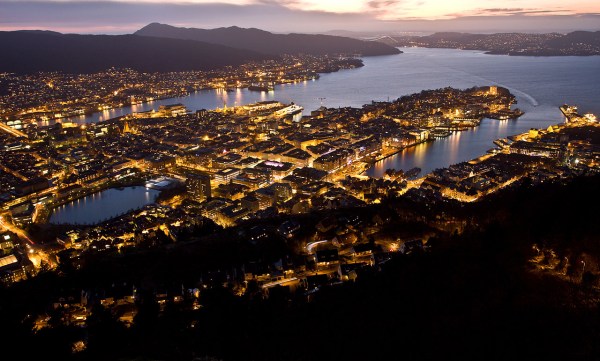 In his latest Forbes column, the ever insightful Richard Epstein uses the medieval town of Bergen, Norway, as a case study in law and economics. It’s a great example of how efficiency can guide rule creation. Because Bergen was built on a sliver of land between mountains and the sea, and because stone was not available for construction, the closely packed, wood buildings created a tinderbox of a town. Epstein writes:
Risks this large required firm collective action. From earliest times, Bergen was subject to strong laws that regulated every aspect of its operation. The most obvious laws were those which specified what kinds of wood and other materials should be used in construction of roofs and walls. Those rules were not enough. Other regulations dug far more deeply. Most strikingly, the risk of fire forced a mandated partial conversion from private to common ownership. Kitchens were much too dangerous to have in large numbers, so all the cooking was concentrated in a single communal location, tightly watched and inspected. Other heating was concentrated in large assembly rooms. Lamps were forbidden in dark corridors during long and cold winters. Certain businesses, like gold smelting were only allowed on dirt floors in order to further minimize the risks of combustion.
And it all made sense. One prediction of modern economic theory is that ex ante regulations against compensable losses will be less pervasive in circumstances where ex post compensation is possible through the tort system. But the tort law–even the criminal law–could not provide deterrence equal to the risk at hand. Who knew who started a fire, or who contributed to its acceleration? Even if the wrongdoer could be identified, he could not pay for the losses imposed, assuming he survived the catastrophe.
Similarly, a fire insurance market was not viable because the high correlation of risk negated any possibility of loss spreading. The only legal rule that had real traction was the rule of public necessity that required the compensation of anyone whose home was consciously burned to protect the other properties from destruction. And that rule was only applied when the other homes were saved, where the limited burden was divided among others. But for the most part, it was either land-use regulation or nothing.
Fortunately, none of the imagined designs for Seasteads rely on wood. But it’s interesting to see how circumstances can push rules to their most efficient application. (Especially when transaction costs are low.) This is why it’s more important to create a system for rule innovation, where rules organically evolve to respond to local needs, rather than a system with one single rule set. Anyhow, Epstein goes on to lament the current malaise in land-use regulation:
Zoning is no longer plausibly connected to harm prevention, but has a more insidious purpose: to shift the competitive balance by keeping out some businesses and residences in order to create economic rents for others, all under the lazy eye of courts who don’t see how the risks to private property endanger the economic system as a whole.
Distributed Resilience and the Knowledge Problem
A year ago, many economists failed to predict a 25 standard deviation event. But then again, seismologists fail at this all the time. And when they do, the science of seismology does not undergo a period of existential against. Mark Thoma writes:
We may never be able to predict earthquakes far enough in advance and with enough specificity to allow us time to move to safety before they occur, but that doesn’t prevent us from understanding the science underlying earthquakes…even though earthquakes cannot be predicted, at least not yet, it would be wrong to conclude that science has nothing to offer. First, understanding how earthquakes occur can help us design buildings and make other changes to limit the damage even if we don’t know exactly when an earthquake will occur.
In short, macro-economics is the new seismology. So how are we to avoid the consequences of catastrophe? How are we to build resilient structures? I couldn’t help but think of this parable from Kevin Kelly’s recent essay:
Nobelist Herbert Simon conjured a timeless fable to illustrate this principle. Imagine two old watchmakers assembling a batch of fine gold watches built from 1,000 tiny parts each. One of the watchmakers (call him Tempus) starts with the first gear and keeps adding the next part until the watch is done. If Tempus gets a phone call and puts down his work, the delicate assembly falls apart and he has to start over again. However the other watchmaker (Hora) assembles the watch in subgroups of 10 pieces each. Now if Hora is interrupted and puts down his work he loses no more than one hundredth of his progress. Simon calculated that if there was a one in ten chance that the watchmaker’s next step might be interrupted (since both watchmakers had many loyal customers clamoring for their quality craftsmanship) then it would take Tempus on average 4,000 times as long to make the same watch as Hora.
In Simon’s fable, Hora’s invention of modularity forms a ratchet which prevents his progress from backsliding. Science philosopher Jacob Bronowski calls that ratcheting “stratified stability.” Risky innovations are stabilized by operating as modules. The worst that can happen is that complexity will collapse down to the stratum of the previous stable unit.
Governance that builds like a Tempus is more susceptible to catastrophic events and slower to recover; governance that proceeds like Hora–in a distributed, modular fashion–prevents backsliding. I leave it to you to judge whether the U.S. government is more of a Tempus than a Hora.
Craigslist Government
Wired has a fascinating article on Craigslist and its founder, Craig Newmark:
Newmark’s claim of almost total disinterest in wealth dovetails with the way craigslist does business. Besides offering nearly all of its features for free, it scorns advertising, refuses investment, ignores design, and does not innovate. Ordinarily, a company that showed such complete disdain for the normal rules of business would be vulnerable to competition, but craigslist has no serious rivals. The glory of the site is its size and its price. But seen from another angle, craigslist is one of the strangest monopolies in history, where customers are locked in by fees set at zero and where the ambiance of neglect is not a way to extract more profit but the expression of a worldview.
The axioms of this worldview are easy to state. “People are good and trustworthy and generally just concerned with getting through the day,” Newmark says. If most people are good and their needs are simple, all you have to do to serve them well is build a minimal infrastructure allowing them to get together and work things out for themselves. Any additional features are almost certainly superfluous and could even be damaging.
Newmark has been working hard to extend the influence of his worldview. His public pronouncements have the delighted yet apologetic tone of a man who has stumbled on a secret hiding in plain sight and who finds it embarrassingly necessary to point out something that should long have been obvious. He seems to have discovered a new way to run a business. He suspects that it may be the right way to run the world.
Wouldn’t it be awesome if he had a way to run a government? Or start one on his own?
It is easy to find hypocrisy in the idealism of a business owner who prescribes democracy for others while relieving himself of the tiresome burden of democratic consultation in the domain where he has the most power. But of course, craigslist is not a polity; it is just an online classified advertising site, one that manages to serve some basic human needs with startling efficiency. It is difficult to overstate the scale of this accomplishment. Craigslist gets more traffic than either eBay or Amazon .com. eBay has more than 16,000 employees. Amazon has more than 20,000. Craigslist has 30. Craigslist may have little to teach us about how to make decisions, but that’s not the aspect of democracy that concerns Newmark most. He cares about the details, about executing all the little obvious things we’d like government to do. “I’m not interested in politics, I’m interested in governance,” he says. “Customer service is public service.”
Precisely. There’s a reason we keep harping on the idea of government as a business – because that’s all it is. Government is an industry, and governance is the service provided by that industry. The service provided in the status quo is awful. In a world where you allow the world’s best and brightest entrepreneurs to try their hand at governance, great things will happen.
What Good Governance Looks Like
From a speech by Lee Hsien Loong, prime minister of Singapore, on the potential repeal of section 377a from Singapore’s penal code:
Mr. Lee, in this speech, is defending his government’s position to retain section 377a, which criminalizes, among other things, sodomy in the Republic of Singapore. (Stay with me.) Loong explains that his government will not actively enforce the provision, but that it will be maintained, symbolically, as a measure of the fact that Singaporean society is broadly conservative.
What is remarkable about this speech is not the specific position laid out by the government, but the way in which it is laid out. Lee feels it necessary to give a detailed, well-thought-out, 30 minute speech to Parliament on the reasoning behind this decision, to the point that even if you were to disagree with Lee and his party, you would at least respect the fact that they gave the issue serious consideration. He’s talking to his citizens as though they were adults, not children, and as though they were customers, who could leave Singapore with relative ease if they were dissatisfied.
This is more remarkable when you consider that Singapore is a broadly authoritarian society. Lee, and his father Lee Kuan Yew, have held power in Singapore continuously since its separation from Malaysia in 1965. With this sort of dynastic power structure, one would hardly expect the government to be this responsive to its citizens. But it is. Why?
In a word: exit. Singapore’s political structure is based heavily on the immigration of skilled citizens, because the birth rate in Singapore is well below replacement – only 1.29 children per woman of childbearing age. Not only do they have to attract new citizens to ensure the health of their polity, they have to ensure that their existing citizens don’t leave. And given that most of their citizens are wealthy immigrants, and that Singapore is a relatively small country, the relative ease of leaving Singapore has a way of focusing their leaders to work hard on providing what can be considered good customer service.
But, you might say, Singapore has these draconian restrictions on drug use and consensual sexual behavior – if that is the future of competitive government, then that’s not a future I want to be a part of. The key here is to remember that if we Let A Thousand Nations Bloom, some of those nations will probably be socially conservative, and while Singaporean society might be illiberal, it is still a liberal goal to ensure that people can live in a society that meshes with their values. A political world based on exit, and not voice, will have plenty of societies that any given individual would find unsuitable. But just as you don’t have to buy every product you see at the supermarket, you don’t have to live in every single polity. You just need to find the one that fits.
Let One Dusty, Temporary Nation Bloom
 If you’re going to make it the Playa this year for Burning Man 2009, come by Future Camp at Playagon (9:00 & Fossil), where myself and several other Seasteading Institute staff & volunteers will be camping. We will be holding Future Salons on Thursday (Seasteading) and Friday (Ephemerisle), both at 3pm. Or come by the camp anytime to say hi – I’ll be around most days between 1pm and 5pm.
Decentralization And Social Change
The Lioness’ Den has two interesting posts on how secession, anarchism, and other localism movements (ie, anything that moves us towards A Thousand Nations) will affect society. What will a decentralized world look like, culturally and economically? These are important questions, and it’s great to see someone grappling with them – especially since they are questions I often get asked, and the cultural aspect is one I must admit I haven’t thought deeply about.
In Decentralism for the Masses: The Big Sort and What It Reveals About Localism and Voluntary Segregation, she writes:
I’ve seen two major options so far for what a decentralized world might look like. Kevin Carson presents a model of decentralism of driven by necessity through eroding transportation and lack of mobility, characterized by small regional markets, localized production and high levels of economic autarky. By contrast, Keith Preston portrays a model of decentralism by choice along lines of interest and affinity, a panarchy of multiple systems in which social, political and cultural factors are motivating influences, and some degree of segregation and separatism are likely (though not necessarily universal).
Which is more likely to occur — and which would be more successful? According to Bill Bishop ‘s The Big Sort: Why the Clustering of Like-Minded America Is Tearing Us Apart (2008), an experiment along these lines is already taking place. The United States is becoming progressively more differentiated into smaller units along political, social, economic and geographical lines. What do the data show?
So far, the process fits more into Preston’s model of decentralization by choice rather then necessity, enabled by mobility and based on personal preference rather than economic need. Although the two are interconnected, it is primarily sociocultural choice that drives economic reorganization. People are going to places with people they like and jobs they want, rather than adjusting themselves to local necessities.
That’s only the beginning, as she moves on to cover “The Psychology of Tribes and Neo-Tribes: How Free Is Galt’s Gulch?”, “Political Subcultures and Partisan Lifestyles”, and “Genetic Implications”. She clearly gets the idea of a market for government, concluding:
A complete micronational-anarchist system would be quite different, with many more options and a more-market-like structure in which communities would compete for mobile resources like people, trade and investment, rather than centralized political influence. Thus, the Big Sort should be seen as only a very rough intimation of what true panarchy or anarcho-pluralism would be like.
Nonetheless, it is the road down which we are now moving. Whether it continues will depend on political, economic and environmental .factors, including whether energy shortages induce constraints on mobility (as Kevin Carson has argued.) If technology succeeds in keeping up with such changes, and if new political visions of anarchism, secessionism, and microanarchism take hold, the 21st century could witness the transition into a decentralized America.
The consequences of freedom of association need to be understoood as a set of trade-offs: large-scale diversity and local segregation, individual choice and group homogeneity, political autonomy and economic specialization . Unlike collectivist visions of utopia, it offers no guarantees; people sometimes become snared in their own choices.
You may also want to check out: Does Decentralism Lead To Social Regression?, which begins:
There’s an assumption…that decentralized, organic communities will necessarily be socially conservative, much more so than communities in the same geographical areas under statism, and they will remain so permanently with no incentive to change. I do not see any reason to assume this. The fallacy arises from the fact that the only such small-scale, autonomous societies that we currently know of, with few exceptions, are from earlier stages of history: tribal, ancient and medieval. Therefore these simple societies serve as the image and model in terms of which we imagine decentralism. There is, however, no reason to assume that a shift to political and economic localism will necessarily require a regression toward more restrictive traditional mores, any more than it need require the abandonment of modern science and technology.
This guest post comes from Michael Strong. He is the CEO of FLOW, Inc., and the author of Be The Solution: How Entrepreneurs and Conscious Capitalists Can Solve All The World’s Problems. Michael will be speaking at the Seasteading Conference in September–Editor
One of the deep inconsistencies in mainstream left-liberal moral thought is that gated communities are bad, because they are exclusive, whereas nation states are good, despite the fact that they are exclusive. If the exclusivity of small-scale gated communities is bad, why should the exclusivity of much larger scale gated communities somehow be good? This moral perversity shows just how deeply the nation state paradigm distorts our moral vision.

This is not the US-Canadian Border, But It Could Be!
I may be one of the few libertarians who half likes the Scandinavian nations, if only they would get over their moral presumption and acknowledge that they are no more morally lofty than are gated communities. If we allowed the Mormons to put up borders around Utah and keep the riff-raff out, they might set up something that looks like Sweden – Mormons are committed to helping other Mormons when they are down on their luck. I see Swedes as a clan of people who want to help other Swedes and keep non-Swedes out as much as possible. That clan happens to own a nation state, the Mormons don’t. If we allowed for entrepreneurial government, through secession, free zones, charter cities, or seasteading, then I could imagine a lot of clans setting up their own nation states/gated communities, and many of them might have very generous “welfare” programs.
The fastest way at present to make the global poor better off is to give them access to a developed nation – allow them to immigrate. An unskilled Mexican can earn ten times as much per day in the U.S. as in Mexico, and although some costs of living are higher, some are actually lower here. There is no transfer program of any kind that can provide as great an improvement in standard of living, as quickly, as immigration can. Until we can create a world of entrepreneurial governments, open borders ought to be moral priority number one for all who are committed to the Rawlsian principle of making “the worst off, best off.”
(Of course, utilitarian moral philosophers can be just as clueless; in a dialogue between the famed moral philosopher Peter Singer and the economist Tyler Cowen, when Cowen brought up immigration as a moral issue and explained why, Singer was forced to acknowledge that it did sound like an important moral issue, but one that he had never thought about. Here is a guy who has written dozens of books on moral philosophy, one of the most famous moral philosophers of our age, the book being discussed was Singer’s most recent book on ending world poverty, and he had never even thought about the issue of immigration!)
But immigration is so effective at increasing wealth only because we have a legally binding cartel on the creation of new legal systems. Normally we are morally outraged by monopolies and cartels because they use their monopoly power to restrict output and raise price; it is a pure power play with no moral justification whatsoever – “We’re going to cheat you because we have the power to do so.”
But in the case of nation-states, there are 200 or so legally allowed sovereignties, a club the entry into which is tightly controlled by a small cabal of the most powerful nation-states, and new nation-states are rarely allowed to come into being. A private, for-profit nation state, no matter how effective at improving its citizen’s lives, would not stand a chance of receiving diplomatic recognition in today’s climate of opinion.
Global poverty is caused by restricted access to high quality legal systems. Insofar as there are obstacles to replicating high quality legal systems, the global governance system is acting like a cartel that restricts entry. Thus some four billion people are getting screwed because the people at the top like the system the way it is, and all academic Rawlsians (do let me know if you discover even one exception) blindly support this system of screwing the world’s poorest four billion. By their own moral standard, they are accomplices to the single greatest moral crime on earth.
Insofar as new Free Cities (Perhaps as Autonomous Free Zones) arise, they will increase the supply of high quality legal systems and reduce the power of the cartel slightly. If we had a global industry of Free City developers, that was allowed to create new sovereign entities, and those competitive corporations responded to market demand for high quality legal systems and infrastructure, then the power of the cartel would decrease. Not only would poverty be reduced dramatically, but higher quality versions of all of services currently provided by cartel members would become available, the qualify of life of the vast majority of humanity would improve. This is obviously the direction that all thoughtful Rawlsians should support.
This is why I refer to the movement for entrepreneurial government, without irony, as The Most Progressive Movement on the Planet. Or, to put it another way, Nozick was the ultimate Rawlsian.


 Let A Thousand Nations Bloom