The Difficulty of Selling Greek Islands
From Bloomberg:
Confronted with monthly debt payments of 4 billion euros, [Prime Minister] Papandreou, while at the January 2010 gathering of the World Economic Forum in Davos, Switzerland, suggested a strategy that ailing companies often pursue when fighting for survival: selling prized assets. The most valuable treasures that Greece has to offer are its 6,000 sun-soaked islands, which, along with luxury properties and other land the government controls, might fetch a healthy premium on the open market…
The trouble is that the labyrinthine federal, state, local, military and religious regulations, decrees, laws, proclamations and edicts have made it almost impossible for anyone to sell anything, because no one can agree on who owns what.

Sharp In Klein
Ezra plays stooge and asks:
People say that the government should be run more like a business. So imagine you are CEO of the government.
Oh. Okay.
Your bridges are crumbling. Your schools are falling apart. Your air traffic control system doesn’t even use GPS. The Society of Civil Engineers gave your infrastructure a D grade and estimated that you need to make more than $2 trillion in repairs and upgrades.
Wait, if we’re going to think of government as a business, as is our wont here, then why be prudish about the thought experiment?

First MBA Prez, Now Case Study
The difference between a CEO and POTUS has nothing to do with a willingness to indulge in Keynesian fantasies. Of course Ezra knows POTUS can assassinate the competition. Leave that aside. A set of institutional constraints, encouragements, and privileges guides the behavior of each position in very different ways. And these are differences in kind not degree. To state the libertarian obvious, you can’t pretend to play CEO of US Gov because your revenue base depends on systematic compulsion.
But I understand you’re tired of people making that point. So I won’t elaborate. Instead let’s talk about businesses and what they do. They provide goods and services to their customers. Who controls a business? Yes, the CEO and others down the flowchart, but ultimately the customer does. If you can’t provide a product that is worth more to the customer than the price they’re willing to pay, then you’re not going to last. In the end customers control the business by expressing their dissatisfaction through the power of exit.
If governments were controlled by their customers, they would have strong incentives to decrease their operating costs as much as possible.
But governments aren’t controlled by their customers. Certainly not in authoritarian regimes. And not even in democracy. Yes, citizens are able to express their dissatisfaction through non-market institutional channels. They exercise voice. They vote. But the rub is that the citizen is less a customer and instead, as of late, increasingly an employee. Democracy is government controlled by the employees.
What does a business controlled by employees look like? Public schools. Employee-run firms tend to promote policies that ensure job security over productivity. They favor any policy that increases the number of jobs, unproductive or not, and they oppose any measures which reduce the number. Job security and advancement through seniority mean more than how effective you are. To fire any employee is nearly impossible. Costs are ignored in favor of maximizing size. And if the resistance to higher prices or taxes has any strength, they happily spend more than they take in. Customer service is poor, at best.
With each redistributive transfer payment, more citizens are put on the payroll. Why even bother to show up for work? Vote and get your paycheck instead.
What’s more is that, with an employee-run organization, you don’t even have to ask the customer how he wants to spend his money. Instead, ask other employees how to spend it. It’s easier. Let’s go back to Ezra Klein’s urgent report to the CEO:
The Society of Civil Engineers gave your infrastructure a D grade and estimated that you need to make more than $2 trillion in repairs and upgrades.
Are these engineers customers? Or employees? Who controls this business? Why don’t we ask the customer what he wants?
Patri Elsewhere
Patri has an article up at Reason on letting the states serve as experimental laboratories in social policy. He focuses on the de facto legalization of marijuana in California:
Now, any libertarian must raise a cup, pipe, vaporizer (or whatever) to finally seeing a little bit of progress in the demented War On People Who Use Some Kinds Of Drugs. Combined with the resurgence in research on medical uses of psychedelics—which often find positive benefits—it looks like this may be the beginning of a positive shift in America’s drug policy. Slow, partial, and late, but in the right direction.
Change, however, often causes backlash, and we need to be prepared with the right arguments to make sure that the right lessons get drawn from this experience.
Progressive Yglesias Sez Detroit Would Make Good Charter City
But, he adds, it’ll never happen:
There are clearly insurmountable logistical, legal, practical, constitutional, and political obstacles to doing this but I can’t help but think that with 165 million people around the world telling Gallup they’d like to permanently relocate to the United States that it would be possible to find 1.3 million people who’d be interested in permanently relocating to Detroit and bringing the city back up to its peak population level. Economic and governance opportunities in Detroit are poor by American standards (or even by Italian standards) but they’re great compared to what you’ll find in Haiti, Gaza, Myanmar, Chad, or Nicaragua. There’s discussion of trying to turn Detroit into some kind of hub for wealthy immigrants who are just trying to escape a bad political situation, but there’s simply a limited number of such people, and the real opportunity is in thinking bigger and creating a kind of Detroit Special Migration Zone that would become a diverse, bustling hub of economic opportunity for the world’s poor while providing new taxpayers for Detroit’s government, new customers for Detroit’s businesses, and a new source of value for Detroit’s property owners.
While it may be nice to float balloons of sentiment that signal “I’m a nice, caring guy,” I wish Yglesias would follow his moral intuitions to their logical conclusion. His view needs a sense of proportion. If you care about poor people, you can’t just drop this issue in one post and say, oh well, it’ll never happen. Yawn. Those 165 million people want a better life for themselves and their families. If they can’t come here, then let’s do our best to create other places where they can. Start writing on Charter Cities and spread the word among your prog-star friends.
Russians to Build Floating Nuclear Plant to Aid Arctic Oil Drilling
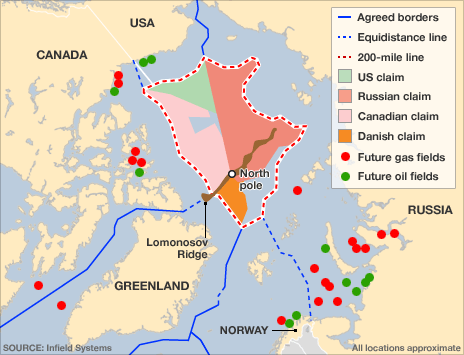
This takes the Seasteading Sink or Swim contest to a whole new level. The BBC is reporting that the Rooskies are building floating nuclear power plants that will be able to provide enough electricity and warm water for 45,000 people. According to the story, these eight monolithic nuclear flotillas will be able to stay at sea for up to twelve years while they drill for oil near the North Pole. Watch the video here or read more at the BBC.
Courtesy of BBC
Claims to sovereignty over the Arctic and its oil are hotly contested, with Russia, Canada, the U.S., Denmark, Norway, Finland and–am I missing anyone?–all tip toeing around each other. (Here’s a 2007 NYT op ed on the subject. Old Marginal Revolution here.) Two interesting facts:
- Between 1958 and 1992, Russia dumped 18 nuclear reactors into the Arctic Ocean, several of them still fully loaded with nuclear fuel.
- Floating nuclear power plants were suggested in the United States during the mid-1970s.
Hat tip Alexis Madrigal.
Channelling Mania to Socially Desirable Results

Mad Man? Old ad placed by political entrepreneur in a bazaar of violence
In capitalism (the still unknown ideal), the price system channels self-interest to the pursuit of socially desirable results. But what about self-interest driven by mania? The NYTimes recently wrote an article discussing the psychology of entrepreneurs. The nut graph:
a thin line separates the temperament of a promising entrepreneur from a person who could use, as they say in psychiatry, a little help. Academics and hiring consultants say that many successful entrepreneurs have qualities and quirks that, if poured into their psyches in greater ratios, would qualify as full-on mental illness…The attributes that make great entrepreneurs, the experts say, are common in certain manias, though in milder forms and harnessed in ways that are hugely productive.
Somewhat relatedly, Scott Adams says leadership is a form of mental illness. The Dilbert cartoonist writes:
In Exhibit One, we note that the leaders of countries we consider enemies are undeniably bat-spit crazy.
- Kim Jong-il: crazy midget
- Ahmadiniejad: crazy holocaust denier
- Khadafy: designs his own hats
I think the evidence is clear: The leaders of enemy countries are always crazy. And logically, since every national leader is someone’s enemy, all national leaders are crazy. The only exception to the rule is the leader of neutral Switzerland, who is actually a refrigerated chocolate rabbit.
And Bryan Caplan once summarized three theories to explain the horrific crimes of socialism:
“How could a movement founded to liberate workers from capitalist oppression end up shooting them in the back when they tried to flee the Workers’ Paradise?”
- The Actonian “power corrupts” story
- The Hayekian “worst get on top” story
- The Richterian “born bad” story
When free markets shrink, and political markets of patronage take their place, the “just manic enough” find socially undesirable outlets for their obsessions. I’m not sure if some cultures select for mania more than others, but delusions of grandeur are every where in some non-negligible quantity. Harnessing these foibles and transforming them into productive rather than destructive ends is a problem all societies must solve. The same attributes that the NYTimes uses to describe entrepreneurs could also describe John Edwards. Ilya Somin says Caplan’s three stories aren’t mutually exclusive. And I’d side with that. But of the three, I think Hayek’s is the main driver. In a way, it depends when you start your story. If the worst get on top because the incentives have changed, then the born bad will eventually find their way to the summit, no?
Ideas Matter
Max Borders, our sometime guest author, is blogging at Ideas Matter as part of the Free to Choose Network. Do check it out. On top of insightful content, he’s been posting fantastic bits of interviews featuring Hayek, James Buchanan, and Thomas Hazlett. Here’s Hayek on democracy and the political economy of patronage:
And here’s a discussion between Buchanan and Hayek on John Rawls’s conception of social justice. Was Hayek, along with Will Wilkinson, a Rawlsekian?
An Idea is a Network
So says Steven Johnson in this TED talk. His argument is that ideas are cobbled together from whatever happens to be available. A greater velocity and density in idea exchange–say, as occurred in London coffee houses during the Enlightenment–the more innovation is likely. New ideas are born in blends and unforeseen collisions. Promiscuity is a virtue.
Johnson says this model is in opposition to the conventional wisdom on genius and creativity. The lone brilliant thinker, the solitary iconoclast originating paradigm shifting views, simply does not exist, he says. Hotbeds of innovation should look more like Hogarth’s chaotic coffee house than pictures of lonely Newton and his apple.
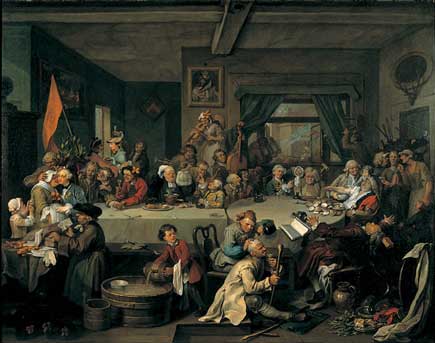

It may be that we overestimate the creativity of great minds. Or how responsible any one person is for generating big theories. Robinson Crusoe type innovators are as real as unicorns. Self-sufficiency impoverishes the mind. It also makes you poor. Paul Graham has a fascinating essay that suggests there may be millions of Da Vincis alive today, only they have no Florence to nurture and focus their talents. Creative space teeming with ideas, whether it be a city or a chat room, is an important necessary condition for innovation.
But that is not to deny the power of genius. We should not discount it entirely. Shakespeare is my favorite example. In Contested Will, James Shapiro describes a theater scene in late 16th century London that Johnson would recognize as an innovative hotbed. Many talented writers, such as Thomas Kyd and Christopher Marlowe, lived and worked together. Writers and actors would congregate and swap ideas and barbs at a pub called the Mermaid. Shakespeare was known to wander around the bookstalls near Old St. Paul’s Cathedral, where he would browse the racks to mine for ideas. And the player’s companies, such as Shakespeare’s Chamberlain’s Men, were the equivalent of today’s production companies in Hollywood. They’d listen to pitches from writers, invest in projects, develop them. Moreover, they were in direct competition with each other. Innovations in staging were quickly emulated.
All of this was necessary to hone Shakespeare’s talents, but still, Shakespeare is Shakespeare. His work clearly stands above all the rest of his era. The man, uneducated compared to his competitors, was nevertheless a genius of the first rank. He may have needed them, but he certainly stood above them.
Long digression–I apologize. Anyway, I see two lessons here for letting a thousand nations bloom. One is to keep in mind the positive returns to density. There’s a reason people live in cities and this may prove to be a problem for Seasteads. The more isolated any group becomes, the more self-sufficient they are, the farther they may be from creative idea networks. The second issue I’ll call the virtue of Hogarth’s chaos. With respect to political philosophies and ways of life, many think in terms of solitary units. In Johnson’s example, it’s Newton. In mine, it’d be a single national rule set. The moral of Johnson’s story is that we need to create coffee house-like conditions if we want to increase the amount of innovation in the world. I’ll leave it here and say competitive government is the coffee house of national rule sets.
Economic Freedom of the World Annual Report 2010
Freshly pressed from the Fraser Institute, the newest rankings in freedom-loving governance:
In the wake of the global recession, the average level of economic freedom around the world dropped for the first time in decades, according to a new study released today by the Fraser Institute, Canada’s leading public policy think-tank. This year’s report shows that economic freedom experienced its first global downturn in a quarter century, with the average score falling to 6.67 in 2008 (the most recent year for which data is available) from 6.74 in 2007. Of the 123 countries with economic freedom rankings dating back to 1980, 88 (71.5 per cent) saw their rankings decrease while only 35 (28.5 per cent) recorded increases.
The top ten of 2010:
In this year’s index, Hong Kong retains the highest rating for economic freedom, 9.05 out of 10. The other top 10 nations are: Singapore (8.70), New Zealand (8.27), Switzerland (8.08), Chile (8.03), United States (7.96), Canada (7.95), Australia (7.90), Mauritius (7.82), and the United Kingdom (7.81).
When U.S. Tax Returns Vote With Their Feet…
The TaxProf offers up a stimulating data set on interstate migration trends from 1993 to 2008. (From MyTaxBurden.org). He concludes people who pay taxes don’t particularly like living in Blue States:
The Tax Foundation has launched an interactive tool that shows state-to-state migration data, including the number of taxpayers that move into and out of a particular state, along with changes in the flow of income to and from the state.
Users select a state and a range of years between 1993 and 2008. The site then calculates immigration to and emigration from that state. Because the tool is based on IRS tax return data which include both personal and financial information, the site can calculate the flows of both people and their income. Also, data can be compared between two specific states or between one state and all other states.
Here are the ten states with the largest net migration outflow from 1993-2008:
Rank State Tax Return Outflow Exemptions Outflow AGI Outflow 1 NY 962,100 2,161,953 $71,732,015,000 2 CA 723,098 2,249,194 $47,653,140,000 3 IL 376,373 831,433 $31,959,827,000 4 NJ 280,044 492,545 $21,724,614,000 5 MI 276,750 409,144 $15,880,307,000 6 OH 273,378 395,847 $19,683,721,000 7 PA 195,837 174,517 $10,093,603,000 8 MA 169,540 371,635 $12,496,936,000 9 LA 133,989 291,900 $7,192,784,000 10 CT 117,057 176,962 $7,862,730,000
Nine of the ten states voted for President Obama in 2008 (the tenth state — Louisiana — suffered massive migration from Hurricane Katrina).
Here are the ten states with the largest net migration inflow from 1993-2008:
Rank State Tax Return Inflow Exemptions Inflow AGI Inflow 1 FL 864,960 1,666,629 $97,161,723,000 2 AZ 448,463 862,732 $29,762,956,000 3 NC 402,594 803,148 $25,266,713,000 4 GA 383,030 798,849 $15,205,329,000 5 TX 362,494 861.576 $20,768,262,000 6 NV 296,276 569,094 $19,831,176,000 7 CO 202,079 346,303 $14,120,073,000 8 TN 183,594 402,551 $9,662,364,000 9 SC 153,181 323,383 $13,557,343,000 10 WA 145,217 256,834 $11,091,142,000
Five of the ten states voted for John McCain in 2008; nine of the ten states voted for President Bush in 2004.


 Let A Thousand Nations Bloom