David Sloan Wilson Hankers After a Paradigm Shift in Economics
The prominent evolutionary biologist is on a tear at his Evolution for Everyone blog. He has a string of posts on the gaps between our knowledge of human nature and the assumptions economists make in their predictive models. Here is the first in the series. Wilson wants to tame some wild views in economics–namely, that self-interest is king–and, with the help of his Institute, he hopes to create better regulations and public policy recs based on more realistic assumptions about human behavior. All well and good.
In evolutionary biology, Wilson is best known for his pioneering work on multi-level selection theory, which looks at the ways evolution occurs at the group level in addition to the individual. On this view evolution is comprised of a nested hierarchy of embedded evolutionary systems, from the group to the individual to the cell to the gene. For a very insightful application of this theory to religion and community, I highly recommend his brilliant Darwin’s Cathedral. When applied to national rule sets, I call his multi-level selection theory competitive governance. But now I’m getting ahead of myself.
Based on Wilson’s string of posts, he fits squarely into what Arnold Kling describes as the MIT mantra: markets fail, let’s use government. He devotes a lot of space to pointing out the fallacies in Milton Friedman’s 1953 paper on positive economics (see here) and on describing (what he sees as) the inadequacies of the invisible hand. He also hates Ayn Rand and “market fundamentalism.” However, a lot of his posts seem blissfully unaware of public choice problems, almost as if there could never be government failure or democratic fundamentalism. I begin to wonder–is Wilson willing to apply his model of human behavior to regulating government failures? Hard to ascertain, which is too bad, because his thinking here seems better adapted to what Kling calls the GMU view of economics: sure, markets fail, but let’s use markets.
For instance, Wilson writes:
Other rules cause honeybees to act as if guided by an invisible hand for other aspects of their lives, as recounted by Tom Seeley in The Wisdom of the Hive: The Social Physiology of Honeybee Colonies and for other social insects by Bert Holldobler and Ed Wilson in their bookThe Superorganism. Similarly, the cells within our bodies follow rules than enable us to be miracles of collective action. In both cases, the rules that contribute to the common good are a tiny fraction of the set of all possible rules. A worker honeybee could use a longer waiting time, the time of day, the amount of cloud cover, or innumerable other environmental stimuli as a cue to forage more. Those rules would not contribute to the common good. The reason that real foraging bees employ just the right rule, of course, is due to the winnowing action of natural selection, which discovers rules that work as needles among the haystack of rules that don’t work.
This is so basic, at least in retrospect, that it can’t be wrong, but it has profound consequences for the invisible hand metaphor in relation to human economies. The invisible hand is not axiomatically true. It is not the case that individuals following any rule automatically contribute to the common good.
Ahhh, yes, but do legislators automatically create rules that contribute to the common good? Among bees, the best rules emerge from a bottom up process of natural selection. As they do within single cells. So if we’re thinking about rule discovery, what is the best kind of system to filter out the bad from the good? Certainly not by top down rule imposition. Remember, there are no bee “regulators.” The knowledge to craft the best rules simply isn’t there. It has to emerge. Therefore I suggest Wilson would do well to look at his own work for the answer: a nested hierarchy of embedded evolutionary systems. A system of competing systems…and the best rules will emerge from a group level evolutionary process of discovery and emulation. In other words, Mr. Wilson, I’d like to introduce you to Paul Romer’s theory of history. Or what I call competitive governance.
Wilson comes very close to expressing this view in his discussion of Lin Ostrom’s work:
First, her work shows that human life is permeated with situations in which the invisible hand does not operate. Again and again, behaviors that are “for the good of the group” require forms of restraint and coordination that are highly tailored to the particular situation and are undermined by narrow self-interest. In other words, Lin’s work is centered upon the conflict between levels of selection and adaptation, as I describe for multilevel selection theory in the previous installment.
Second, people are capable of managing their own affairs only by virtue of a suite of psychological traits that cannot be collapsed into the narrow construct of self-regarding preference. Human psychology must be studied in all its complexity and evolutionary theory is required to understand human psychology.
Third, certain environmental conditions are required for people to manage their own affairs. Adaptations only work in the environments to which they are adapted and can spectacularly misfire in other environments. Lin’s work recognizes the importance of studying individuals and groups in relation to their environments, far more than contemporary economic theory.
Fourth, Lin’s work recognizes the importance of ongoing cultural evolution, rather than trying to derive everything from a conception of universal human psychology. Every group trying to manage its own affairs is an experiment in open-ended cultural evolution, with all the historicity and indeterminacy inherent in any evolutionary process. Different groups trying to solve the same problem will arrive at different solutions, none optimal, some better than others, and a few meltdowns. Groups will learn from other groups, resulting in cumulative cultural evolution, especially when environmental conditions facilitate the comparison of solutions across groups. The suite of psychological traits shared by all people creates the architecture for this kind of rapid adaptation to current environmental conditions.
To say rules are important is not to say top down regulation is. Regulations are a kind of rule, but given the assumptions Wilson makes, he should look for meta-rules that let the best rules emerge. In other words, competitive governance.

If People Could Vote With Their Feet…
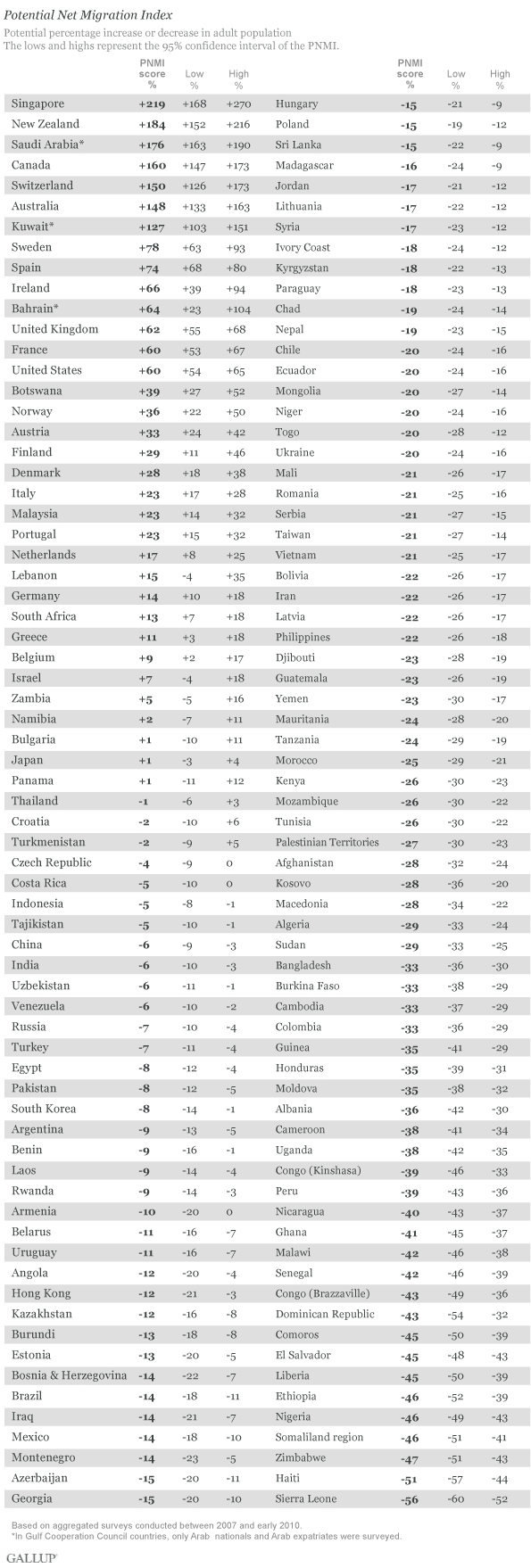
There’s some new poll data from Gallup on trends in potential migration. Earlier data sets focused on whether people would like to emigrate–it turned out 700 million said yes. This latest batch focuses on which nations would have the largest net percentage increase in population, assuming the barriers to immigration were eliminated. All the usual caveats about surveys aside, I think it provides an interesting, if rough snapshot of how desirable it is to live in some places.
The Rise of the City State and the New Hanseatic League

Singapore, Courtesy of Foreign Policy
Parag Khanna has a fascinating think piece in the newest Foreign Policy. He says the age of nations is over:
The 21st century will not be dominated by America or China, Brazil or India, but by the city. In an age that appears increasingly unmanageable, cities rather than states are becoming the islands of governance on which the future world order will be built. This new world is not — and will not be — one global village, so much as a network of different ones…
Neither 19th-century balance-of-power politics nor 20th-century power blocs are useful in understanding this new world. Instead, we have to look back nearly a thousand years, to the medieval age in which cities such as Cairo and Hangzhou were the centers of global gravity, expanding their influence confidently outward in a borderless world. When Marco Polo set forth from Venice along the emergent Silk Road, he extolled the virtues not of empires, but of the cities that made them great. He admired the vineyards of Kashgar and the material abundance of Xi’an, and even foretold — correctly — that no one would believe his account of Chengdu’s merchant wealth. It’s worth remembering that only in Europe were the Middle Ages dark — they were the apogee of Arab, Muslim, and Chinese glory.
Read the whole thing, as Kling says. HT to Reason’s Hit and Run.
Newt Gingrich Proposes “Free Cities”
At the National Review, (and oddly, without mentioning Paul Romer) Gingrich rebrands Romer’s Charter Cities:
The U.S. should negotiate a series of bilateral treaties with receptive governments, carving out undeveloped sites the size of Hong Kong. Then a joint venture between the host government and the U.S. would launch brand new Free Cities in these places, with a complete set of American-style freedoms and responsibilities, guaranteed by treaty for 50 years.
Treaty-based Free Cities would entice and attract enterprising people and capital from around the world by offering: self-government; the rule of law; low taxes; reliable prosecution of corruption; freedom of faith, speech, and press; public registration of real property; a merit-based civil service; multi-ethnic meritocracy; zero tariffs; and an American university.
Free Cities would exemplify free-market globalization, rather than the economic exploitation of protectionist colonialism. They would generate millions of jobs where there are none today. And rather than opening another bottomless pit of statist foreign aid, these cities would be self-funding. A Free Cities development strategy would pay its own way by attracting funds from the private sector.
Hat tip to Karl Gallagher. That Newt has taken up the cause of competitive governance is tremendous news. Welcome aboard. I can’t help but raise a few quibbles, however, as Newt appears to insist on American-style this and American university that. If the U.S. can lead the way on the creation of Charter Cities in the poorer regions of the world…awesome. Dynamite. But the irony is that the U.S. itself doesn’t even offer the freedoms Gingrich calls American. One of Paul Romer’s tactics seems wise to me here. Whenever Romer raises the idea of multilateral agreements for establishing a Charter City, he mentions Canada as a party and not the U.S.. And with good reason. The U.S. has a long, shameless history of intervening in the affairs of puppet states. And given America’s own political constraints, I find it hard to believe the freedoms Gingrinch adumbrates will receive ensured protection. What happens when a Free City starts making autos in direct competition with General Motors? How long will that promise on zero tariffs last? I’ll take the under on 3 months.
[Update: Michael Strong has alerted me to the fact that Gingrich’s coauthor, Ken Hagerty, proposed the Free City concept in the Weekly Standard, back in 2007.]
Please Vote For Me
I’ve been meaning to watch this documentary about an election for class monitor in a third grade class in the Evergreen Primary School in Wuhan, China. The preview offers a glimpse of the sordid underbelly of electoral politics–for example, I love how readily these eight year olds offer deals to buy votes. “Vote for me, I’ll make you Study Committee Officer.”
The Most Underrated Works of Political Philosophy
Over at the Pileus blog, Jason Sorens asks for what are the most persuasive and insightful, but overlooked works in political philosophy. I assume he means overlooked by university courses, so my suggestions will work on that assumption. He breaks it down into categories by era. Here are my passed over greats, with emphasis on the non-conforming but thought-provoking:
19th Century
- The Limits of State Action by Wilhelm Von Humboldt, whose work J.S. Mill cannibalized and regurgitated into On Liberty.
- The Grand Inquisitor by Ivan Karamazov, which makes a very persuasive argument that by nature humans cannot bear very much freedom. The Inquisitor’s insights about the church apply mutatis mutandis to the state. “Anyone who can appease a man’s conscience can take his freedom away from him.”
- The Law by Bastiat. A classic in libertarian circles, but unknown to the philosophically credentialed. With great economy and eloquence, it covers topics that remain bugbears to this day, in particular the political economy of democratic plunder and the importance of unseen, disparate costs.
Early Modern
- The Elementary Forms of Religious Life by Emile Durkheim. There’s been a resurgence of interest in Durkheim (see Jonathan Haidt’s work) because, unlike many of the secular left who are blind to such things, Durkheim paid great attention to the emotional sources of what binds communities together. Whole aspects of human nature–the full panoply of its innate moral intuitions–have been ignored by contemporary philosophers and their models of the just state. Durkheim gives a sense of what motivates community building and, when read in tandem with Nietzsche’s death of God musings, provides a satisfying account for the rise of The People’s Romance and other barbaric hordes.
Contemporary
- Nozick’s Anarchy, State, and Utopia, but only the last third of the book, A Framework for Utopia. The first two thirds have drawn fire from all comers for years. In fact, the book is now known only for these sections. You can earn yourself a PhD writing on Anarchy and State, but not Utopia, getting pats on the head if you point out that Nozick never justifies his notion of “rights.” This party upfront is extremely unfortunate–the last third of his book is a cascade of fireworks on competitive government, a reinvention of a theory of clubs, and is far more rewarding than the previous sections. It deserves more attention than this.
- The Calculus of Consent by James Buchanan and The Logic of Collective Action by Mancur Olson–both seminal works in understanding the incentives of constitutions and democratic decision making procedures. These make Rawls’ Theory of Justice look like it was written in crayon by a kindergartner on a lunch bag.
- The Use of Knowledge in Society by Hayek. Knowledge problem. Emergent spontaneous order. Nuff said.
- Story by Robert McKee, Ogilvy on Advertising by David Ogilvy, and The Seven Basic Plots-Why We Tell Stories by Christopher Booker. I view all of these books as providing a keen and deep understanding of how delusional the human mind can be when it tries to explain complex disaggregated phenomena such as the modern economy or a political system. The legerdemain of storytelling and its emotional drivers explain an overlooked aspect to the behavioral economics of the voting booth and the demand driving an insipid mass media.
- Impro by Keith Johnstone. Develop a Robin Hanson like world view in one easy to read chapter. (Chapter 2, Status.)
- Google Reader–why have a bias towards books, when the best and most intelligent writing is on the web?
There is, of course, our recommendations page, which has links to many of the articles, books and posts that explain and justify competitive governance.
Constraint and Flexibility
I think Dani Rodrik is right that we should prefer democracy to dictatorship if we care about economic growth:
When we look at systematic historical evidence, instead of individual cases, we find that authoritarianism buys little in terms of economic growth. For every authoritarian country that has managed to grow rapidly, there are several that have floundered. For every Lee Kuan Yew of Singapore, there are many like Mobutu Sese Seko of the Congo.
As usual, though, the debate reveals why we need competitive government so damn badly. Chris Blattman’s term “authoritarian roulette” is apt: when we hand the keys to an economy to a small and unaccountable group of individuals, there is a chance things will turn out really well. Without needing to pander to ignorant and irrational voters, a wise and benevolent ruler can enact whichever policies best serve his subjects’ interests. That’s why we see relatively undemocratic countries at the top of economic freedom rankings.
The more likely outcome, though, is that things will turn out really badly. Without needing to pander to ignorant and irrational voters, a vicious and stupid ruler can enact whichever policies best screw up his subjects’ lives. That’s why we see relatively undemocratic countries at the bottom of the economic freedom rankings. With functional democracy, we almost always get mediocre policy. Given only those two options, I’d choose democracy.
The tradeoff between avoidance of tyranny and the possibility of really good government is not inevitable, though. The problem with democracy’s use of voice to constrain rulers is that it reduces flexibility in an undirected way: rulers are equally prevented from making good and bad decisions. The other potential way to constrain rulers – exit – does not have this problem. When people are voting with their feet (or their boat), autocratic rulers are prevented from doing stupid things while being at complete liberty to do sensible things. We get the best of both democracy and autocracy – constraint and flexibility simultaneously.
In other words: Heathian anarchism FTW!
Dani Rodrik On Why Democracies Are Good For Economic Growth
There’s an old debate among classical liberals about whether economic freedom ought to precede and help foster political freedom. Many hope this will be the case in nations like China, whose authoritarian rules play a dissonant counterpoint to its burgeoning markets. On the other hand, there are countries like India that are both democratic and impoverished. So what is the overall trend? Rodrik comes down on the side of giving priority to democracy. The Harvard Prof writes:
The relationship between a nation’s politics and its economic prospects is one of the most fundamental – and most studied – subjects in all of social science. Which is better for economic growth – a strong guiding hand that is free from the pressure of political competition, or a plurality of competing interests that fosters openness to new ideas and new political players?
East Asian examples (South Korea, Taiwan, China) seem to suggest the former. But how, then, can one explain the fact that almost all wealthy countries – except those that owe their riches to natural resources alone – are democratic? Should political openness precede, rather than follow, economic growth?
When we look at systematic historical evidence, instead of individual cases, we find that authoritarianism buys little in terms of economic growth. For every authoritarian country that has managed to grow rapidly, there are several that have floundered. For every Lee Kuan Yew of Singapore, there are many like Mobutu Sese Seko of the Congo.
Democracies not only out-perform dictatorships when it comes to long-term economic growth, but also outdo them in several other important respects.
His book on related themes is One Economics, Many Recipes: Globalization, Institutions, and Economic Growth.
Easter Islanders Want to Secede from Chile
From the Guardian:
Community leaders on Easter Island have threatened to secede from Chile and transfer allegiance to Polynesian states in a row over land rights and immigration.
Prominent families from the indigenous Rapa Nui population have told the Pacific Islands Forum, an inter-governmental body, that they wish to renounce Chilean sovereignty and be considered part of Oceania rather than the Americas…
Leviante Araki, head of the Rapa Nui “parliament”, an advocacy group for indigenous people who comprise half the 5,000 population, requested secession in a letter this week to the Pacific Island Forum and Chile’s President Sebastian Pinera. The would-be separatists resent what they say is an uncontrolled influx of tourists and settlers and accuse the government of taking over ancestral land with state offices. Protesters occupied several state-owned buildings.
Litigating Your Way to Sovereignty In Wyoming
Benjamin Barr is directing a group called Winning Sovereignty Solutions. Its aim is to win back some self-rule for Wyoming from the Feds by way of the common law:
The federal government is the largest landowner in the state of Wyoming. And just like any other landowner, we expect the same kind of responsible care and conduct as we would from any other neighbor. At Winning Sovereignty Solutions, we refuse to accept that the federal government is immune from its wrongdoing and negligent actions and believe that it should be held to the same standard of accountability as any resident of the state. To do otherwise is to pervert justice – denying an equitable remedy to an entire class of injured people for the sake of novel federal experimentation. Damaged for too long, these victims of federal malfeasance must be heard.
Sovereignty here seems to mean something along the lines of protecting the rights of individuals against Fed.gov. In that way it’s not really all that different from the Institute of Justice, which has had some success and a few disappointments. Still, as with IOJ, anything that draws attention to unfair Federal practices ought to be applauded. Huzzah.


 Let A Thousand Nations Bloom