Manhattan Before & After
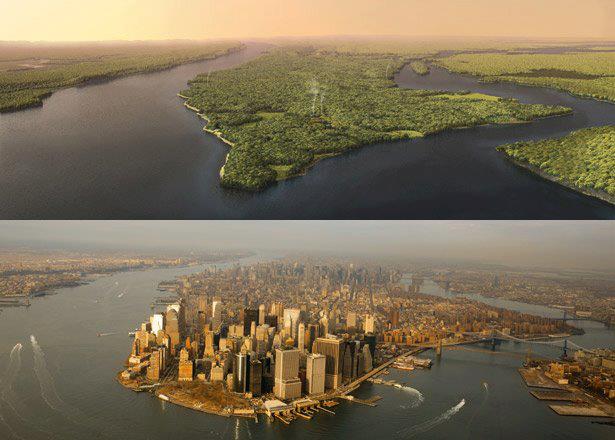 “And as the moon rose higher the inessential houses began to melt away until gradually I became aware of the old island here that flowered once for Dutch sailor’s eyes—a fresh, green breast of the new world. Its vanished trees, the trees that had made way for Gatsby’s house, had once pandered in whispers to the last and greatest of all human dreams; for a transitory enchanted moment man must have held his breath in the presence of this continent, compelled into an aesthetic contemplation he neither understood nor desired, face to face for the last time in history with something commensurate to his capacity for wonder.”
–F. Scott Fitzgerald
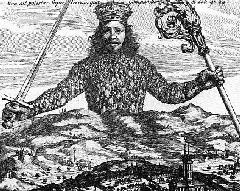
The Honduran Supreme Court has ruled unconstitutional a project to build privately-run cities, with their own police and tax system.
The “model cities” project was backed by President Porfirio Lobo, who said it would attract foreign investment and create jobs
By 13 votes to one, Supreme Court judges decided that the proposal violated the principle of sovereignty.
Demonstrators celebrated the decision outside the court in Tegucigalpa.
“This is great news for the Honduran people. This decision has prevented the country going back into a feudal system that was in place 1,000 years ago,” said lawyer Fredin Funez.
Making It Easier For Cubans To Vote With Their Feet
 Good news from Havana:
Cuba’s government will eliminate much-hated travel restrictions in January, making it easier for its citizens to leave the island, live abroad longer and return to the island, in a long-awaited move announced Tuesday.
Granma, the newspaper of the Cuban Communist Party, said Havana will end expensive requirements to obtain an exit visa as well as a letter of invitation from a person in another country to allow citizens to travel abroad. The exit visa costs about $150, or about six months of a typical Cuban’s salary.
More from Reuters:
An editorial in the Communist Party newspaper Granma blamed the island’s longtime policy on the United States, which it said had long tried to sabotage Cuba in various ways, including the enticement of doctors and other professionals away from the island.
Yes, nothing like offering a better life as a form of sabotage…
Sorry If You Read That Spam Post
Some bot or entity must have hacked into Will’s account.
Antwerp Politician Rides Secessionist Wave
In the FT (gated):
The moderate nationalist leader of the New Flemish Alliance party (NVA), Mr De Wever has turned a local ballot in Belgium’s business heartland into a referendum on independence for Flanders and the latest polls suggest there is momentum behind his call for secession.
Mr De Wever believes victory in Europe’s second largest port city will revive the call for Flanders’ secession from Belgium just as Spain’s economic crisis has done in Catalonia.
Lex Moolenaar, a veteran political analyst for the Gazet Van Antwerpen, the city’s daily, said an NVA victory would be a historic event in Belgium: “It would enlarge NVA’s power at the regional and national level . . . the next natural step would be towards seeking the independence of Flanders.”
Dutch Architect Dreams of Floating Cities

He thought, if a house can float, why not an office complex or a structure big enough to hold a whole city?
Olthuis, who along with building partner Dutch Docklands, designed a section of floating islands for Dubai’s man-made Palm Islands development project, has also created a patent which scales up the technology used for a houseboat to floating structures big enough to hold cars, roads and houses.
“Water is a workable building layer or a floating foundation and if you turn water into space, which is a dramatic change of mindset, there’s a whole new world of possibilities,” Olthuis told Reuters.
He said the basis for his design isn’t any different than the normal Dutch floating technology used for houseboats.
“It is just a floating foundation, mostly made of concrete and foam which is quite stable, heavy, and goes up and down with waves and up and down with the sea level,” he said.
The floating city of the future is still a dream, but Olthuis’s firm, WaterStudio, which he started a decade ago, designs buildings and floating structures which try to combat the challenges posed by rising sea levels.
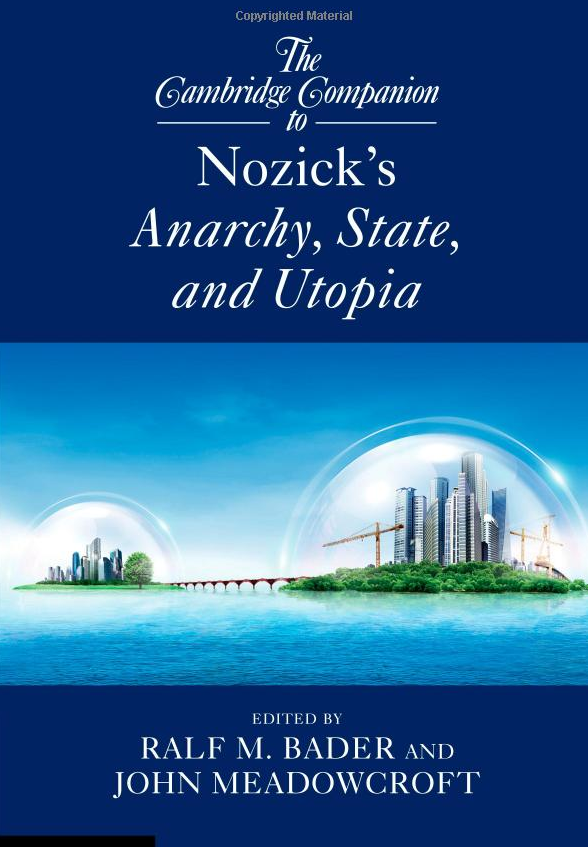
Dani Rodik’s Trilemma
An informative take on sovereignty and the EU:
We cannot have globalization, democracy, and national sovereignty simultaneously. We must choose two among the three.
French Exit Signs
A flood of top-end properties are hitting the market as businessmen seek to leave France before stiff tax hikes hit, real estate agents and financial advisors say.
“It’s nearly a general panic. Some 400 to 500 residences worth more than one million euros ($1.3 million) have come onto the Paris market,” said managers at Daniel Feau, a real-estate broker that specialises in high-end property.
While it is not yet on the scale of the exodus of rich French after the election of Socialist president Francois Mitterrand in 1981, real estate agents said, the tax plans of France’s new Socialist President Francois Hollande are having a noticeable effect.
While the Socialists’ plan to raise the tax rate to 75 percent on income above 1.0 million euros per year has generated the most headlines, a sharp increase in taxes on capital gains from the sales of stock and company stakes is pushing most people to leave, according Didier Bugeon, head of the wealth manager Equance.
European Endgame: The Crackup or Tighter Union
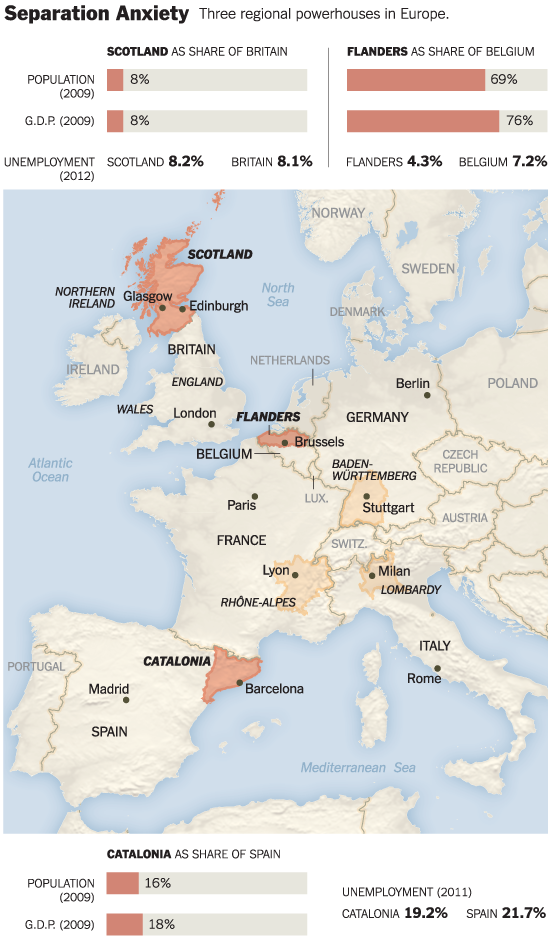 Amid soaring debts and shrinking economies plagued by sclerosis, Eurocrats have navigated choppy waters much better than I ever thought they would. It’s difficult to determine what the endgame will be and when it will arrive: default, wild money printing, or muddling through. Whatever the case, the status quo is untenable. Either the EU will centralize even more tightly, braiding monetary and fiscal sovereignty into one knot, or it will fly apart into smaller pieces, smaller than even our current maps suggest. The New York Times has a story on the rising popularity of separatism:
There are countless things that hold unhappy countries, like marriages, together — shared history, shared wars, shared children, shared enemies. But the economic crisis in the European Union is also highlighting old grievances.
Many in Catalonia and Flanders, for example, argue that they pay significantly more into the national treasury than they receive, even as national governments cut public services. In this sense, the regional argument is the euro zone argument writ small, as richer northern countries like Germany, Finland and Austria complain that their comparative wealth and success are being drained to keep countries like Greece, Portugal and Spain afloat.
Some Venetians recently gathered to call for secession from Rome:
Protesters have gathered in front of the central government in Veneto, Italy to demand an immediate referendum on the region’s independence from Rome. The reason is mainly economic, according to the rally’s organizer.Demonstrators are presenting the local government with a resolution which demands an immediate referendum for the region to become its own country. The new territory would include Venice, the surrounding region of Veneto, and parts of Lombardy, Trentino and Friuli-Venezia Giulia.
This blog hopes for more new entries in the market for governance, but dissolution after both financial and sovereign debt crises is an ugly, painful way to get there. The forking paths to greater centralization or greater fragmentation remain open and yet opaque. Only the future will tell. More at Zero Hedge. (HT to Rui Nobre Pinheiro)


 Let A Thousand Nations Bloom